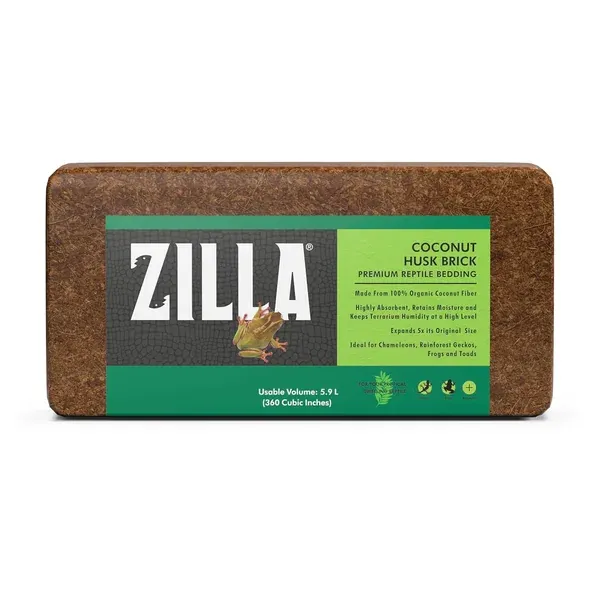
What It Is and Key Specs
The Zilla Coconut Husk Brick is a single compressed block of 100% coconut fiber substrate marketed toward keepers of tropical reptiles and amphibians. According to the manufacturer, adding hot water causes the brick to expand up to five times its original volume — enough, Zilla states, to cover the bottom of a 55-gallon enclosure. The substrate arrives in compact brick form, making storage and shipping straightforward compared with loose, bagged alternatives in the same category.
Zilla's listed compatible species include chameleons, rainforest geckos, frogs, toads, and other moisture-loving animals. The product is also positioned as suitable for egg incubation, where consistent moisture retention is critical.
Material and Composition
The substrate is described by the manufacturer as made with 100% organic coconut fiber — the fibrous material derived from coconut husks. Coconut coir at this tier is typically processed into compressed bricks for ease of transport, and the Zilla brick follows that standard form factor. The manufacturer makes no additives claims, positioning the product as a natural, sustainable bedding choice. Independent verification of the organic claim is not available from the sources reviewed here.
Humidity Control and Burrowing Support
According to Zilla's product page at
zillarules.com, the substrate is "highly absorbent" and designed to maintain humidity levels in tropical terrariums — a key requirement for species like chameleons and rainforest geckos that need elevated ambient moisture. The soft texture is cited by the manufacturer as actively encouraging natural burrowing behavior, which can support the psychological well-being of species that burrow in the wild.
Coconut coir substrates in this category are commonly noted for their moisture-retention properties, though actual in-enclosure performance will vary depending on ventilation, enclosure size, ambient temperature, and keeper maintenance habits.
Real-World Fit: Who It Suits, Who Should Skip
This substrate is best matched to keepers of humidity-dependent tropical species — the manufacturer specifically calls out chameleons, rainforest geckos, frogs, and toads. It is also suited for egg incubation setups where a moist, soft medium is needed.
Keepers housing arid or desert-species reptiles — such as bearded dragons, leopard geckos, or sand boas — should skip this product. Coconut fiber substrates are engineered to retain moisture, which is the opposite of what dry-habitat enclosures require. Similarly, keepers who prefer a ready-to-use loose substrate may find the brick expansion process — requiring hot water and preparation time — an extra step compared with pre-expanded bagged coir.
Category Context
Compressed coconut coir bricks are a common format across the reptile and gardening supply markets. A thread on THCFarmer (
thcfarmer.com) notes that the pet-store coconut coir bricks intended for reptile bedding are interchangeable in at least some hobby applications, suggesting the core material is broadly similar across brands at this tier. That said, no direct performance comparison between Zilla's brick and competing reptile substrates is supported by the sources available for this review.
Honest Limitations
A few practical limitations are worth noting:
- Preparation required. The brick must be hydrated with hot water before use. Keepers looking for a drop-in substrate should factor in the expansion and cool-down time.
- Single expansion yield. The manufacturer states one brick covers a 55-gallon footprint. Keepers with multiple enclosures or deeper substrate layers will need multiple bricks, which affects cost-per-use calculations.
- No CPSC safety data. No CPSC compliance language or independent safety certification was included in the manufacturer materials or sources reviewed. Keepers with concerns about contaminant levels should contact Zilla directly.
- Organic claim unverified by third-party sources. The listing states 100% organic coconut fiber, but no third-party certification is referenced in the available materials.
Bottom Line
The Zilla Coconut Husk Brick occupies a straightforward position in the tropical reptile substrate market: a compact, expandable coconut fiber option for humidity-dependent enclosures. Its natural composition and burrowing-friendly texture align well with the needs of chameleons, rainforest geckos, frogs, and toads, and the egg incubation use case adds practical versatility. The preparation step and single-enclosure yield per brick are the most relevant practical considerations before purchasing.