What It Is and Key Specs
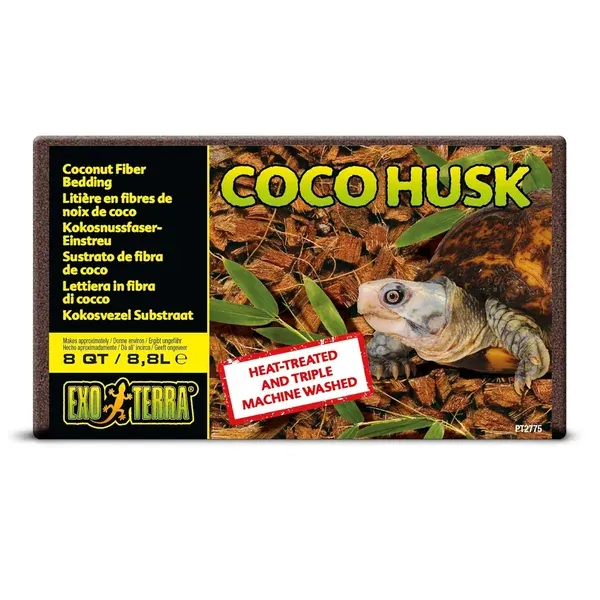
The Exo Terra Coco Husk Brick is a compressed terrarium substrate made from ground coconut husk fiber. According to the official Exo Terra product page, it is 100% natural and biodegradable, sourced from sustainable coconut plantations in tropical Asia. The single-brick format expands to 8 quarts (8.8 liters) once hydrated, and a three-pack option is also available through select retailers for those setting up larger or multiple enclosures.
Exo Terra positions the product for reptiles, amphibians, and any terrarium requiring a tropical environment — a broad target audience that reflects the substrate's general-purpose hygroscopic character.
Composition and Humidity Regulation
The Exo Terra product page highlights the substrate's "unique hygroscopic properties," which help regulate terrarium temperature and humidity levels. In plain terms, the fiber absorbs and slowly releases moisture, making it easier to maintain the elevated humidity that species like dart frogs, ball pythons, or crested geckos typically require. Coverage from The Pet Enthusiast confirms that the coco husk is "very absorbent, which helps increase humidity levels quickly."
The same source notes that the material is naturally resistant to bacteria and fungi — a property inherent to coconut fiber rather than a result of chemical treatment, consistent with the product's all-natural positioning.
Build Quality and Safety
Exo Terra states on the listing that the product is "tested for safety and health." The fiber originates from plantation-grown coconuts rather than wild-harvested sources, which supports consistency in material quality. Because it is biodegradable and free of synthetic additives (per the manufacturer's description), it is generally considered a low-irritant option compared to some processed substrates — though keepers with animals prone to ingestion should monitor usage depth and feeding practices as they would with any loose substrate.
Real-World Fit: Who It Suits, Who Should Skip
Good fit:- Keepers of tropical reptiles and amphibians (tree frogs, chameleons, anoles, ball pythons, and similar species) that require sustained high humidity.
- Bioactive or naturalistic enclosure builds, where a biodegradable, organic substrate supports live plant growth and clean-up crew organisms.
- Hobbyists who prefer a single-ingredient, chemical-free bedding they can compost or dispose of sustainably after use.
The Pet Enthusiast notes that the husk "can be layered across the base of your enclosure at the thickness you desire," giving keepers flexibility in depth depending on species and whether burrowing behavior is a factor.
Less ideal for:- Arid or desert species (bearded dragons, leopard geckos in dry setups) where sustained moisture retention would work against appropriate humidity targets.
- Keepers who need an odor-absorbing substrate for high-waste species, as the listing and sources do not make specific odor-control claims.
- Those with very large enclosures who want a single-purchase solution — one 8 QT brick covers a modest footprint, and multiple bricks or the three-pack may be necessary.
Honest Limitations
A few practical limitations are worth naming. First, the compressed brick format requires hydration before use, adding a preparation step that some keepers may find inconvenient compared to ready-to-use loose substrates. Second, because the fiber is finely ground, dust during expansion and initial setup is a common characteristic of this substrate category — adequate ventilation during prep is advisable. Third, the 8 QT yield, while sufficient for smaller enclosures, will not go far in larger builds, making cost-per-volume an important consideration when comparing to bulk coco fiber alternatives.
Finally, while the manufacturer describes the product as "tested for safety and health," the specific parameters or standards of that testing are not detailed in the listing or the sources reviewed here.
Bottom Line
Based on the manufacturer's product page, listing details, and third-party coverage, the Exo Terra Coco Husk Brick is a straightforward, naturally sourced substrate that does what coconut fiber does well: retains moisture, supports humidity, and resists microbial growth without synthetic additives. It is a credible choice for tropical and rainforest enclosures. Keepers should size their purchase to their enclosure volume and account for the hydration prep step before setup day.