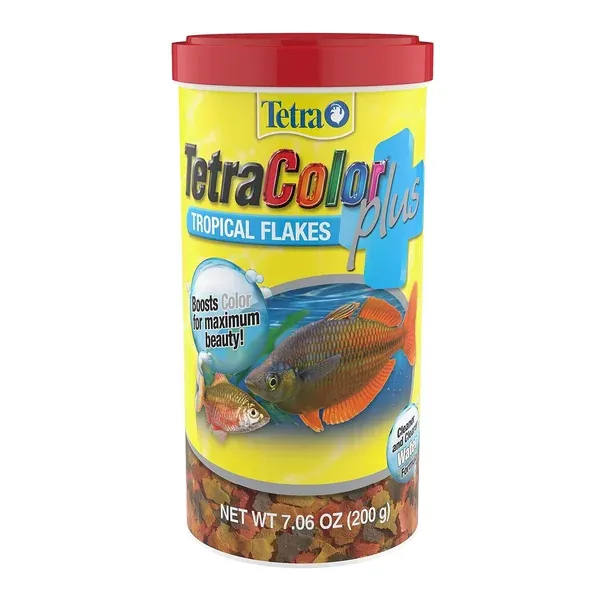
What It Is and Key Specs
Tetra ColorPlus Tropical Flakes is a 7.06-ounce (single-pack) flake food positioned as a dual-purpose staple: everyday nutrition for tropical fish, plus color enhancement. According to the manufacturer, the formula is rich in carotene and other ingredients intended to bring out natural pink-to-orange-red coloration in fish. Tetra describes it as the brand's most digestible flake food, crediting a specialized fish meal base for that claim. The recommended feeding routine is two to three times daily, offering only as much as fish can consume within several minutes — a standard guideline for flake foods across this category.
The product is listed on Tetra's own site under its "Clean and Clear Water Formula" umbrella, meaning it is engineered to leave fewer uneaten particles and reduce fish waste, theoretically keeping tank water cleaner than conventional flakes (tetra-fish.com).
Build Quality and Nutritional Design
From the manufacturer's feature bullets, the food is built around three pillars: digestibility (via specialized fish meal), color enhancement (via carotenoids), and water clarity (via a reduced-waste flake structure). Tetra's product page also notes that its related tropical flake lines include an "Active Life Formula" component intended to nutritionally support fish immune systems for long-term health (tetra-fish.com). Whether that benefit extends fully to the ColorPlus variant is not explicitly confirmed in available sources, so readers should verify on the current label.
Real-World Fit: Who It Suits
Community aquarium keepers with a mixed tropical setup — guppies, platies, tetras, and similar species — represent the clearest target audience. Hobbyist coverage from Boxed Nature notes that related Tetra tropical flake formulas are accepted by a wide range of fish, including both common livebearers and more particular species like dwarf cichlids (
boxednature.com). That breadth of acceptance is a practical advantage for community tanks where multiple species share a single feeding.
Keepers of larger, carnivorous, or highly specialized species (predatory cichlids, large catfish, marine fish) should look elsewhere — the "tropical flake" format is not designed with those fish in mind.
Honest Limitations
Flake foods as a category carry well-documented drawbacks in hobbyist communities, and this product is not immune to them. Forum discussion on FishLore reflects a recurring complaint: flakes can be messy, and uneaten portions frequently sink and accumulate on the substrate (
fishlore.com). While Tetra's Clean and Clear Water Formula is specifically engineered to reduce this problem, the manufacturer's own feeding guidance — "only as much as your fish can consume in several minutes" — implicitly acknowledges that overfeeding remains a real risk with flake formats generally.
Additionally, the color-enhancement claim is tied specifically to fish with pink-to-orange-red coloration. Hobbyists keeping species outside that color range (blues, blacks, yellows) should not expect a visible difference in appearance from the carotenoid additives.
Finally, readers should weigh this as one component of a varied diet. Nutritionally complete staple foods are a solid foundation, but many experienced hobbyists supplement flakes with frozen, freeze-dried, or live foods to more closely replicate natural feeding variety.
Reader Consensus
Aggregate reader ratings for this product are available on the current product page and reflect real purchaser experience — worth checking alongside this editorial overview before making a decision.