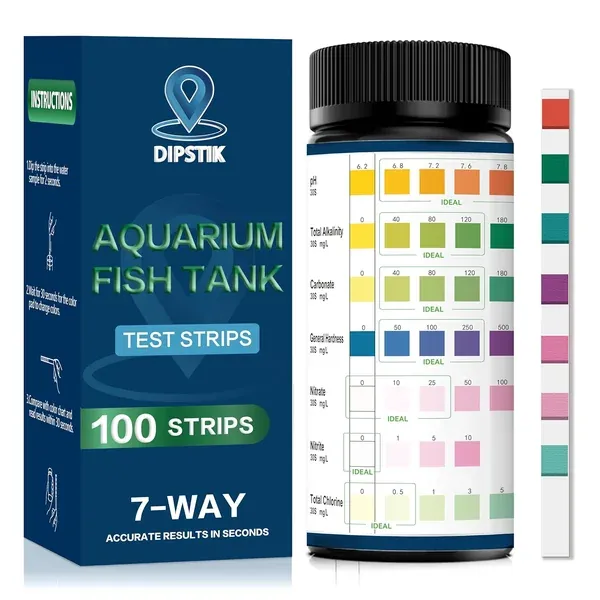
What It Is and Key Specs
The LuvemPets 7-Way Aquarium Test Strips are a multi-parameter water quality kit designed for both freshwater and saltwater use. Each strip tests for seven parameters simultaneously: nitrate, nitrite, general hardness (GH), carbonate hardness (KH), total alkalinity, total chlorine, and pH. The bottle contains 100 strips, making it one of the higher-count options at this tier of the market.
The testing process, as described in the manufacturer's listing, is straightforward: dip a strip in water for two seconds, remove it, wait 30 seconds for the color pads to develop, then compare results against the color chart printed on the bottle. The strips are made from what the manufacturer describes as "high-quality fiber paper" with "no color bleeding pads," intended to keep individual parameter readings distinct and readable.
The listing recommends use at least twice per week for ongoing water quality monitoring, and notes that strips are single-use and not reusable.
Build Quality and Handling
The manufacturer's guidance on storage and handling is notably specific: keep hands dry before removing a strip, read results under natural light, and store the bottle in a cool, dry place with wet fingers kept away from the interior. These instructions point to a real-world vulnerability common across strip-based test kits—moisture contamination of unused strips can compromise the entire bottle over time.
Coverage from Fish Keeping Secrets notes that a screw-top container design is a meaningful differentiator in this category, as it helps keep moisture out and strips dry over extended use. Prospective buyers should confirm the closure style on the current product packaging, as this detail directly affects the shelf life of unused strips.
Real-World Fit: Who It Suits, Who Should Skip
These strips are well-suited to aquarium owners who want a fast, low-friction way to perform routine water checks—fish bowls, community tanks, ponds, breeder setups, and tropical aquariums are all listed as compatible environments by the manufacturer. For hobbyists who already use a liquid reagent kit for periodic deep-dives, strips like these can serve a complementary role for between-test snapshots.
However, hobbyists who need precise readings for critical decisions—medicating a sick fish, cycling a new tank, or managing a heavily stocked system—should approach strip results with caution. Community discussion on the Aquarium Co-Op Forum includes firsthand accounts of strips reading zero nitrates and logging pH at 6.8 in tanks where liquid test kits returned meaningfully different results. A thread on FishLore similarly describes strips failing to register nitrates in an underfiltered, overstocked tank with infrequent water changes—a scenario where elevated nitrates would be expected. These are community-reported experiences, not controlled lab comparisons, but they reflect a consistent pattern worth factoring in.
How It Compares in the Category
Strip-based tests as a category are generally understood to trade precision for convenience when compared to liquid reagent kits. The 7-parameter coverage here is broad for a strip product, and the 100-count quantity offers good run-time before replacement. Coverage from Fish Keeping Secrets observes that sulfate detection—found on some competing strips—tends to feel redundant for most home users, suggesting that the parameter selection on a 7-way strip focused on nitrate, nitrite, hardness, alkalinity, chlorine, and pH may actually be a more practical lineup.
Honest Limitations
- Accuracy questions around nitrates and pH: Multiple aquarium community members, as reported on the Aquarium Co-Op Forum and FishLore, have documented strip readings that diverged from liquid kit results, particularly for nitrates. This is a recurring concern in the hobbyist community with strip tests broadly, and these strips are not exempt from that scrutiny.
- Moisture sensitivity: The bottle's integrity and proper handling are critical. Contaminated strips yield unreliable results, and the manufacturer's own care instructions underscore this risk.
- Color-chart comparison is subjective: Reading color pads against a printed chart under varying lighting conditions introduces user interpretation variability. The listing recommends natural light specifically, which isn't always practical.
- Not a substitute for liquid testing in high-stakes situations: For cycling tanks or diagnosing water quality emergencies, community consensus consistently favors liquid reagent kits as the more reliable reference.