What It Is and Key Specs
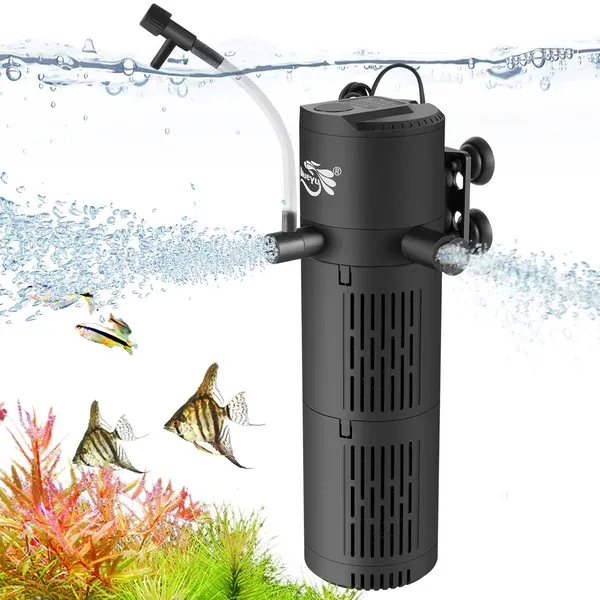
The 4-in-1 submersible internal filter is designed for tanks between 30 and 80 gallons, running on 12 watts and rated for a maximum flow of 200 GPH (gallons per hour). Its feature set spans mechanical filtration, water circulation (wave-making), oxygenation, and adjustable airflow — all from a single submerged unit. The manufacturer describes a modular, dual-layer filtration configuration that can be scaled down to a single layer for smaller setups within the stated range. It is listed as compatible with freshwater, saltwater, and turtle tanks.
Build Quality and Filtration Design
The filter uses what the manufacturer calls 2-stage (dual-layer) filtration, intended to trap large particulates such as food debris, fish waste, and plant matter before they can cloud the water. The modular design allows the user to swap between single- and dual-layer media arrangements depending on tank load and size — a practical feature that adds some longevity to the unit's usefulness as a tank grows or stocking levels change.
Noise is rated at below 35 dB, which the manufacturer characterizes as "ultra quiet." For context, internal submersible filters across this category typically operate at low noise levels compared to hang-on-back designs because the water muffles motor vibration — though actual noise perception can vary depending on tank stand resonance and impeller condition.
Cleaning is handled by rotating the filter base to detach and access the media — a tool-free process that lowers the barrier to the regular maintenance that all filters require to perform well.
Real-World Fit: Who It Suits, Who Should Skip
Based on the listing and published aquarium guidance, this filter is a reasonable candidate for hobbyists running mid-size community freshwater tanks, reef-adjacent saltwater setups, or turtle enclosures in the 30–80 gallon window who want an all-in-one internal solution without the plumbing complexity of a canister or sump system.
The adjustable inlet valve for controlling oxygen output is a useful feature for tanks with mixed inhabitants — fish and aquatic plants can have meaningfully different dissolved oxygen needs, and manual control over airflow addresses that without requiring a separate air pump and diffuser.
Shoppers who should look elsewhere include those managing heavily stocked tanks or large bioloads where filtration capacity is paramount. Research published by Aquarium Science (
aquariumscience.org) notes that internal and cartridge-style filters generally rank below canister filters and sumps in ammonia oxidation efficiency on a per-volume basis. For lightly to moderately stocked tanks in the stated gallon range, that gap may be acceptable; for densely stocked systems, it is worth weighing carefully.
The manufacturer also notes that large-tank owners can pair two units — a practical workaround, though it adds cost and occupies more internal tank space.
How It Compares in Its Category
Internal submersible filters occupy a distinct niche: they are easier to install and maintain than canister filters, less visible than hang-on-back designs, and significantly simpler than sump systems. The trade-off, consistent across the category, is that they typically offer less total media volume and lower biological filtration capacity than external alternatives, as noted in independent aquarium filtration reviews (
aquariumscience.org). Within the internal filter segment, the 4-in-1 feature bundling — circulation, oxygenation, wave-making, and filtration — is a genuine differentiator over single-function models.
Reader Sentiment
Across 115 Amazon ratings, readers give this filter a 4.2/5 aggregate — a solid result for an internal submersible in a competitive price tier. That level of satisfaction suggests the unit generally delivers on its core promises of quiet operation and adequate filtration for typical home aquarium use, though individual results will vary with stocking density, feeding habits, and maintenance frequency.
Honest Limitations
No filter is without drawbacks, and several are worth naming here:
- Filtration ceiling: As noted above, internal filters as a class typically provide lower biological filtration efficiency than canister or sump-based systems (aquariumscience.org). Buyers with high-bioload tanks should factor this in.
- No chemical filtration stage explicitly listed: The manufacturer describes mechanical filtration and oxygenation but does not call out activated carbon or other chemical media in the feature bullets. Buyers who want chemical filtration will want to confirm media compatibility or supplement accordingly.
- Internal placement trades off space: A submersible unit inside the tank occupies visible real estate, which matters in aquascaped setups.
- Common internal filter vulnerabilities apply: Published guidance from AllPondSolutions and Charterhouse Aquatics identifies impeller damage, blocked intakes, and low water level as the most frequent failure points for submersible internal filters as a class — not unique to this model, but worth monitoring with routine maintenance.
Darrell Steward
1 Feb, 2021Brilliant
This is the best product that has ever been made. It is also one of the best items in the world right now. Definitely go for it.
Albert Flores
17 Oct, 2020Just WOW
It's good to use this product for development as it has very good performance, display quality and all other features.