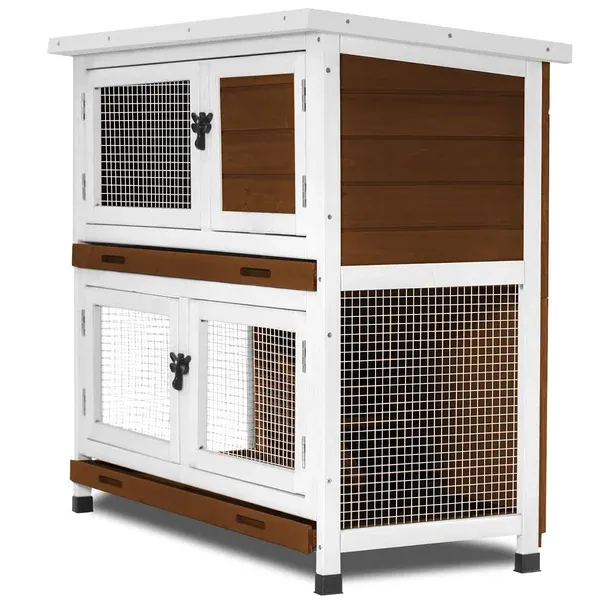
What It Is and Key Specs
The LuvemPets 2-Story Rabbit Hutch is a dual-level small-animal enclosure constructed from 100% Finnish spruce timber finished with a water-based, pet-safe paint in a walnut tone. The two-story layout separates a lower living and exercise area from an upper nesting box, connected by a ramp and a hinged trap door that can be opened or closed to partition the levels. Multiple access doors are built into the frame, and upgraded butterfly locks secure each entry point. Two pull-out plastic trays sit beneath the wire flooring for waste collection. The roof is covered with waterproof asphalt sheeting. The manufacturer lists compatible animals as rabbits, guinea pigs, chinchillas, and small chicks.
Build Quality and Materials
Finnish spruce is a close-grained softwood commonly used in pet furniture for its dimensional stability, and the water-based paint finish is described by the manufacturer as pet-safe — an important distinction given that rabbits and guinea pigs habitually gnaw on enclosure surfaces. The asphalt roof is a practical weather-resistance choice for outdoor use, as it sheds rain without the long-term delamination risk of thin plywood alone. The butterfly locks represent an upgrade over simple barrel-bolt hardware, which is worth noting because predator-proofing at night is a genuine concern for outdoor hutches.
The pull-out trays are described as leak-proof and rust-resistant plastic. Plastic trays are standard in this hutch category and do simplify daily spot-cleaning, though owners of heavy chewers should be aware that exposed tray edges can be accessible to persistent gnawers — a common consideration across wood hutches of this style, not a specific reported defect of this model.
Real-World Fit: Who It Suits and Who Should Skip
Good fit:- Owners of one or two small rabbits, guinea pigs, or similarly sized animals who want separate sleeping and activity zones without a large footprint.
- Mixed indoor/outdoor households where the hutch may be moved seasonally; the asphalt roof and sealed timber make it more weather-tolerant than unfinished pine alternatives.
- Keepers who want easy daily cleaning — the dual pull-out trays address the most time-consuming maintenance task.
Community rabbit forums (rabbitrehome.org.uk) raise a relevant point for prospective buyers: two-story hutches can present a fall risk for very young kits or elderly rabbits with reduced mobility. The hinged trap door between levels does allow owners to close off the upper story when needed, which partially addresses this concern — but buyers housing babies or senior animals should weigh the ramp incline carefully before purchasing.
The same community discussions note that hay management in two-story hutches requires some planning; hay placed only on one level means animals must navigate the ramp to access it, which suits most healthy adults but may not suit all individuals.
Less ideal for:- Owners of larger rabbit breeds (e.g., Flemish Giants) where square footage and ceiling height are the primary constraints.
- Buyers seeking a permanent outdoor installation in climates with prolonged heavy rain or snow loading — wood hutches across this category typically benefit from additional weatherproofing treatments over time.
Two-Story Layout: Category Context
Two-story hutch designs, as noted by specialty retailers like Aivituvin, are generally chosen to maximize usable animal space while keeping the ground footprint compact. The vertical separation can also suit rabbits that naturally prefer a dedicated resting zone elevated from their waste area — a behavioral tendency documented across rabbit-keeping communities. Whether a given rabbit takes to the ramp and upper level readily varies by individual temperament, as forum discussions at rabbitrehome.org.uk consistently reflect.
Honest Limitations
- No stated interior dimensions per level. The listing does not break out individual floor dimensions for the upper or lower story, making it difficult to verify suitability for specific breeds without cross-referencing assembly documentation.
- Wood maintenance over time. Finnish spruce with a paint finish performs well initially outdoors, but as noted in broader rabbit-keeping communities (rabbittalk.com), wood hutches in wet climates are susceptible to rot and mildew with prolonged exposure. Periodic re-sealing is a realistic long-term requirement.
- Ramp access. The single connecting ramp works for agile, healthy adults but may need modification or closure for kits, injured animals, or less mobile seniors.
- Assembly required. The listing implies self-assembly; complexity is not detailed in available sources.