What It Is and Key Specs
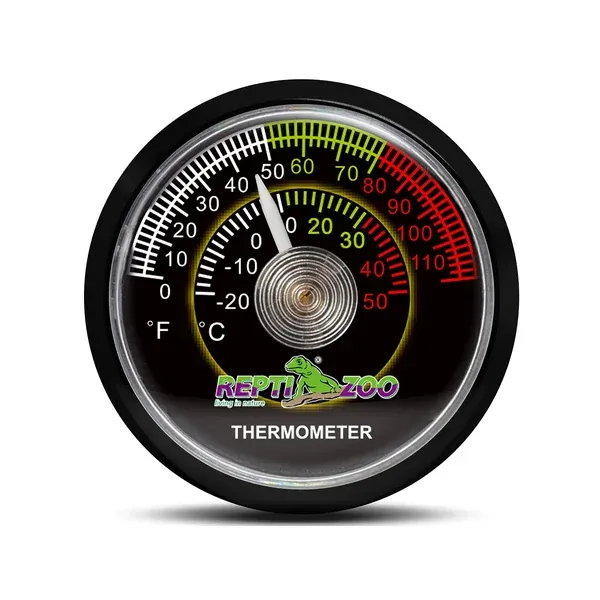
The REPTI ZOO Reptile Terrarium Dial Thermometer is an analog, needle-style gauge intended for monitoring temperatures inside reptile enclosures, hatchers, brooders, and propagators. It reads in both Celsius and Fahrenheit simultaneously, and it requires no battery — making it a purely passive instrument. According to the manufacturer's listing, the dial uses color-coded segments: white for cold, green for comfortable, and red for hot, giving keepers a quick visual reference without having to parse exact numbers every time.
Mounting is handled via a sticky pad on the reverse of the gauge, which the manufacturer states allows attachment to most surfaces.
Build Quality and Ease of Use
Based on the product listing and manufacturer information, the thermometer's design prioritizes simplicity. The color-coded dial system is a genuine usability feature — particularly for newer reptile keepers who are still learning the ideal temperature ranges for their species. Rather than requiring a keeper to memorize exact figures, the green "comfortable" zone provides an immediate visual cue.
The no-battery design is a meaningful practical advantage: there are no dead cells to replace, no low-battery warnings to miss, and no ongoing consumable cost. The manufacturer also backs the product with a 12-month quality assurance guarantee and commits to a 24-hour customer support response window, which provides a reasonable safety net for a budget-tier instrument.
That said, analog dial thermometers as a category carry inherent accuracy limitations compared to digital alternatives. Community discussion on reptile forums (
ourreptileforum.com) reflects a clear preference among experienced keepers for digital thermometer/hygrometer combos — particularly models with external sensors — for more precise habitat monitoring. The dial format cannot match the readout granularity of a digital display.
Real-World Fit: Who It Suits and Who Should Skip It
This thermometer is a reasonable fit for:
- Beginner reptile keepers who want a simple, inexpensive way to confirm their enclosure is within a safe general temperature range.
- Secondary or backup monitoring in setups where a primary digital instrument is already in use.
- Low-stakes enclosures such as propagators or hatchers where ballpark temperature confirmation is sufficient.
Keepers who should look elsewhere include those housing temperature-sensitive species — such as many tropical or desert reptiles — where maintaining a precise thermal gradient is critical to the animal's health, digestion, and daily activity (as noted in published reptile husbandry guidance from
hardypaw.com). For those use cases, a digital thermometer with an internal probe and external display, or an infrared spot thermometer for surface readings, will provide meaningfully more reliable data.
REPTI ZOO itself offers digital thermometer/hygrometer alternatives — including LCD display and dual-gauge combo models listed on reptizoo.store — that address the accuracy gap if budget allows.
Honest Limitations
No product is without trade-offs, and this one has several worth naming clearly:
- Analog accuracy ceiling: Dial gauges are inherently less precise than digital sensors. The color-coded zones help with usability but mask the fact that exact degree-level readings may not be reliable.
- No humidity measurement: This is a thermometer only. Reptile enclosures typically require both temperature and humidity monitoring; this gauge covers only half the equation.
- Sticky-pad mounting: Adhesive pads can lose grip over time, particularly in the humid environments common to many reptile setups. Longevity of the mount is not addressed in the manufacturer's materials.
- No remote sensing: The gauge measures ambient temperature at its mounted location only. It cannot capture hot-spot or cool-zone differentials, which are often critical for proper reptile thermoregulation.
Reader Sentiment
Readers who have purchased and reviewed the product give it an aggregate positive rating, reflecting that it delivers on its core promise as a simple, no-fuss temperature indicator for everyday enclosure monitoring.
Darrell Steward
1 Feb, 2021Brilliant
This is the best product that has ever been made. It is also one of the best items in the world right now. Definitely go for it.
Albert Flores
17 Oct, 2020Just WOW
It's good to use this product for development as it has very good performance, display quality and all other features.