What It Is and Key Specs
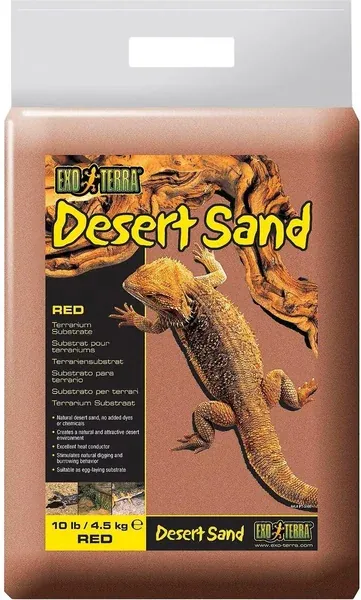
Exo Terra Desert Sand Red is a 10-pound bag of natural desert sand intended for reptile and other desert-dwelling terrarium inhabitants. According to the manufacturer, the sand contains no added dyes or chemicals — the red coloration is its natural state. Exo Terra states the product is sifted to remove impurities and to produce a homogenous grain size throughout the bag. It is sold in a single 10-pound plastic bag configuration and is described as suitable for all breed sizes.
Per Exo Terra's own product pages (https://exo-terra.com/products/substrates/desert-substrates/desert-sand-red/), the Desert Substrates line is designed to mimic the natural sands found in arid desert or savannah regions, with the specific weight of the sand engineered to give reptiles a realistic, naturalistic feel underfoot.
Build Quality and Composition
The manufacturer positions this as a "real" desert sand rather than a processed or artificially colored product. A review published by Reptile Craze (https://reptilecraze.com/exo-terra-desert-sand-review/) noted that when the sand was wet-tested, the water ran approximately normal brown rather than red, which is consistent with the claim of no added dyes. The same source noted relatively little dust in its sample, observing this characteristic is meaningful since excessive fine particulates can cause respiratory issues in reptiles.
The sifting process Exo Terra describes is aimed at consistency — a uniform grain size helps with even heat distribution, which the brand says makes it an effective heat conductor beneath a basking spot or undertank heater.
Functional Claims
Exo Terra describes three primary uses for this substrate, as drawn from its listing and product pages:
1. Heat conduction — the sand's density and grain uniformity help distribute warmth across the enclosure floor.
2. Behavioral enrichment — the substrate stimulates natural digging and burrowing behavior, which is an important aspect of husbandry for species like sand boas, uromastyx, and certain gecko species.
3. Egg-laying substrate — Exo Terra lists it as suitable for use as an egg-laying medium, relevant to keepers managing breeding animals.
Real-World Fit: Who It Suits, Who Should Skip
This substrate is best suited to keepers housing species that genuinely live on sandy substrate in the wild — such as uromastyx, sand boas, or certain agamid species — and who are experienced enough to monitor their animals' feeding behavior closely.
It is a more complicated choice for smaller or younger reptiles, or for fast-striking feeders. Community discussion on Reptile Forums (https://www.reptileforums.co.uk/threads/exo-terra-desert-sand.549903/ and https://www.reptileforums.co.uk/threads/exo-terra-desert-sand.675500/) raises a recurring concern: reptiles that lunge at prey can ingest sand alongside food, and even occasional ingestion can accumulate over time. Forum contributors noted that smaller animals are at heightened risk, and that impaction — a potentially fatal gastrointestinal blockage — can develop gradually before symptoms become visible. One poster observed that sand is not necessarily the natural substrate for all species commonly marketed with it.
Keepers who prefer to feed in a separate enclosure, or who use tongs to minimize substrate contact during feeding, may manage this risk more effectively.
Honest Limitations
No substrate is without trade-offs, and this one is no exception:
- Impaction risk is real and documented in community forums, particularly for small animals or those fed directly on the substrate.
- Species-appropriateness matters — sand is not the natural ground cover for every reptile sold in the hobby, despite being commonly used across many setups.
- Loose substrate generally requires more maintenance than tile or mat alternatives, as waste and uneaten food must be spot-cleaned or the substrate periodically replaced to prevent bacterial buildup.
- The 10-pound bag may cover only a modest footprint depending on enclosure size, and keepers with large tanks may need multiple bags to achieve meaningful depth for burrowing.
Bottom Line
Exo Terra Desert Sand Red is a cleanly sourced, dye-free substrate with a legitimate role in naturalistic desert terrariums — particularly for burrowing species housed by attentive keepers. The manufacturer's claims around grain uniformity and minimal dust are broadly supported by third-party observation. That said, the impaction debate in reptile-keeping communities is longstanding and worth taking seriously: this review, synthesized from the product listing, Exo Terra's manufacturer information, and published third-party sources, reflects that the substrate suits some setups well and others poorly. Matching the substrate to the specific species and its feeding behavior is the most important step before purchase.
Darrell Steward
1 Feb, 2021Brilliant
This is the best product that has ever been made. It is also one of the best items in the world right now. Definitely go for it.
Albert Flores
17 Oct, 2020Just WOW
It's good to use this product for development as it has very good performance, display quality and all other features.