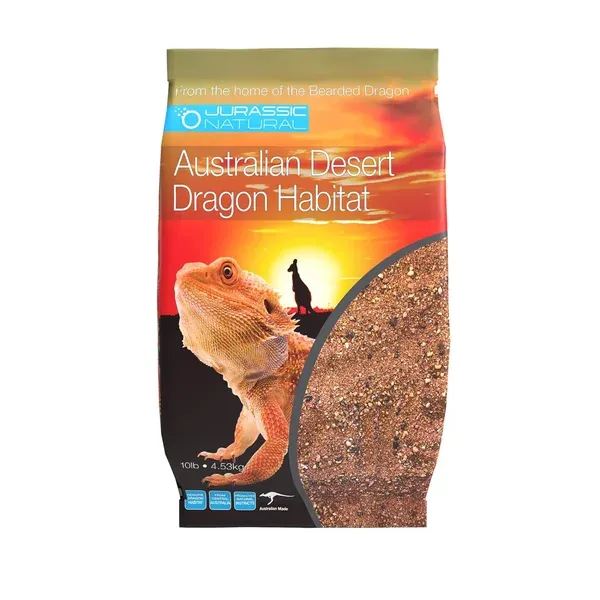
What It Is and Key Specs
The Jurassic Natural Australian Desert Dragon Habitat Substrate is a 10 lb bag of authentic red sand collected from Central Australia — the native range of bearded dragons (Pogona vitticeps) and related species. According to the manufacturer's listing, the material is ethically sourced from the same habitat regions where bearded dragons originate, making it one of the few reptile substrates that is literally pulled from its subjects' wild home environment rather than formulated in a processing facility.
Per the listing, the substrate is positioned for bearded dragons primarily, but is also described as suitable for other Australian desert-dwelling lizards and reptiles that share similar habitat requirements.
The Natural Habitat Case
The core selling proposition rests on an ecological argument: bearded dragons have evolved over millennia in Central Australian desert conditions, meaning their biology — thermoregulation, burrowing instincts, hydration balance, and general behavior — is calibrated to a specific substrate type. As reptile specialist Jonathon Howard notes in a ReptiFiles review of this product, that native substrate is effectively a thick layer of packed Australian red sand (
reptifiles.com). The manufacturer's bullets echo this directly, citing "natural environment replication" and "environmental enrichment benefits" that promote natural behaviors and instinctive activities through authentic substrate interaction.
Community discussion on BeardedDragon.org has similarly flagged this product as notable for being substrate taken directly from Central Australia rather than a manufactured analog (
beardeddragon.org).
Heat Retention Properties
The manufacturer states that this substrate retains warmth for extended periods due to its "unique geological composition and natural mineral content." This is a plausible characteristic of dense, mineral-rich desert sands broadly — though how this specific product's thermal performance compares to other reptile substrates in practice is not quantified in the available sources. Prospective buyers should weigh this claim with that caveat in mind.
Build Quality and Safety
No specific CPSC safety recall or warning notice was found in the sources reviewed for this product. As with any particulate substrate, the standard reptile-keeping considerations apply: loose sand or soil substrates carry an ingestion risk, particularly for juvenile reptiles or animals fed directly on the substrate. The manufacturer does not address this in the listing bullets. Buyers with juvenile bearded dragons or animals with a history of substrate ingestion should research this dimension carefully before purchasing.
Real-World Fit — Who It Suits and Who Should Skip
This substrate is a reasonable consideration for:
- Adult bearded dragon keepers seeking an authentic, naturalistic vivarium setup aligned with the animal's wild environment.
- Hobbyists housing other Central Australian desert lizards (agamids, geckos, skinks native to arid zones) that share similar substrate preferences.
- Bioactive or naturalistic enclosure builders for whom provenance and ecological authenticity matter.
It is likely less appropriate for:
- Juvenile bearded dragon owners, given the general reptile-keeping concern about particulate ingestion in young animals — a risk category the listing does not address.
- Keepers on a tight budget who need to cover large enclosure floor areas, as 10 lbs covers a limited surface area depending on desired depth.
- Those in regions where importing natural soil/substrate may face agricultural or biosecurity restrictions — worth verifying at the point of purchase.
Honest Limitations
A few limitations are worth naming directly. First, the manufacturer's claim of "ethical sourcing" from Central Australia is asserted but not independently verified in the available sources — no third-party certification or audit is referenced. Second, while the ReptiFiles review acknowledges the ecological logic behind the product's premise, the available excerpt does not constitute a full endorsement of real-world outcomes. Third, value-tier and niche particulate substrates in this category typically vary in consistency between production batches, which can affect particle size, dust content, and color uniformity — though this is a general category observation and not a documented finding specific to this product. Finally, 10 lbs is a modest quantity; keepers with larger enclosures will likely need multiple bags to achieve a meaningful substrate depth.