What It Is and Key Specs
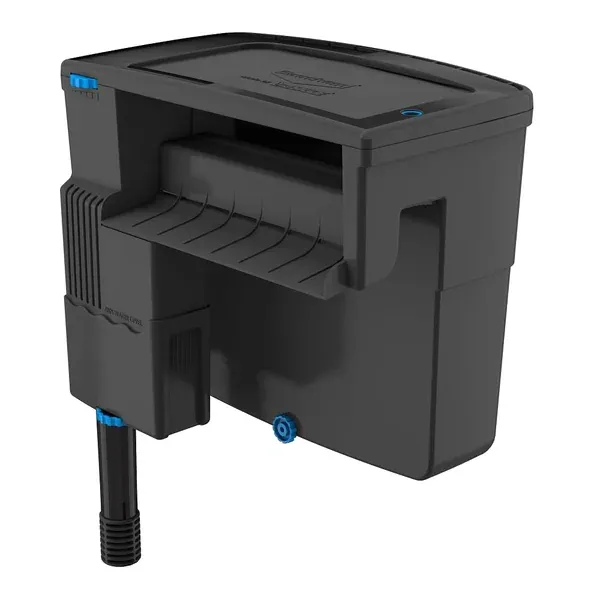
The Seachem Tidal 110 is a hang-on-back (HOB) power filter designed for aquariums up to 110 US gallons (approximately 400 liters). It is manufactured by Sicce and branded under the Seachem label. Seachem's own comparison page lists the Tidal line spanning multiple tank sizes, with the 110 sitting at the top of the range for hobbyists who need meaningful flow capacity without moving to a canister setup (
seachem.com).
The defining design choice is a bottom-to-top flow path, which the manufacturer says draws water through media from the bottom up — a departure from the top-down or side-entry approach common in many competing HOB filters. The unit includes an adjustable leveling device intended to accommodate aquariums where the rim is not perfectly level, and intake flow regulation allows the user to dial back water movement for tanks with slow-moving or surface-sensitive inhabitants.
The Tidal 110 ships with a self-priming pump, meaning it should start drawing water without manual siphoning after an initial fill. The impeller is also described as self-cleaning, which is intended to reduce the debris buildup that can cause premature flow loss. Notably, Seachem positions the filter around a no-cartridge media basket system: users fill the basket with media of their choice rather than swapping proprietary cartridges.
Build Quality and Reliability
Seachem's support documentation acknowledges that the Tidal filters do occasionally stop working, and the company provides a published troubleshooting guide covering impeller checks, outlet blockages, and priming failures (
seachem.zendesk.com). The existence of a dedicated FAQ for this scenario suggests stoppage issues, while not routine, are common enough to warrant structured guidance. The impeller is flagged in that documentation as a first checkpoint when flow is lost.
Seachem's support forums reflect a company that engages directly with troubleshooting inquiries, which is a meaningful service consideration for a product that runs continuously (
seachem.com support forums).
Real-World Fit: Who It Suits, Who Should Skip
The Tidal 110 is a reasonable candidate for freshwater community tanks, planted aquariums, and lightly stocked cichlid setups in the 75–110 gallon range where a HOB form factor is preferred over a canister. The no-cartridge approach is particularly well-suited to hobbyists who want to customize their media stack — for example, running biological media such as porous inorganic solids alongside mechanical and chemical layers — without being locked into manufacturer-specific replacements.
The intake flow regulation makes it more viable for tanks with Betta fish, small surface-dwelling species, or delicate planted layouts where excessive surface agitation is undesirable.
Those running
saltwater or reef systems should approach carefully. Seachem's own support documentation makes clear that not all Seachem products translate cleanly across freshwater and saltwater applications, and medication compatibility questions are common enough to have their own knowledge base section (
seachem.zendesk.com). The filter itself is not restricted to freshwater by the listing, but prospective reef keepers should verify suitability for their specific setup.
Honest Limitations
A few genuine limitations are worth naming:
- Troubleshooting complexity: The self-cleaning impeller does not eliminate the need for maintenance oversight. Seachem's FAQ makes clear that impeller fouling is the most common cause of failure, so periodic manual inspection remains necessary (seachem.zendesk.com).
- No-cartridge convenience has a trade-off: While freedom from proprietary cartridges is a genuine benefit, it places the burden of media selection and replacement scheduling on the owner. Beginners who prefer a simpler "swap and go" experience may find this less intuitive.
- Brand-level mixed feedback: Customer service reviews published on Trustpilot reference product experiences with other Seachem products that did not meet expectations (trustpilot.com). These do not relate directly to the Tidal filter but are part of the broader brand picture a buyer will encounter.
- HOB ceiling: At 110 gallons, this filter sits at the upper boundary of the HOB category. Heavily stocked tanks or those with high bioloads at that gallon rating may be better served by a canister filter with greater media volume.