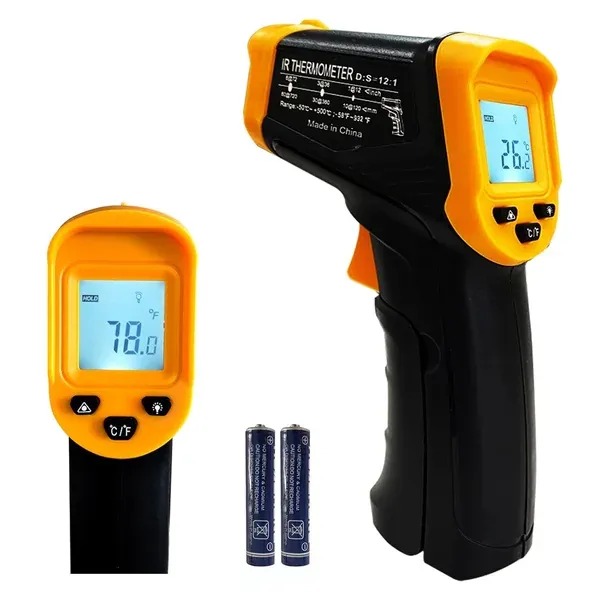
What It Is and Key Specs
This Digital Infrared Thermometer Gun is a handheld, non-contact temperature measurement device aimed at cooking applications — BBQ grills, pizza ovens, stovetops, and similar tasks. According to the manufacturer listing, it covers a measurement range of -58°F to 932°F (-50°C to 500°C) with a display resolution of 0.1°C or 0.1°F, which is a respectable span for home cooking use.
Key features drawn from the listing include:
- °C/°F conversion toggle for user flexibility
- LCD backlight that activates with any button press, useful in low-light cooking environments like outdoor grilling at night
- Data-hold function: pulling the trigger shows a live SCAN reading; releasing it locks the display with a HOLD icon
- Auto power-off after approximately 8 seconds of inactivity to conserve battery
- Power source: 2 × AAA batteries (not included, per standard convention for this category)
The device is explicitly labeled Not for Human use — it is not a medical thermometer and should not be used for body temperature measurement.
Build Quality and Emissivity Considerations
The thermometer ships with a fixed emissivity preset of 0.95, which the manufacturer notes is appropriate for most organic materials and painted or oxidized surfaces. This is a widely accepted standard preset in entry-level IR thermometers.
However, the listing is transparent about a meaningful limitation: shiny or polished metal surfaces will produce inaccurate readings at this fixed emissivity. The manufacturer's own guidance suggests compensating by covering such surfaces with masking tape or flat black paint and measuring once the covering reaches the same temperature as the underlying material. Buyers who frequently work with stainless steel cookware or bare metal grill grates should take note of this workaround.
There is no adjustable emissivity setting listed, which distinguishes this unit from higher-tier options reviewed by outlets such as Bob Vila and Smoked BBQ Source, where adjustable emissivity is cited as a key differentiator among the best infrared thermometers for cooking.
Real-World Fit: Who It Suits, Who Should Skip
Based on the manufacturer specifications and context from published buying guides (
smokedbbqsource.com,
bobvila.com,
foodandwine.com), this thermometer is likely a solid fit for:
- Home BBQ enthusiasts checking grill surface temperatures before cooking
- Pizza makers verifying stone or oven deck temps
- General home cooks monitoring cast iron pans, woks, or baking surfaces
- Users who need nighttime outdoor use, given the backlit display
It is a less suitable choice for:
- Anyone needing adjustable emissivity for varied surface types, including polished metals
- Professionals or competition cooks requiring certified accuracy specs (no ±accuracy figure is stated in the listing)
- Anyone seeking a thermometer that can double for body or medical temperature checks — the listing explicitly excludes this use
How It Fits the Infrared Thermometer Category
The broader IR thermometer market for cooking spans a wide range of capability and price. As noted in buying guides from Smoked BBQ Source and Bob Vila, top-tier options like the Fluke 62 MAX Plus offer ranges up to 1202°F, accuracy ratings of ±1.0%, and distance-to-spot ratios that allow reading from several meters away. This LuvemPets unit's 932°F ceiling covers the vast majority of home cooking scenarios — pizza ovens and most grills operate well within this range — but it does not match the ceiling or specified accuracy of professional-grade instruments.
For everyday home use, the 932°F upper limit, backlight, and data-hold are practical features that align with what cooking-focused buying guides identify as baseline requirements for a functional IR thermometer.
Honest Limitations
Every product in this category has trade-offs, and this one is no exception:
- No adjustable emissivity: Fixed at 0.95, which causes inaccurate readings on shiny or polished metal — a common surface in kitchens
- No published accuracy specification: The listing does not state a ±°F/°C or percentage accuracy figure, making it difficult to benchmark against competitors with published specs
- Short auto-off window: 8 seconds of inactivity triggers shutdown, which may interrupt workflow for users who pause frequently between measurements
- Battery not included: Requires 2 × AAA batteries, a minor but common inconvenience at unboxing