What It Is and Key Specs
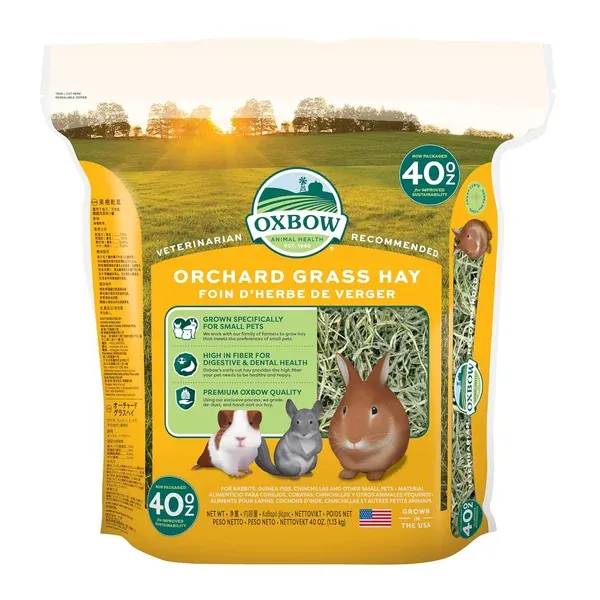
Oxbow Orchard Grass Hay is a single-ingredient grass hay sold in a 40 oz bag, grown specifically for small herbivores including rabbits, guinea pigs, chinchillas, and bunnies. According to the manufacturer and the product's listing on Oxbow Animal Health's own site, the hay is hand-selected, aromatic, and high in fiber — the two properties most often cited as differentiators from commodity hays. It is made in the USA, sourced from what Oxbow describes as a family of farms, and has been de-dusted prior to packaging, which is a meaningful consideration for pets and owners sensitive to airborne particulates.
The listing's described characteristics — soft texture, sweet smell, and a fruity, green appearance — are consistent across both the manufacturer's product page and third-party coverage on Influenster, which notes it as "a sweet smell that will satisfy any sweet tooth" and flags veterinarian recommendations for feeding orchard grass to small herbivores.
Build Quality and Sourcing
Unlike pelleted foods or treats, hay quality is assessed largely through sourcing and handling practices. Oxbow positions this product as "hand-sorted" and "crafted with the finest natural ingredients," language that implies manual quality checks rather than fully automated processing. The hay is grown with small pets explicitly in mind, per the manufacturer, rather than being a repurposed agricultural byproduct — a distinction Oxbow emphasizes in its product bullets.
The AFRMA (American Fancy Rat and Mouse Association) published a community review of Oxbow Orchard Grass Hay that noted mice used it enthusiastically for both nesting and eating, describing it as a product suitable even beyond the primary target species of rabbits and guinea pigs.
This review synthesizes the product listing, manufacturer information, and published third-party coverage — no hands-on evaluation was conducted.
Dental and Digestive Support
Oxbow's core claim for this hay centers on fiber. High-fiber grass hay is widely recognized by small-animal veterinarians as essential for two reasons: it keeps the gastrointestinal tract moving in hindgut fermenters like rabbits and guinea pigs, and the mechanical chewing action required to process long-strand hay helps wear down continuously growing teeth. Oxbow's listing explicitly frames this product around both "digestive & dental health," and Influenster coverage notes that veterinarians recommend orchard grass for small herbivores — though readers should consult their own vet for species- and age-specific guidance.
Real-World Fit: Who It Suits, Who Should Skip
Oxbow Orchard Grass Hay is likely a strong fit for owners of rabbits, guinea pigs, or chinchillas who want a name-brand, vet-recommended hay with defined sourcing and handling standards. The de-dusting process may particularly appeal to those whose pets have shown sensitivity to dusty hays. Readers on Amazon give it an aggregate score of 4.6 out of 5 from 6,965 ratings, suggesting broad satisfaction at scale.
That said, community forum feedback on Guinea Pig Cages includes owners reporting that some guinea pigs flat-out refuse orchard grass, with a few noting their animals also rejected timothy/orchard blends from Oxbow. Hay preference in small herbivores is notoriously individual — palatability is not guaranteed regardless of brand or quality tier. Owners with particularly selective eaters may want to purchase a smaller quantity first before committing to the 40 oz bag.
Honest Limitations
- Palatability is not universal. Published community feedback documents cases where guinea pigs rejected this hay outright, and some owners have switched brands as a result.
- No nutritional panel in available sources. While the listing emphasizes high fiber, specific percentages (crude fiber, protein, moisture) are not surfaced in the sources reviewed here; buyers seeking precise macros should consult Oxbow's full product documentation.
- Single-grass format. Some owners prefer a timothy/orchard blend for variety; this product is orchard grass only, which may not suit all feeding philosophies or pet preferences.
- Bag size consideration. At 40 oz, the bag represents a reasonable bulk purchase — but given the palatability variability noted above, first-time buyers may want to trial a smaller size if available.