What It Is and Key Specs
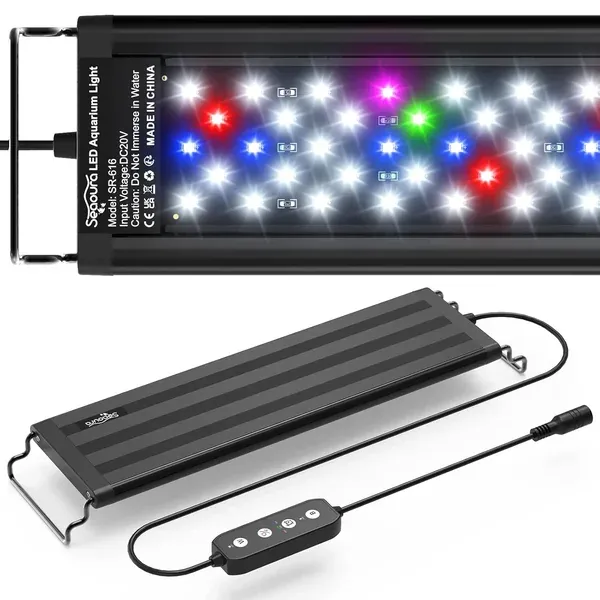
The SEAOURA LED Aquarium Light (12–18 inch) is a clip-and-bracket freshwater fixture built around SMD2835 LED chips arranged in five columns. It covers a White, Red, Green, Blue, and Pink (WRGBP) spectrum at a 6,500 K white color temperature with a Color Rendering Index (CRI) of 89%, which the manufacturer describes as close to natural light. The adjustable metal extender brackets are designed to fit most glass or acrylic aquariums — rimmed or rimless, with or without a transparent hood or lid.
The fixture includes a three-button controller that manages timing, brightness, and color mode without any app or Wi-Fi dependency. Ten brightness levels are selectable, and three preset timer durations — 6, 10, or 12 hours — handle the auto on/off cycle. Three color modes are available: all lights on (full WRGBP), white/red/green/pink only, or blue only for a moonlight effect. A memory function retains settings through power outages, restarting the countdown once power is restored.
A notable detail called out in the listing: the light ramps up gradually over 15 minutes at the start of the cycle and dims over the final 15 minutes, which is intended to reduce stress on fish.
Build Quality and Safety
The housing is ABS plastic, which the manufacturer says provides good heat dissipation. The bracket system uses metal for stability and durability. According to the Seaoura SR-666 user manual published on Manuals+, the power cord on this type of fixture cannot be replaced — if the cord is damaged, the unit should be discarded rather than repaired. Users should also not operate the light if the cord or plug is damaged, if the unit is malfunctioning, or if it has been dropped or damaged in any way. Buyers should factor in that cord-damage means full unit replacement.
Published coverage from Glassboxdiaries.com describes the SEAOURA SR-616 — a model in the same lineup — as punching above its price point, noting full-spectrum output, customizable settings, energy efficiency, and minimal heat generation as standout traits. The reviewer highlights its ability to support healthy plant growth across a variety of species, including those considered more demanding. Seaoura's own blog notes that a stable lighting schedule matters more than extended hours, and that running lights too long encourages algae — context worth keeping in mind when selecting one of the three timer presets.
The 89% CRI and 6,500 K color temperature are figures consistent with fixtures intended to support photosynthesis in freshwater planted tanks. The five-column LED layout is positioned by the manufacturer as denser than competing designs in the same category, though independent side-by-side comparisons were not available in the sources reviewed here.
Real-World Fit: Who It Suits, Who Should Skip
This fixture is well-matched to hobbyists running nano to small freshwater tanks (12–18 inches) who want automated lighting without the complexity of an app or programmable controller. The listing explicitly calls it suitable for all skill levels, from beginners to experienced aquarists, and the three-button interface supports that claim. The slow sunrise/sunset ramp is a thoughtful touch for community fish tanks.
Those running saltwater or reef systems should look elsewhere — the manufacturer specifies freshwater-only compatibility. Hobbyists wanting granular scheduling (custom on/off times by the minute, separate day and night cycle programming) may find the three fixed-duration presets limiting; Seaoura's own collection page shows more programmable models for that use case. Tanks larger than 18 inches are also outside the designed coverage range.
Honest Limitations
- Timer flexibility is limited to three preset durations (6, 10, or 12 hours); there is no custom minute-level scheduling on this model.
- The power cord cannot be repaired or replaced — cord damage means replacing the entire unit.
- Coverage is restricted to 12–18 inch tanks; those with longer tanks will need a different fixture.
- Only three color mode combinations are selectable, so users wanting fine channel-by-channel intensity control will find the options limited.
- No wireless connectivity or app control is available, which is either a pro or a con depending on user preference.
Darrell Steward
1 Feb, 2021Brilliant
This is the best product that has ever been made. It is also one of the best items in the world right now. Definitely go for it.
Albert Flores
17 Oct, 2020Just WOW
It's good to use this product for development as it has very good performance, display quality and all other features.