What It Is and Key Specs
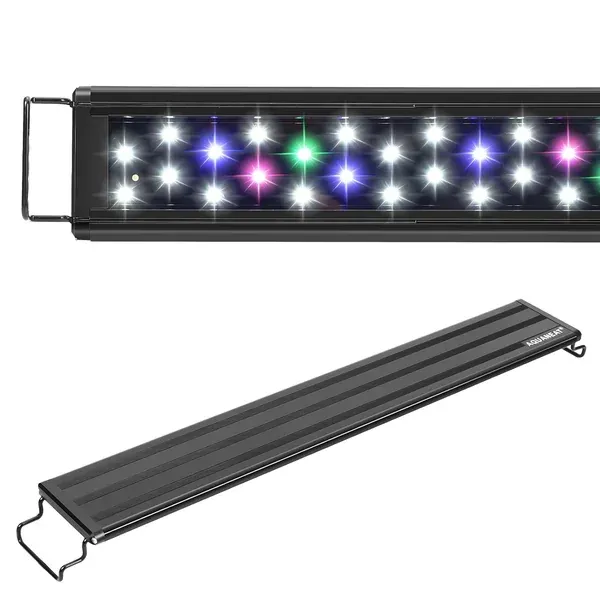
The AQUANEAT LED Aquarium Light (18"–24") is a freshwater-focused fixture built around a 17-inch light body that extends to fit tanks between 18 and 24 inches long via two included docking brackets. Assembled minimum length is 18.5 inches; width is 2.7 inches across the board. The manufacturer states there is no limit to rim thickness, which makes it compatible with rimless and rimmed tanks alike.
Inside the slim housing sit 42 LEDs arranged across four color channels: 30 white LEDs at 6,500 K (a daylight-temperature output suited to planted and community freshwater setups), 6 blue LEDs, 3 pink LEDs, and 3 green LEDs. The manufacturer identifies this as a "full spectrum" configuration intended to support freshwater livestock and live plants. According to the listing, the light works best over a 10-gallon tank with a 20-inch footprint for optimal coverage.
The control scheme is straightforward — all lights on, all lights off. There is no built-in timer and no brightness adjustment.
Build Quality and Safety
The fixture is a low-profile plastic unit with extendable bracket arms as its primary mounting mechanism. The bracket system is the main adjustability feature, letting it span different tank widths without tools.
One safety note from the manufacturer deserves particular attention and should not be overlooked: the light is explicitly not waterproof. The listing states in capital letters that the light must be kept away from splashing water. This is standard for many entry-level aquarium fixtures but is especially important to observe during water changes, feeding, or any activity that agitates the water surface near the light.
Real-World Fit: Who It Suits, Who Should Skip
This light is well-matched for hobbyists setting up a small freshwater community tank — particularly a standard 10-gallon — who want a no-fuss, budget-friendly light without programming menus or app connectivity. The bracket system makes installation straightforward, and the 6,500 K white-dominant spectrum is a reasonable general-purpose choice for fish-keeping and low-to-moderate light freshwater plants.
Shoppers who should look elsewhere include:
- Planted tank enthusiasts who need precise PAR output data or intensity control to dial in growth for demanding plant species.
- Saltwater and reef keepers. Discussion on Reef2Reef notes that AQUANEAT fixtures are a topic of curiosity in the reef community, but this specific fixture's spectrum and output are intended for freshwater use only.
- Aquarists who need automation. Without a timer, the light must be switched manually every day. Buyers who want consistent photoperiods without daily intervention should consider a fixture with a built-in timer or purchase a separate outlet timer.
- High-splash or aggressive surface-agitation setups where water contact with the fixture is likely — the lack of waterproofing is a genuine risk factor.
How It Compares in the Category
AQUANEAT produces a range of similarly styled freshwater fixtures spanning 12-inch to 48-inch sizes, all using comparable multi-color LED arrays (per coverage at
bestviewsreviews.com). Within that lineup, this 18"–24" model sits in the small-tank tier. Reviewaqua.com describes the broader AQUANEAT LED line as "a reliable and efficient lighting solution for small to medium-sized fish tanks," noting that adjustable mounting brackets and compact design ease installation. The lack of a timer and non-adjustable brightness, however, are features that some competing fixtures at similar price points do offer.
Honest Limitations
- No timer, no dimming. The binary on/off control is the most significant functional limitation. Consistent light cycles are important for fish health and algae management; this fixture cannot automate that without an external outlet timer.
- Not waterproof. Splashing water poses a real hazard. The manufacturer's own warning is explicit.
- Coverage caveats. The manufacturer's "best performance" claim is specific to a 20-inch, 10-gallon tank. Buyers stretching the brackets to cover a 24-inch tank may see reduced intensity at the edges.
- No PAR or lumen data published. Planted tank keepers cannot easily assess whether the light meets their plants' needs without independent measurement.
Darrell Steward
1 Feb, 2021Brilliant
This is the best product that has ever been made. It is also one of the best items in the world right now. Definitely go for it.
Albert Flores
17 Oct, 2020Just WOW
It's good to use this product for development as it has very good performance, display quality and all other features.