What It Is and Key Specs
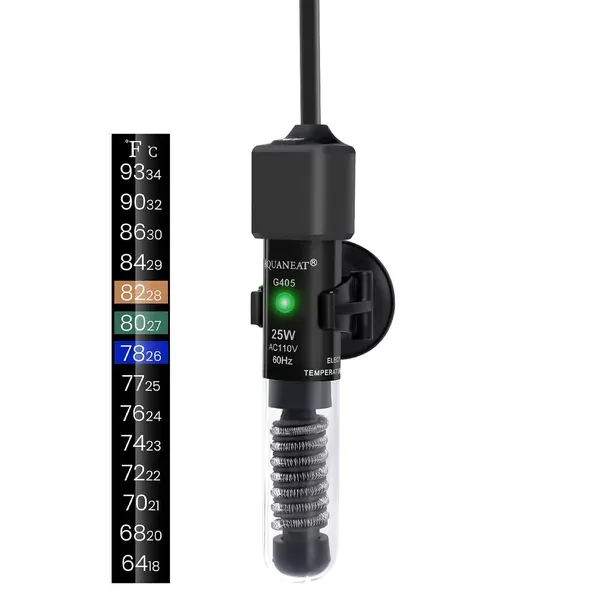
The AQUANEAT 25W Aquarium Heater is a mini submersible heater built specifically for small freshwater tanks. At just 4.5 inches in length, it is sized for tanks between 3 and 5.5 gallons — a range that covers many popular betta setups. The unit comes factory-preset to 78°F, a temperature widely cited as suitable for betta fish and most other common tropical species, which means there is no dial to calibrate and no configuration required beyond submerging it and plugging it in. A dual-color indicator light reports operating status in real time: red while actively heating, green while resting. The package includes the heater itself, one suction cup for positioning, and a free adhesive thermometer strip.
Build Quality and Safety
AQUANEAT's own listing includes explicit safety cautions that are worth quoting closely: the heater must be fully submerged before being plugged in, and users must unplug it and wait at least 10 minutes before performing any tank maintenance or removing it from the water. The listing also warns users not to touch the heater while powered on, citing scalding risk. These are standard precautions for submersible glass heaters, but they are particularly worth emphasizing in a product targeted at beginner betta keepers who may be handling aquarium equipment for the first time.
At the nano-tank price point, preset heaters typically rely on a fixed internal thermostat rather than an adjustable bimetallic or electronic controller — a design trade-off common across this tier that prioritizes simplicity over precision. That trade-off has implications discussed below.
Real-World Fit: Who It Suits, Who Should Skip
This heater makes the most sense for keepers running a single small betta tank who want a low-fuss, plug-and-play solution and whose fish thrive near 78°F. The compact form factor genuinely minimizes visual intrusion in nano aquascapes, and the included thermometer strip provides a basic cross-check at no additional cost.
Keepers who should pause before purchasing include those housing fish with narrow, species-specific temperature requirements outside the 78°F preset — since there is no adjustment mechanism — and those who prefer precise, independently verified temperature control. Anyone housing invertebrates or more delicate species in the same tank would likely benefit from a heater with an adjustable thermostat and a separate, reliable digital thermometer. As noted in forum discussion at Aquarium Advice, stick-on thermometer strips can return inaccurate readings when ambient room temperature is significantly lower than the tank, so treating the included strip as a rough guide rather than a precision instrument is wise.
Honest Limitations
The most significant concern surfaced in community coverage comes from My Aquarium Club, where at least one user reported a unit malfunctioning and overheating a tank to approximately 90°F despite being set to 78°F — a failure that proved fatal to their fish. This is a serious data point. Thermostat runaway is a known failure mode across the broader category of preset and budget submersible heaters, not unique to any single brand, but the incident is specific enough to warrant mention here. The constructive takeaway, consistent with guidance from aquarium heater troubleshooting resources, is that no heater — regardless of price point — should be operated without an independent thermometer check as part of a daily routine. The included strip thermometer is a starting point; a separate digital or glass thermometer used alongside it adds a meaningful layer of protection.
The preset-only design is also a genuine limitation for anyone whose tank runs warm or cool due to room conditions, since there is no way to compensate through adjustment.
Reader Sentiment
Across 1,258 Amazon ratings, readers give the AQUANEAT 25W a 4.4/5 aggregate — a strong signal that the majority of buyers find it performs as described for everyday betta keeping. Patterns in community discussion suggest the heater tends to work reliably for many users, while a subset report accuracy or durability concerns. That spread is consistent with what broader aquarium forums describe as typical variance in the value-tier heater segment.
Bottom Line
This review is based on the manufacturer's listing, product specifications, and published community coverage — not hands-on installation. The AQUANEAT 25W is a genuinely convenient, space-efficient heater for uncomplicated betta tanks, and the preset 78°F design removes a real barrier for beginners. The trade-off is that preset thermostats carry inherent reliability risk that makes independent temperature monitoring not optional, but essential. Pair it with a reliable standalone thermometer, observe the safety instructions to the letter, and check the temperature daily.