What It Is and Key Specs
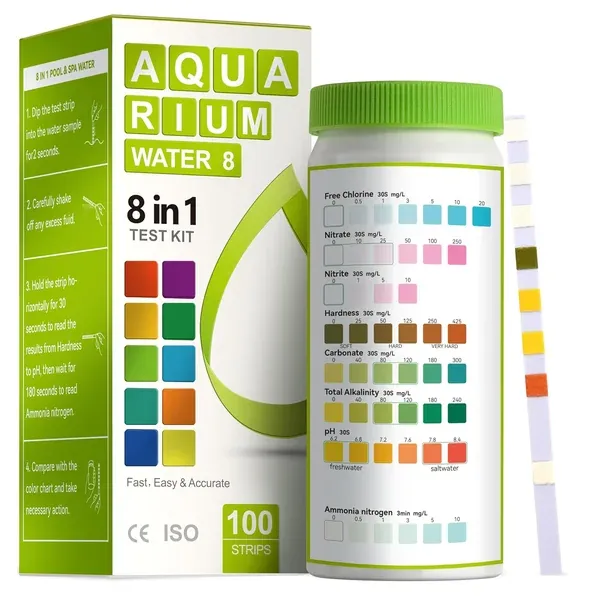
The AAwipes Aquarium Ammonia Test Strips 8-in-1 (model K02-100) is a 100-count test strip kit developed, according to the manufacturer, by experts for fish enthusiasts. Each strip carries pads for eight water-quality parameters: Free Chlorine, Nitrate, Nitrite, Total Hardness, Sodium Chloride, Total Alkalinity, pH, and Ammonia nitrogen. The strips are made with high-quality fiber paper and are engineered with non-bleeding colors to prevent adjacent pads from interfering with each other — a construction detail the manufacturer highlights as a mark of professional-grade quality.
The kit is positioned for freshwater aquariums, saltwater tanks, ponds, pools, and shrimp tanks, making it broadly applicable rather than single-environment specific.
How It Works
The manufacturer describes a three-step process. First, dip the strip into tank water for two seconds (pads 1–7) — pad 8, the Ammonia nitrogen pad, requires a separate five-second dip. Second, remove the strip without shaking off excess water and hold it horizontally: 30 seconds for pads 1–7, and a full 180 seconds (three minutes) for the Ammonia pad. Third, compare the developed colors against the included chart. AAwipes claims up to 99% accuracy when this procedure is followed correctly.
The extended wait time for the Ammonia pad is worth noting. Unlike the other seven parameters, which resolve in half a minute, ammonia results demand patience — skipping or shortening the 180-second development window will likely compromise accuracy.
Build Quality and Shelf Life
According to the manufacturer, strips are packaged in a well-sealed bottle designed to protect against moisture and other environmental factors that degrade reagent pads over time. No specific expiration window is stated in the available listing materials, but the sealed-bottle format is a standard and practical approach to extending usable shelf life. The fiber-paper construction and non-bleeding color formulation are cited as differentiators from lower-cost alternatives.
Real-World Fit: Who It Suits, Who Should Skip
This kit is well-suited for hobbyist aquarists who want a quick, routine snapshot of tank conditions between deeper liquid-reagent tests. The manufacturer recommends testing at least twice a week, and at 100 strips per bottle, the supply supports roughly six to seven weeks of twice-daily checks or several months of twice-weekly monitoring. The broad compatibility across freshwater, saltwater, ponds, and shrimp tanks adds practical versatility.
Hobbyists who need highly precise ammonia readings — for example, during a new tank cycle where early ammonia detection is critical — should be aware of a broader category limitation. Community discussion on the Aquarium Co-Op forum (https://forum.aquariumcoop.com/topic/26604-finding-the-problem-with-aco-ammonia-test-strips/ and https://forum.aquariumcoop.com/topic/24229-ac-test-strips-not-accurate/) highlights ongoing accuracy concerns with ammonia test strips as a format, with users who are water-quality professionals noting specific reliability issues independent of brand. While that forum discussion centers on a competitor's strips, it reflects a well-documented category-wide limitation: strip-based ammonia testing is generally considered a screening tool rather than a precision measurement. Hobbyists managing critical fish health situations — disease treatment, cycling, or recovery — may want to confirm ammonia readings with a liquid drop test kit.
Honest Limitations
- Ammonia accuracy caveat: Strip-format ammonia tests are widely recognized in the aquarium hobby as less precise than liquid reagent kits. The 180-second development window adds procedural complexity, and any deviation from the protocol can affect results.
- No independent third-party verification cited: The 99% accuracy claim comes from the manufacturer; no independent lab validation is referenced in available materials.
- Color-matching subjectivity: Like all colorimetric strip tests, results depend on the user's ability to match developed pad colors to a printed chart under consistent lighting — a process that introduces human variability.
- Ammonia pad protocol is separate: The two-step dipping procedure (pads 1–7 first, pad 8 separately) adds a small but real complexity versus kits where all pads dip simultaneously.
Darrell Steward
1 Feb, 2021Brilliant
This is the best product that has ever been made. It is also one of the best items in the world right now. Definitely go for it.
Albert Flores
17 Oct, 2020Just WOW
It's good to use this product for development as it has very good performance, display quality and all other features.