What It Is and Key Specs
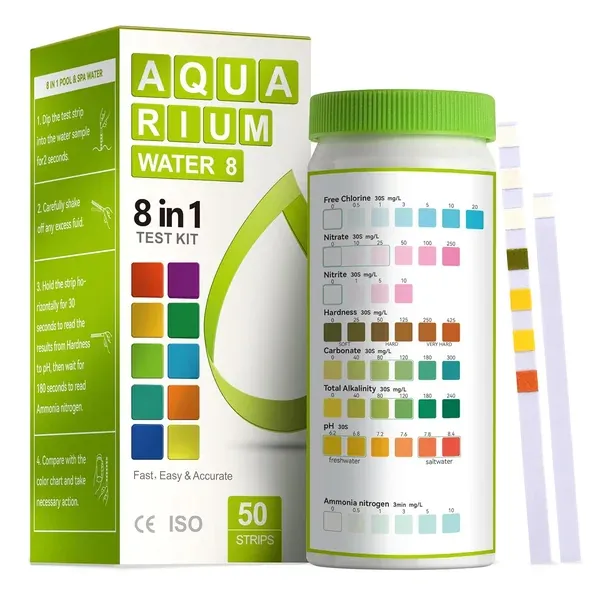
The AAwipes K02-50 is a single-bottle pack of 50 test strips, each carrying eight reagent pads. According to the manufacturer listing and supporting product pages on aawipes.com, the eight parameters covered are:
- Free Chlorine
- Nitrate
- Nitrite
- Hardness
- Carbonate (listed on manufacturer product pages as "Carbonate," though the Amazon bullet uses "Sodium Chloride" — a discrepancy worth noting)
- Total Alkalinity
- pH
- Ammonia Nitrogen
The strips are constructed from high-quality fiber paper with non-bleeding colors, according to the manufacturer. A 150-strip variant (K02-1500) and a 100-strip variant (K02-1000) are also available through aawipes.com for higher-volume users.
How to Use It
The manufacturer specifies a three-step process. Dip the strip into water for two seconds (pads 1–7), then remove it without shaking off excess water and hold it horizontally. Pads 1–7 are read after 30 seconds; Pad 8 (Ammonia Nitrogen) requires a separate five-second dip and a full 180-second wait before reading. Results are interpreted by comparing pad colors against the included chart, with the manufacturer claiming up to 99% accuracy.
Experts cited in the listing recommend testing aquarium water at least twice a week to maintain optimal water quality — a useful benchmark for planning strip consumption across the 50-strip supply.
Build Quality and Shelf Life
The strips ship in a well-sealed bottle designed to protect against moisture and environmental degradation, per the manufacturer. This packaging approach is standard for reagent-based test strips and is intended to preserve effectiveness over the product's shelf life. The fiber paper construction with non-bleeding colors is positioned as a professional-grade material choice, distinguishing it from basic dye-paper alternatives, according to the product listing and aawipes.com.
Real-World Fit: Who It Suits, Who Should Skip
Based on the listing and coverage from
reviewaqua.com, this kit is designed for both novice and experienced fish enthusiasts. Its broad compatibility — freshwater tanks, saltwater tanks, ponds, pools, shrimp tanks — makes it a versatile tool for hobbyists managing multiple water environments.
The at-home convenience factor is real: there is no need to send water samples to a lab, and the multi-parameter strip format consolidates what would otherwise require several separate tests.
Who may want to look elsewhere: Aquarists who need highly precise, parameter-specific readings — particularly for Ammonia and Nitrite in sensitive reef or breeding setups — often prefer liquid drop test kits, which generally offer finer color gradations. Strip-based kits as a category are better suited to routine trend-monitoring than to diagnosing acute, subtle imbalances.
Honest Limitations
- Parameter labeling inconsistency: The Amazon listing bullet lists "Sodium Chloride" as one of the eight parameters, while the manufacturer's own product pages (aawipes.com) consistently list "Carbonate" in that slot. Buyers should verify the current strip configuration matches their testing needs before purchasing.
- Ammonia pad requires separate handling: The two-step dipping protocol — standard pads at two seconds, Ammonia pad at five seconds, then a three-minute wait — adds friction compared to single-dip strips. Rushing the Ammonia read risks inaccurate results.
- 50-strip supply at twice-weekly testing: Testing twice a week as recommended exhausts the bottle in roughly 25 weeks. Higher-frequency monitoring or multi-tank households may find the 100- or 150-strip variants more economical.
- 99% accuracy claim is manufacturer-stated and not independently verified in the sources available for this review.
Darrell Steward
1 Feb, 2021Brilliant
This is the best product that has ever been made. It is also one of the best items in the world right now. Definitely go for it.
Albert Flores
17 Oct, 2020Just WOW
It's good to use this product for development as it has very good performance, display quality and all other features.