What It Is and Key Specs
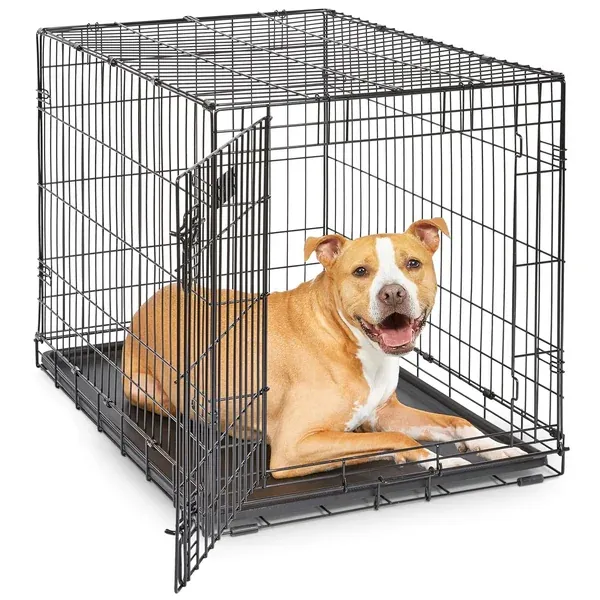
The MidWest iCrate 36-Inch Single Door is a folding metal wire dog crate aimed at medium to medium-large breeds in the 41–70 lb range. According to the manufacturer listing, it measures 36.5 x 23.25 x 24.75 inches and is sized for breeds such as Bulldogs, Beagles, and Whippets. The crate ships with a divider panel, a leak-proof plastic tray, rubber feet, a carry handle, and requires no tools to assemble. The wire body carries a protective black e-coat finish intended to resist rust and everyday wear.
MidWest notes that dogs approaching the upper end of the 70 lb weight range may be better served by the brand's 42-inch model — a candid sizing caveat worth taking seriously before purchasing.
Build Quality and Safety
MidWest emphasizes what it calls precision welding, rounded corner clips, and slide-bolt latches equipped with a proprietary "Paw Block" feature. Together, these are designed to reduce the risk of snags, cuts, and escapes — concerns that matter especially for determined or anxious dogs. The brand states the iCrate undergoes rigorous safety testing, and the e-coat finish is positioned as a durability measure against rust and wear over years of use.
The rubber feet help stabilize the crate on hard floors, reducing shifting and noise — a small but practical detail for overnight or unsupervised use.
Real-World Fit: Who It Suits
This crate is well-suited to owners who are actively crate training, particularly those raising puppies. The included divider panel allows the interior space to be sectioned off for a young dog and then expanded as the animal grows — eliminating the need to purchase a second crate. The manufacturer highlights large openings and low entry thresholds as features that ease the acclimation process and help dogs feel less confined.
A customer account published on the MidWest Homes for Pets website (midwesthomes4pets.com) describes purchasing the 36-inch model with a divider specifically for a black Labrador puppy, citing the crate's suitability for overnight use and periods when owners are away from home. This aligns with the product's positioning as a housetraining-focused crate.
The folding design and integrated carry handle make this a reasonable option for owners who need to move the crate between rooms or transport it occasionally, though it is not designed as a travel carrier for vehicles or air travel.
Honest Limitations
A few limitations are worth flagging based on the listing itself:
- Single-door configuration: This review covers the single-door version only. Owners who want front and side access — useful in tighter spaces or for training flexibility — would need to look at MidWest's double-door variant.
- Size ceiling: MidWest explicitly advises sizing up to the 42-inch model for dogs near the 70 lb upper limit. Buyers should measure their dog and not assume the 36-inch is adequate simply because their dog falls within the stated weight range.
- Wire construction: Like most wire crates, the iCrate is not a chew-proof or escape-proof solution for highly anxious or destructive dogs. It is designed for general crate training, not containment of dogs with severe separation anxiety.
- Finish durability over time: While the e-coat is marketed as rust-resistant, no finish on a wire crate is indefinitely immune to wear, particularly in humid environments or with heavy use.
Brand Context
MidWest Homes for Pets is a family-owned company headquartered in Indiana. The manufacturer's listing cites over 100 years of pet product experience and US-based customer service. For buyers who weigh brand longevity and domestic support availability, that context may carry some weight alongside the product's specifications.
Darrell Steward
1 Feb, 2021Brilliant
This is the best product that has ever been made. It is also one of the best items in the world right now. Definitely go for it.
Albert Flores
17 Oct, 2020Just WOW
It's good to use this product for development as it has very good performance, display quality and all other features.