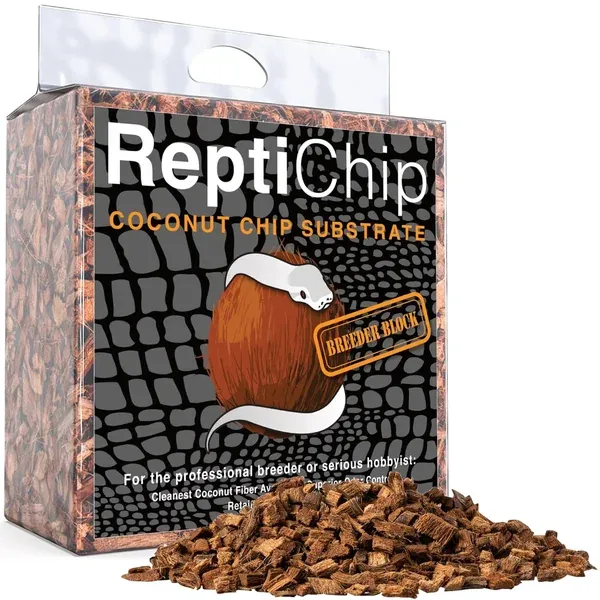
What It Is and Key Specs
The ReptiChip Reptile Substrate Coconut Chip Bedding Breeder Block is a single compressed brick that yields 72 quarts — roughly 10 lbs — of coconut husk chip bedding once water is added. The material is derived from coconut husk, processed into chunky chips rather than fine coir, and is marketed as 100% organic and free of dust and dirt. According to the manufacturer, the block is designed for professional breeders and serious hobbyists who maintain large enclosures or multiple animals.
Hydration is the activation step: add water to the compressed block, allow it to expand, and the substrate is ready for the enclosure. The manufacturer lists compatibility with ball pythons, leopard geckos, bearded dragons, turtles, tortoises, and hermit crabs — making it a broadly applicable choice rather than a species-specific product.
Build Quality and Material Safety
ReptiChip states the coco chips are "meticulously cleaned to ensure a dust and dirt free" substrate, an important distinction from lower-processed coconut products that can introduce respiratory irritants into an enclosure. The listing describes the sourcing process as involving "extensive research" to identify "the highest quality coconut husk in the world," with attention paid to processing, packaging, and delivery with environmental impact in mind.
The organic, plant-derived composition means no synthetic dyes, chemical treatments, or artificial binders are listed as ingredients. For keepers who prioritize natural, additive-free bedding, this aligns with what the manufacturer publishes. Independent verification of these claims is not available through the sources used for this review.
Humidity management is the central functional claim. The manufacturer describes the substrate as having "superb humidity retention" suited to tropical and moderate-to-high humidity setups. ReptiChip's own substrate guide (reptichip.com/blogs/the-blog/a-guide-to-choosing-your-substrate) positions ReptiChip coconut chip as "the go-to for many snake species, lizards, and amphibians that thrive in moderate to high humidity environments, offering a comfortable and naturalistic bedding for burrowing and general habitation."
Coco husk chips are also noted for their odor-absorbing properties. The listing states the substrate "encapsulates waste product," helping keep the enclosure environment healthier and reducing household odors — a practical consideration for indoor reptile rooms.
Real-World Fit: Who It Suits and Who Should Skip
This product is well-matched for keepers housing humidity-dependent species — ball pythons, tropical tortoises, and freshwater turtles are explicitly called out — who also want a bioactive-compatible, natural-looking substrate. The 72-quart yield is a meaningful volume, making it most cost-effective for large enclosures (4×2 footprints and up) or breeders maintaining multiple tubs or tanks simultaneously.
Keepers housing arid-environment species — such as bearded dragons in drier setups, central Asian tortoises, or certain gecko species — should evaluate carefully. While the listing mentions bearded dragons and leopard geckos, the substrate's primary selling point is humidity retention, which may work against the lower-humidity conditions those animals often require. ReptiChip's own guide notes this product suits "moderate to high humidity environments," which is a meaningful qualifier.
First-time reptile owners with a single small enclosure may find the 72-quart volume more than they need in a single purchase cycle.
How It Compares in Its Category
According to ReptiChip's published substrate guide, the brand also offers a product called RediChip, positioned alongside ReptiChip as part of their lineup for different needs. The guide describes ReptiChip coconut chip as the standard recommendation for humidity-favoring species, suggesting RediChip fills a different niche — though the guide does not elaborate further in the available excerpt. Buyers with specific substrate needs beyond high-humidity setups may want to consult that guide before selecting a product.
Honest Limitations
- Requires preparation: The block must be hydrated before use, which takes time and space. This is standard for compressed coco substrates but worth noting for keepers expecting a pour-and-go product.
- Volume may be excessive for small setups: 72 quarts is a large yield. Unused, hydrated substrate requires storage and has a finite shelf life once wet.
- Humidity claims are directional, not quantified: The manufacturer does not publish specific humidity retention data (e.g., hours of retention at a given ambient RH), so keepers managing precise microclimates should plan to supplement with misting or foggers as needed.
- Arid species mismatch risk: Despite the listing mentioning bearded dragons, the substrate's core strength — humidity retention — can be a liability for species requiring dry conditions if not managed carefully.
Reader Sentiment
Across more than 5,200 Amazon ratings, readers give the ReptiChip Breeder Block a 4.7 out of 5 aggregate score, indicating strong overall satisfaction among a large and diverse buyer base.