What It Is and Key Specs
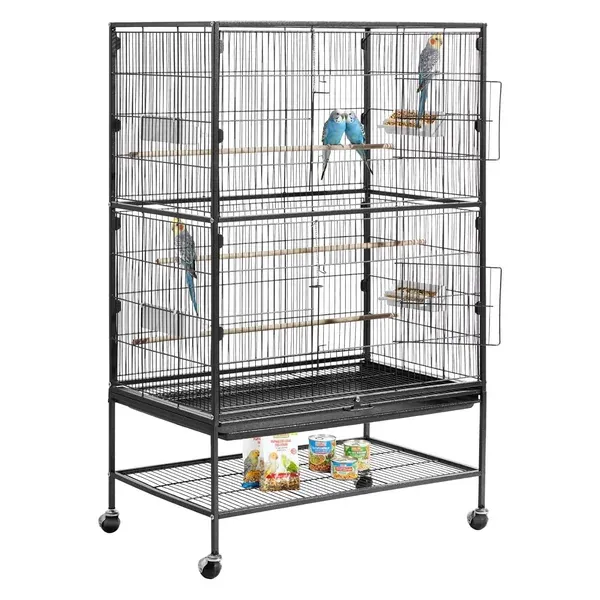
The VEVOR flat-top flight cage measures 31.5 inches long by 20.5 inches wide by 52 inches tall overall, with the usable interior cage space listed by the manufacturer at 31.5 x 20.5 x 37.6 inches — the remainder of the height accounts for the rolling stand. Bar spacing is 0.6 inches, which the manufacturer states is appropriate for 3–4 medium birds including conures, lovebirds, budgies, monk parakeets, and long-tailed parakeets. The frame is wrought iron with a powder-coated black finish for water and rust resistance. Four 360° swivel casters allow the entire unit to roll freely.
Included accessories cover the practical basics: multiple perches, horizontal wires for gripping and resting, plastic feeders (chosen specifically to reduce beak damage compared to metal alternatives, per the listing), a lower storage shelf for food and supplies, and a slide-out bottom tray with a metal grate above it to separate birds from waste.
Build Quality and Safety
VEVOR describes the construction as featuring a "stable frame structure, thickened tubes, and fences" engineered to withstand deformation, paired with a secure lock to prevent escapes. The powder-coated finish is positioned as the primary rust and moisture barrier — a practical concern for a cage that the caster system is designed to move between indoor and outdoor settings.
A note on bar spacing: VEVOR's own broader guidance (
vevor.com) recommends 0.4–0.5-inch bar spacing for smaller birds such as budgies and canaries to prevent injury or escape. The 0.6-inch spacing on this model sits outside that recommended range for the smallest species listed on the label. Prospective buyers housing very small birds should weigh this carefully before purchasing.
Published buyer reviews across comparable VEVOR flight cages in the same line (
vevor.com,
vevor.com) highlight assembly as a positive: buyers note clear instructions and well-designed parts that make setup "quick and stress-free." Reviews for the brand's 60-inch and 64-inch variants (
vevor.com) include comments that the cage is "better made than popular brands," though individual reviewers also flag size-related caveats, suggesting expectations should be calibrated to the specific model dimensions.
Real-World Fit: Who It Suits, Who Should Skip
This cage is a reasonable fit for owners housing 2–4 medium-sized birds — cockatiels, conures, monk parakeets, or lovebirds — who want a self-contained unit with mobility between rooms or from indoors to a sheltered balcony. The caster system and integrated stand mean no separate furniture is needed, and the storage shelf adds genuine everyday convenience.
The cage is less well-suited to:
- Very small birds (canaries, budgies): The 0.6-inch bar spacing exceeds VEVOR's own small-bird guideline of 0.4–0.5 inches and may pose a safety risk.
- Large parrots: At under 32 inches in length and with 0.6-inch bar spacing, the structure is not designed for macaws, large African greys, or similarly sized birds that require heavier gauge bars and wider footprints.
- Permanent outdoor placement: The powder coat provides moisture resistance, but no weatherproofing claim is made for sustained outdoor exposure to rain or UV.
Honest Limitations
No product is without trade-offs, and this cage has a few worth naming plainly:
- Bar spacing ambiguity: The 0.6-inch gap is positioned for medium birds, but canaries and budgies appear on the product title. VEVOR's own published guidance (vevor.com) identifies 0.4–0.5 inches as the safe range for those smaller species.
- Plastic feeders: While plastic reduces beak wear, it is less durable than stainless steel over time and may require earlier replacement.
- Interior versus total height: The 52-inch overall height includes the stand; the actual cage interior is 37.6 inches tall — a distinction that matters when assessing usable flight space versus floor footprint.
- Caster surface compatibility: 360° swivel casters perform well on smooth flooring; deep-pile carpet or uneven surfaces may impede movement.
Darrell Steward
1 Feb, 2021Brilliant
This is the best product that has ever been made. It is also one of the best items in the world right now. Definitely go for it.
Albert Flores
17 Oct, 2020Just WOW
It's good to use this product for development as it has very good performance, display quality and all other features.