What It Is and Key Specs
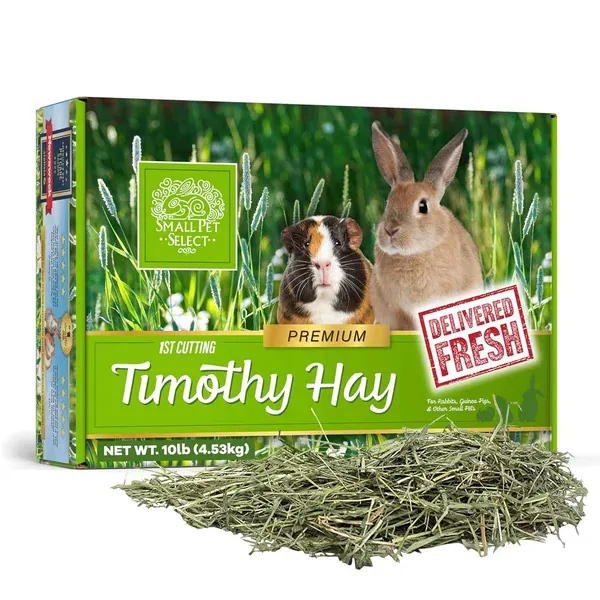
Small Pet Select 1st Cut Timothy Hay is a single-ingredient, 100% US-grown timothy hay sold in a 10-pound corrugated box. The "1st cut" designation refers to the first harvest of the season, which the manufacturer describes as featuring the highest fiber content of their hay varieties, along with more flower heads and a higher stem content than later cuttings. According to the brand's published coverage, this variety is specifically recommended for animals with chronic GI or digestive tract issues, those needing additional dental wear, or those that need to manage their weight. The listing notes that each box provides a mix of protein, fiber, and fat, though no specific nutritional percentages are provided on the Amazon detail page.
Build Quality and Packaging
One of the more distinctive claims here is the packaging approach. Rather than compression-packing — a common method that can damage stem and leaf integrity — Small Pet Select ships the hay in a high-strength corrugated box. The brand frames this as both a quality-preservation decision and a practical storage solution. The box design is also noted as doubling as an enrichment item, since small animals can dig into it directly. For buyers who have received other brands' hay in tightly compressed bales and noticed dusty or broken stems, this non-compression model is a meaningful differentiator, according to the manufacturer's own framing.
What 1st Cut Means for Your Pet
Not all timothy hay cuts are equivalent, and the cut matters depending on the animal's health status. Per Small Pet Select's published guidance, 1st cut is slightly less soft than 2nd or 3rd cutting. The tradeoff is that it delivers the highest fiber content of their hay varieties — a relevant consideration given that hay should typically comprise over 80% of a small herbivore's diet, as the brand notes in its editorial coverage. The higher stem content is specifically called out as useful for wearing down overgrown teeth, making this cut a common recommendation from exotic-animal veterinarians for dental health maintenance. Animals needing a softer, more palatable texture may do better with a 2nd or 3rd cut.
Real-World Fit: Who It Suits, Who Should Skip
This product is well-matched for:
- Rabbits, guinea pigs, and chinchillas that need high-fiber dietary support or are prone to GI slowdowns.
- Pets with dental wear concerns, where the higher stem content provides a functional benefit.
- Owners who want US-sourced, minimally processed hay and are willing to pay a premium over big-box store alternatives.
- Hamsters, gerbils, mice, rats, and ferrets that use hay primarily as bedding rather than a dietary staple.
Buyers who may want to look elsewhere:
- Those whose pets are already on a 2nd or 3rd cut and have shown reluctance to accept the coarser texture of 1st cut — the manufacturer acknowledges that small animals can be picky.
- Owners managing very tight budgets who prioritize volume over sourcing specifics, as value-tier hay options typically exist at lower price points.
Honest Limitations
A few considerations worth noting before purchasing:
1. Texture selectivity: The manufacturer explicitly acknowledges that some animals may reject this hay, which is why a satisfaction guarantee is offered. The coarser, stemier profile of 1st cut is a genuine palatability variable for some pets.
2. No third-party nutritional verification: The listing references a "great mix of protein, fiber, and fat" but does not publish a guaranteed analysis on the Amazon page, making direct nutritional comparison with other brands difficult.
3. Weight vs. Volume: At 10 pounds, the uncompressed box will occupy more physical space than a compressed bale of equivalent weight — a practical consideration for buyers with limited storage.
4. Single sourcing channel: Availability may vary, and the product is primarily sold through Amazon and the brand's own website rather than through broad retail distribution.
Satisfaction Guarantee
Small Pet Select includes a stated 100% satisfaction guarantee for both owner and pet. This is a meaningful backstop given the acknowledged risk of palatability rejection, and it lowers the risk of a first-time purchase with a discerning animal.