What It Is and Key Specs
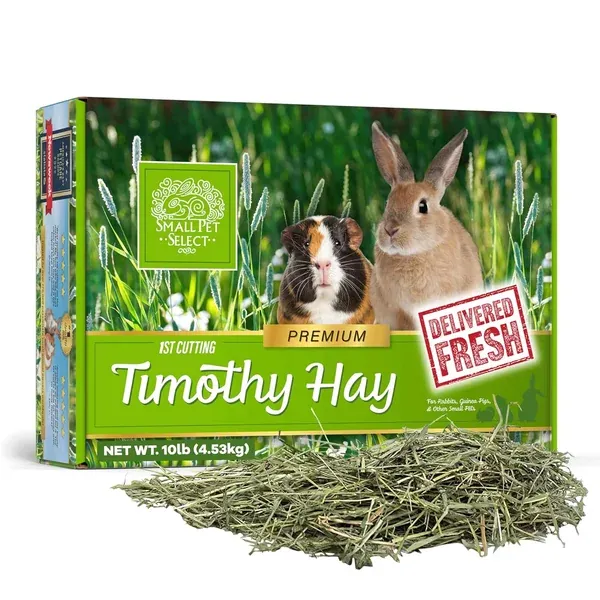
Small Pet Select's 1st Cut Timothy Hay is a 10-pound box of hand-selected, first-cutting timothy hay grown entirely in the United States. According to the manufacturer's listing and product page, first-cut timothy hay carries a higher fiber content and more flower heads than second or third cuttings, along with a greater proportion of coarse stems. The brand ships it in a high-strength corrugated box without compression packing — a deliberate choice, the company says, to preserve stem and leaf integrity. The intended species list is broad: rabbits, guinea pigs, chinchillas, hamsters, gerbils, mice, rats, ferrets, and other small animals.
Build Quality and Freshness Approach
Because this is an agricultural product rather than a manufactured item, "build quality" translates to handling and packaging integrity. Small Pet Select states that each box is hand-packed in small batches, which the company positions as a way to maintain quality control over what arrives at the door. The no-compression shipping method is meant to keep strands long and structurally intact rather than crushed into a dense block — a practical concern for a product whose physical texture is part of its function. The brand also markets the packaging as earth-friendly and notes the corrugated box doubles as a digging enrichment surface for curious small pets.
Dental Wear and Digestive Health Claims
Both the Amazon listing and Small Pet Select's own editorial content (
smallpetselect.com) explain the nutritional profile of first-cut timothy hay in consistent terms. The higher stem content is specifically cited as useful for wearing down overgrown teeth, which is a genuine concern in rabbits and guinea pigs whose teeth grow continuously. The company's blog notes that first-cut timothy hay is "specifically recommended for animals with chronic GI/digestive tract issues, those needing dental wear, or those aiming to shed a few pounds" — making it a more targeted choice than softer second- or third-cut varieties. The tradeoff, acknowledged by the manufacturer, is that first-cut is slightly less soft than later cuttings, which means pickier eaters may show less enthusiasm for it.
Real-World Fit: Who It Suits, Who Should Skip
This hay is a reasonable match for small-animal owners who prioritize digestive fiber and dental maintenance over palatability. Per Small Pet Select's own guidance, it suits pets with chronic gastrointestinal issues, animals prone to dental overgrowth, or pets that need to manage their weight. The coarser texture also makes it functional as bedding for species like hamsters and gerbils that like to burrow and nest.
Pet owners with particularly finicky eaters — or those whose animals strongly prefer the softer texture of second- or third-cut hay — may find the first cut meets resistance. The manufacturer acknowledges this directly through its 100% satisfaction guarantee, which is a candid admission that palatability preferences vary. Owners of younger animals or those without specific fiber or dental concerns might find a softer cutting a better daily staple, though first-cut remains appropriate for general feeding as well.
Category Context
Within the premium small-animal hay segment, first-cut timothy is generally characterized by coarser texture and higher stem-to-leaf ratios compared to later cuttings — a distinction consistent across the category, not unique to this brand. Small Pet Select positions itself against mass-market hay through small-batch handling and no-compression shipping, differentiators that are difficult to verify without direct comparison but are clearly central to the brand's value proposition.
Honest Limitations
A few limitations are worth noting for prospective buyers. First, the coarser texture that makes this hay useful for dental wear is the same quality that can make it less appealing to picky eaters — the manufacturer's own guarantee implicitly acknowledges this. Second, hay is a perishable agricultural product, and quality can vary between harvests; the small-batch, hand-selected process is intended to mitigate this, but it cannot eliminate natural variability entirely. Third, at 10 pounds, the box is practical for multi-pet households or owners committed to regular hay feeding, but buyers with a single small pet should consider storage conditions to maintain freshness over time. Finally, the listing does not provide specific guaranteed analysis figures (protein percentage, fiber percentage) directly in the product description, so owners managing animals with precise dietary needs may want to consult the brand's website for nutritional details before purchasing.
Reader Sentiment
Across 2,144 Amazon ratings, readers give this hay an aggregate score of 4.5 out of 5 — a strong signal of general satisfaction, though individual experiences with palatability and freshness will always vary depending on the specific animal and harvest batch.