What It Is and Key Specs
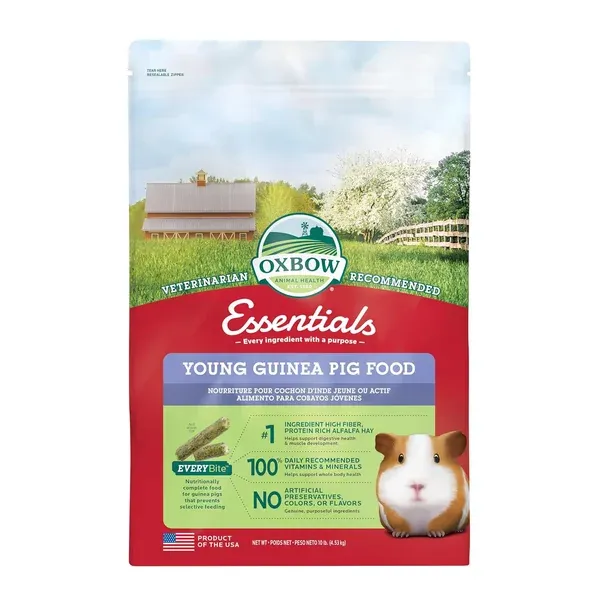
Oxbow Essentials Young Guinea Pig Food is a pelleted diet built on alfalfa hay as its primary ingredient. According to the manufacturer, it is formulated to provide high fiber, protein, calcium, and stabilized vitamin C — the key nutrients guinea pigs cannot synthesize on their own. The listing covers a 10 lb. Bag, and the formula is explicitly intended for young, pregnant, and nursing guinea pigs.
The pellets are uniform in shape and size, a deliberate design choice that, per the manufacturer, discourages selective eating — a common behavior in guinea pigs that can lead to nutritional imbalance when feeding mixed-ingredient foods.
Build Quality and Nutritional Integrity
As described on the Oxbow Animal Health product page, the food begins with high-fiber, protein-rich Oxbow Alfalfa hay and adds balanced sources of protein and calcium to support muscle and bone development. The inclusion of stabilized vitamin C is nutritionally significant: guinea pigs, like humans, cannot produce their own vitamin C and depend entirely on dietary sources. Stabilized forms are preferable in pelleted foods because raw vitamin C degrades quickly.
The formula is produced in the USA with domestically sourced ingredients, as stated in the manufacturer's feature bullets. The product carries a veterinarian-recommended designation, which the listing attributes to its complete nutritional profile for the target life stage.
Real-World Fit: Who It Suits, Who Should Skip
This food is designed for a specific and well-defined audience: guinea pigs under roughly six months of age, as well as pregnant and nursing sows. For these animals, the higher protein and calcium content delivered by alfalfa hay is appropriate for the demands of growth, gestation, and lactation.
Healthy adult guinea pigs, however, are a different story. The adult-formula listing on Vet Shop Australia explicitly notes that Essentials Adult Guinea Pig Food "is not intended for growing, gestating or lactating animals" and directs owners back to the Young formula for those life stages — confirming these two products are not interchangeable in either direction. The manufacturer's own Oxbow Australia resource on adult guinea pig feeding cautions that high-fat, calorie-dense foods fed free-choice can contribute to obesity in adult animals, and that obesity can impair coprophagy, which is essential for normal gastrointestinal health in guinea pigs. Owners of adult guinea pigs should transition to an appropriate timothy-hay-based adult pellet rather than continuing on this formula.
For the correct audience — young cavies and breeding/nursing sows — this product appears purpose-built and well-supported by nutritional rationale.
How It Compares in the Category
Alfalfa-based pellets are the broadly accepted standard for young guinea pig diets across the small-animal nutrition category, owing to alfalfa's higher protein and calcium density compared to grass hays such as timothy. Oxbow's approach of building the pellet directly from its own branded alfalfa hay, rather than generic alfalfa meal, is consistent with the company's positioning as a premium, specialty small-animal brand. This review synthesizes the product listing and manufacturer information rather than independent lab analysis, so a direct nutritional comparison to competing products is not made here.
Honest Limitations
A few considerations are worth flagging before purchase:
- Life-stage specificity is a hard line. This formula is not suitable for adult guinea pigs and should be phased out as the animal matures — typically around six months, or once nursing/pregnancy ends. Continuing to feed it to adult animals risks excess calcium and caloric intake.
- Vitamin C stability over time. Stabilized vitamin C is an improvement over unstabilized forms, but it still degrades with heat, light, and time. Buyers should check the bag's best-by date and store it in a cool, dry location after opening.
- Weight management caveats apply. The Oxbow Animal Health product page notes that overweight or underweight animals may have different feeding requirements, suggesting owners consult a veterinarian in those cases rather than relying solely on standard feeding guidelines.
- No hands-on testing data available. This review is based on the product listing, manufacturer-published information, and available web sources — not independent palatability or digestibility testing.