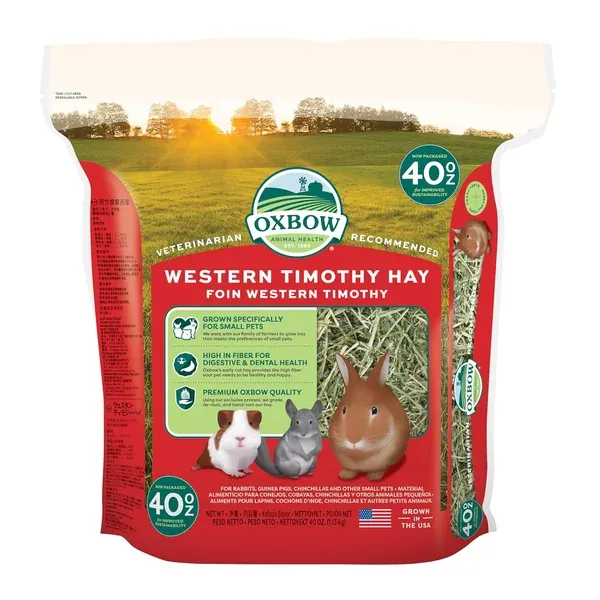
What It Is and Key Specs
Oxbow Western Timothy Hay is an all-natural grass hay sold in a 40-ounce single pack. According to Oxbow Animal Health's own product page, it is described as a "nutritious, sweet-smelling grass" intended to stimulate the appetite of rabbits, guinea pigs, chinchillas, and other small pets. The listing highlights high fiber content as the product's defining nutritional characteristic, positioning it as a digestive and dental health support for daily feeding.
The hay is marketed as hand-selected and sourced from a family of U.S. Farms, with de-dusting as a processing step — both details drawn directly from the manufacturer's listing. It is not a blended or fortified product; it is a single-ingredient grass hay.
Build Quality and Freshness
Oxbow describes the hay as "green, aromatic," and "fresh," with careful harvesting meant to ensure consistent texture and freshness. The manufacturer's listing notes that hand-sorting and de-dusting are part of the process, which in theory reduces the fine particulate matter that can irritate small-animal respiratory systems — a practical consideration often cited by small-pet owners.
Oxbow Animal Health's product page reinforces that the hay is all-natural and sourced domestically, which aligns with U.S. Quality oversight standards, though no specific third-party certification is cited in the available sources.
Real-World Fit: Who It Suits, Who Should Skip
Based on the manufacturer's listing and Oxbow's own product page, this hay is well-suited as a primary, everyday forage for:
- Rabbits and guinea pigs — Timothy hay is widely recognized by veterinarians as a foundational diet component for these species, and the listing notes vet recommendation explicitly.
- Chinchillas — Listed as an appropriate species by both the product title and Oxbow's brand page.
- Pet parents prioritizing domestic sourcing — U.S. Farm origin is a stated feature, which matters to owners concerned about supply chain transparency.
Owners may want to look elsewhere if their pet has already demonstrated a preference for a softer, second-cut timothy (this listing does not specify cut), or if they are managing a pet with a known allergy or sensitivity to timothy specifically. Alfalfa-based hays, for example, are typically recommended for very young or underweight animals — a category where this product is not the primary intended fit.
How Reader Sentiment Stacks Up
The readers' aggregate across 16,852 Amazon ratings stands at 4.6 out of 5, reflecting broad satisfaction among a large and varied buyer base. That volume of ratings lends the score meaningful weight. Positive sentiment in the listing ecosystem clusters around palatability (pets eating readily), freshness on arrival, and the green color indicating quality.
Honest Limitations
No product is without trade-offs, and community discussion surfaces a meaningful one. A thread on Guinea Pig Cages (
guineapigcages.com) documents owner reports of
batch-to-batch variability — specifically, buyers who had long-term success with the product noticing quality differences in newer bags, including changes in texture or composition that led some pets to reject it. This is a recurring concern in the small-pet hay category more broadly, but it has been raised specifically about this product in that forum.
Additionally, hay is a bulk agricultural product, and shipping and storage conditions between production and delivery can affect freshness. The de-dusting claim from the listing is a positive differentiator, but owners in some community posts noted dustier-than-expected batches, suggesting that process outcomes may not be perfectly uniform.
At 40 ounces, the pack size is moderate — appropriate for a single small pet over several weeks, but households with multiple animals may find themselves reordering frequently.
Bottom Line
Oxbow Western Timothy Hay occupies a well-established position in the small-pet hay category, backed by a vet-recommended profile, domestic sourcing, and a high readers' aggregate of 4.6/5 from over 16,000 ratings. The manufacturer's attention to hand-sorting and de-dusting reflects genuine quality intent. The primary caveat worth weighing is the community-reported variability between bags — an inherent challenge with agricultural products that prospective buyers should factor in, particularly if their pet is a picky eater.