What It Is and Key Specs
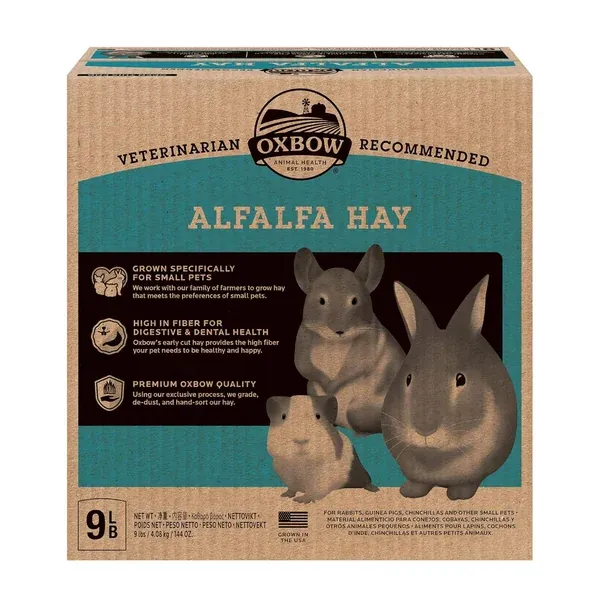
Oxbow Alfalfa Hay is a legume-based hay — as opposed to grass hay varieties like timothy or orchard — grown in the USA in what Oxbow describes as "ideal climates." The 9 lb bag is hand-sorted and de-dusted, meaning physical processing steps are taken to remove fine particulate matter before packaging. According to Oxbow's own product page, alfalfa is high in fiber, protein, and digestible energy, making it nutritionally distinct from grass hays. It is marketed as suitable for rabbits, guinea pigs, bunnies, and chinchillas, with a specific emphasis on life-stage appropriateness: growing, pregnant, or nursing animals.
The formulation is completely free of preservatives and additives, per the manufacturer, and is made in the USA.
Build Quality and Safety
Because this is a natural agricultural product rather than a manufactured item, "build quality" is better framed as sourcing and processing integrity. Oxbow states the hay is hand-sorted and de-dusted — two quality-control steps that matter meaningfully for small animals with sensitive respiratory systems. The product is described as grown with "the highest level of efficacy and safety" with the pet in mind, and comes with veterinarian recommendation, which Oxbow highlights as a mark of trust in its nutritional value.
No CPSC-related safety notices are associated with this product based on the available sources.
Real-World Fit: Who It Suits, Who Should Skip
This is where the sourcing matters most. Oxbow's own published blog guidance — "All About Alfalfa" — is direct: alfalfa hay is the ideal choice for growing, pregnant, or nursing small pets. Its high protein and high digestible energy content supports the elevated nutritional demands of these life stages.
However, Oxbow's own blog also clearly flags a limitation for healthy adult animals: the higher calcium content in alfalfa can be a potential contributor to bladder sludge over time. This is not a flaw in the product itself — it is an inherent characteristic of alfalfa as a legume hay — but it is a meaningful reason why this hay is not recommended as a primary, long-term diet for healthy adult rabbits or guinea pigs, who are typically better served by lower-calcium grass hays.
In short: if you have a young, pregnant, or nursing small pet, this product aligns well with their documented nutritional needs. If you have a healthy adult animal, it is worth consulting a veterinarian before making alfalfa a dietary staple.
Reader Reception
Among 4,291 Amazon ratings, readers have given this product an aggregate score of 4.6 out of 5 — a strong signal of broad satisfaction. While individual reviewer commentary is not reproduced here, that volume of ratings at that level suggests consistent performance in terms of palatability, freshness on arrival, and packaging integrity for the majority of buyers.
How It Compares in Its Category
Alfalfa hay occupies a distinct nutritional niche compared to grass hays. As Oxbow's own resources note, alfalfa is higher in protein, fiber, and digestible energy than typical grass hay varieties. This makes it more calorie- and nutrient-dense — a genuine advantage for animals with elevated needs, and a reason for moderation or avoidance in animals that don't. Buyers comparing alfalfa to timothy or orchard grass hay should understand these are not interchangeable products; the choice should be driven by the animal's life stage and health status, ideally with veterinary input.
Honest Limitations
- Life-stage restricted: This hay is not appropriate as a primary long-term diet for healthy adult small animals; Oxbow's own published guidance specifically calls out bladder sludge risk from the higher calcium content in alfalfa.
- Not a grass hay substitute: Pet owners accustomed to timothy or orchard grass hay should understand that alfalfa is a legume hay with a meaningfully different nutritional profile — it is not a drop-in replacement.
- Agricultural variability: As a natural crop product, batch-to-batch variation in color, texture, and moisture is common across this category of hay products generally, though Oxbow's hand-sorting process is intended to maintain consistency.
Reader Comments
No comments yet
Be the first to share your thoughts!