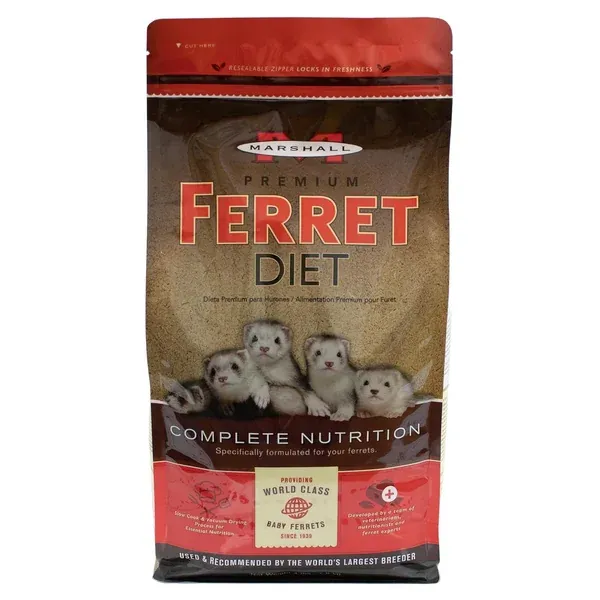
What It Is and Key Specs
Marshall Premium Ferret Diet is a dry-pellet food sold in a 4 lb bag and marketed as a complete, primary diet for ferrets at all life stages. According to the manufacturer's listing and Marshall's own nutrition page (
marshallpet.com/our-diet), the guaranteed analysis comes in at
38% crude protein, 18% fat, and 3.5% fiber — a profile the brand describes as supporting digestive health and desirable stool consistency.
Chicken appears as the second ingredient by name, but chicken by-products (organs only) and chicken by-product meal also feature prominently. The full opening ingredient panel, as listed on the product page, reads: Chicken by-products (organs only), Chicken, Chicken by-product meal, Corn meal, Dried beet pulp, Brewers dried yeast, DL-methionine, L-lysine, Choline chloride, and Sodium propionate (a preservative), with additional ingredients noted in the extended description. The inclusion of corn meal is worth noting, as ferrets are obligate carnivores with limited ability to process plant-based carbohydrates efficiently.
Development and Nutritional Claims
Marshall states on its website that the formula was developed by "a respected team of veterinarians, nutritionists, and ferret experts," and the brand bills it as its flagship diet. The company emphasizes high digestibility, low carbohydrates relative to some alternatives, and an amino acid profile — including supplemental DL-methionine and L-lysine — intended to support a carnivore's metabolic needs (
marshallpet.com/our-diet). Feeding directions specify free-choice access, daily replenishment of fresh food, clean water at all times, and limiting treats and other foods to no more than 10% of total diet.
Real-World Fit: Who It Suits, Who Should Skip
Feeders Pet Supply lists this as formulated "for ferrets to provide complete nutrition for all life stages," making it a broad-spectrum option for shelters, breeders, or owners seeking a single, accessible staple (
feederspetsupply.com). One reviewer on Influenster noted that her ferret took readily to the food and showed strong preference for it — a real consideration, since ferrets are known to imprint on early foods and can resist dietary transitions (
influenster.com).
That said, owners who prioritize a grain-free or low-carbohydrate ingredient list may find corn meal's presence a sticking point. Ferret nutrition communities frequently debate the role of plant starches in obligate carnivore diets, and this is a recurring topic in reviews of value-accessible pellet foods generally.
Honest Limitations
Published reader feedback surfaces meaningful criticism. At least one Influenster reviewer described switching away from Marshall's diet after attributing weight gain in their ferrets to it, and explicitly noted that their veterinarian did not recommend the brand (
influenster.com). The presence of corn meal and by-product meal ahead of whole chicken in the ingredient order is a factual point that informed ferret owners weigh carefully.
It is also worth noting that Sodium propionate is used as a preservative in this formula — an ingredient some pet owners prefer to avoid, though its inclusion is not uncommon across this category of dry pet foods.
Category Context
Pellet-based ferret diets that emphasize affordability and broad availability commonly include grain or plant-based binding ingredients — this is a pattern seen across the category, not a claim specific to this product. Owners who want a meat-only or raw-equivalent diet will need to look at premium grain-free kibbles or raw feeding regimens, which typically come at a higher price point and require more preparation.
Bottom Line
Marshall Premium Ferret Diet delivers on accessibility, a veterinarian-involved development process, and a macronutrient ratio that aligns reasonably with ferret dietary needs on paper. The ingredient list — particularly corn meal and the ordering of by-products — is a legitimate point of scrutiny for owners who read labels closely. Reader experiences, as reflected in published reviews, are genuinely mixed: some ferrets thrive on it, others were switched off it by owners and vets who preferred alternative formulations. Prospective buyers should weigh their ferret's current diet history, their own ingredient priorities, and their veterinarian's guidance before committing.