What It Is and Key Specs
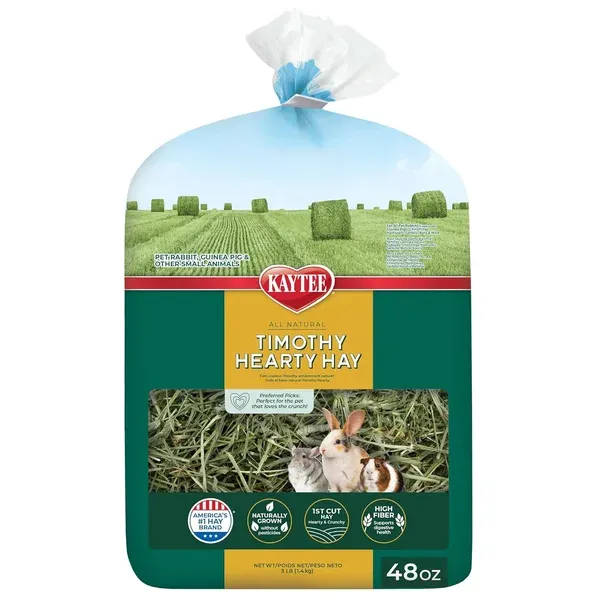
Kaytee Timothy Hearty Hay is a first-cut timothy hay packaged in a 48 oz bag and formulated for guinea pigs, rabbits, and other small animals. According to the manufacturer, first-cut hay is characterized as hearty and crunchy — a texture profile that distinguishes it from softer second- or third-cut varieties. Kaytee states the hay is hand-selected to ensure long fiber strands and a proper leaf-to-stem ratio, and that it is farmed specifically for small pets to maximize nutritional value.
The hay is naturally grown without pesticides, per the manufacturer's listing, and is sun-cured rather than kiln-dried — a process also referenced in Kaytee's broader product line documentation. The brand describes itself as America's #1 hay brand, though independent verification of that claim is not available in published sources reviewed here.
Build Quality and Nutritional Profile
From a nutritional standpoint, Kaytee emphasizes that high fiber content supports digestive health — a well-established principle for herbivorous small animals like guinea pigs and rabbits, whose gut motility depends heavily on consistent hay intake. The first-cut designation means the hay is coarser and stemmy, which provides more chewing resistance and dental wear than later cuts.
Kaytee's broader product documentation (
kaytee.com) confirms that sun-cured Timothy Grass Hay is the primary ingredient across their small animal range, lending consistency to the sourcing story. No artificial additives or preservatives are listed in the manufacturer's description of this product.
Real-World Fit: Who It Suits, Who Should Skip
This hay is a practical everyday option for owners of guinea pigs, rabbits, chinchillas, and similar herbivores who need unlimited access to long-stem fiber. The 48 oz size offers reasonable volume for single- or dual-pet households without the commitment of bulk bales.
Community discussions on Guinea Pig Cages (
guineapigcages.com) reflect a generally positive experience: multiple owners report their animals accept the hay readily, noting it arrives green and smells fresh. One owner noted their pigs went months eating it as their primary hay source without issue.
Pet owners who prioritize softer, leafier hay — such as third-cut timothy or orchard grass — may find the hearty, crunchy first-cut texture less appealing to finicky eaters. The coarser texture is a feature for dental health, not a defect, but it is worth understanding before purchasing.
Honest Limitations
No product is without trade-offs, and community feedback surfaces a recurring concern worth noting:
dust and fines accumulation at the bottom of bags. Owners on
guineapigcages.com mention finding significant dust residue, which raises a reasonable question about effective hay weight per bag. Dusty hay can also be a minor respiratory irritant for sensitive animals.
A second limitation is batch-to-batch variability. Community reviewers note that quality can depend on the individual bag, suggesting that while most purchases are satisfactory, the experience is not perfectly uniform. This is a common challenge across commercially packaged hays and is not unique to Kaytee, but it is a practical consideration for owners who need reliable consistency.
Finally, this product is loose hay, not a complete diet. Kaytee's own product ecosystem (as seen at
kaytee.com) includes pellet-based complete foods that supply vitamins and minerals hay alone cannot provide. Guinea pigs, in particular, require dietary vitamin C supplementation that hay does not deliver.
Bottom Line
Kaytee Timothy Hearty Hay earns its place as a widely available, pesticide-free, high-fiber staple for small herbivores. The first-cut profile suits animals and owners who prefer a crunchier texture, and the brand's hand-selection process and small-animal-specific farming are meaningful quality signals. Dust accumulation and occasional bag variability are legitimate shortcomings to weigh, particularly for owners of animals with respiratory sensitivities. Based on published community feedback, most owners find it a dependable everyday hay — just one best paired with a nutritionally complete pellet and fresh vegetables.
Reader Comments
No comments yet
Be the first to share your thoughts!