What It Is and Key Specs
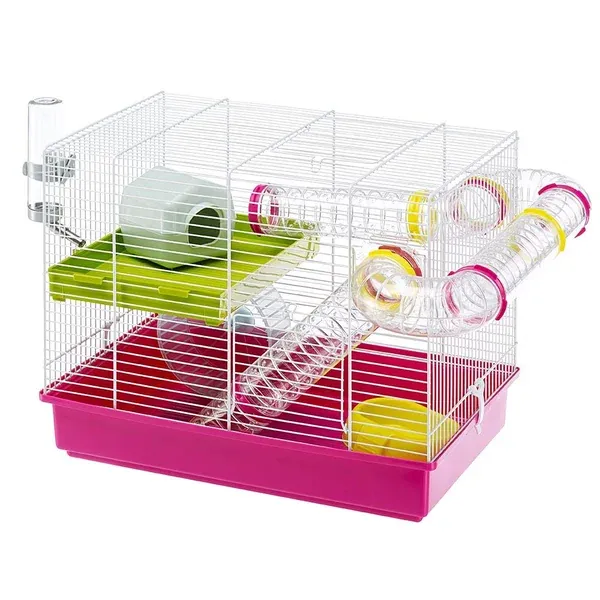
The Ferplast Laura is a small-animal habitat aimed squarely at hamster owners — particularly those setting up a first cage. According to the manufacturer's listing, it measures 18.11" L × 11.61" W × 14.76" H, with a wire mesh grid of 5.25" L × 0.5" W spacing and a plastic base that is 3.25" deep. The design pairs a wire-mesh upper section with a solid plastic lower tray, and Ferplast's own product page confirms it is "equipped with accessories for rodents, including a nest, a feeder, a drinking bottle and a plastic wheel, as well as transparent tubes inside which your little rodent can run and have fun." The cage ships ready to use, which sets it apart from bare enclosures that require separate accessory purchases.
Build Quality and Safety
The cage's construction follows Ferplast's established modular approach: a removable wire top section sits over a deep plastic base. The plastic base is described in the listing as being deep enough (3.25") to contain bedding and prevent scatter — a practical detail for everyday living with the cage. Cleaning is addressed through design: the plastic base lifts out for litter removal, while the wire top and plastic accessories are stated to be washable with a mild, hamster-safe detergent. The transparent tube system, highlighted both in the listing and on Ferplast's official product page, is an integrated play feature rather than an optional add-on.
Important: Consumers should always verify current CPSC compliance and safety recall status for any small-animal product independently before purchase, as product safety information can change.
What's Included: A Genuine Starter Kit
One of the Laura's clearest selling points is its out-of-the-box completeness. The manufacturer listing confirms the package contains:
- 1 food dish
- 1 water bottle
- 1 hamster hide-out
- 1 exercise wheel
- Play tubes
For a new owner, this eliminates the guesswork of sourcing compatible accessories separately. The tube system deserves specific mention: Ferplast positions these transparent tunnels as a habitat enrichment feature, allowing owners to observe their hamster moving through the enclosure in a naturalistic, exploratory way.
Real-World Fit: Who It Suits and Who Should Skip It
The Laura is a strong candidate for first-time hamster owners, children's starter setups, or anyone housing a single dwarf or Syrian hamster in a space-limited environment. The included accessories mean fewer immediate follow-up purchases, and the two-door access system — a top door and a front-access point — makes daily feeding and spot-cleaning reasonably convenient.
However, prospective buyers should weigh the footprint carefully. At just over 18" long and under 12" wide, this cage sits at the lower end of recommended habitat sizes. Hamster welfare guidance from many veterinary and enthusiast sources suggests that more floor space supports better physical and psychological health for hamsters, particularly Syrians. Buyers prioritizing space above all else may find the Laura's dimensions a limitation. Community coverage on Hamster Central notes that this cage has received attention among enthusiast forums, though detailed independent long-term assessments in retrieved sources are limited.
Honest Limitations
- Footprint: The 18" × 11.6" base is compact. For owners who want to prioritize maximum floor space, this cage may serve better as a temporary or travel habitat than a permanent home.
- Included accessories: While the bundled items cover the basics, the exercise wheel and other included pieces are starter-grade. Owners may choose to upgrade individual components over time.
- Tube maintenance: Transparent tube systems, while engaging for hamsters, can accumulate debris and require more detailed cleaning than open-plan cages. The listing does not specify tube diameter, which is worth confirming before purchase to ensure compatibility with the intended hamster breed.
- Wire spacing: The listed 0.5" wire spacing should be verified against the size of the specific hamster being housed, particularly for very small dwarf varieties.
Reader Sentiment
Among 1,294 Amazon ratings, readers give the Ferplast Laura a 4.2/5 aggregate — a solid mark for a cage at this price tier, suggesting that the majority of buyers find it delivers on its starter-cage promise. As always, individual experiences will vary based on hamster species, owner expectations, and how the cage is integrated into a broader enrichment routine.