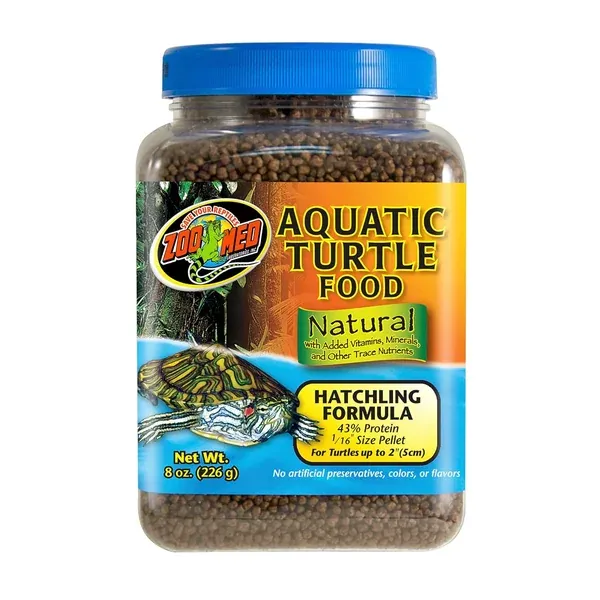
What It Is and Key Specs
Zoo Med Natural Aquatic Turtle Food — Hatchling Formula is an 8-ounce bag of floating pellets formulated for young aquatic turtles. According to the manufacturer and the Pet Supermarket listing, the guaranteed analysis reads: Crude Protein (Min) 25.0%, Crude Fat (Min) 5.0%, Crude Fiber (Max) 8.0%, Moisture (Max) 11.0%, Ash (Max) 10.0%, and Phosphorus (Min) 1.0%. Zoo Med positions the hatchling version as one of three pellet sizes and protein-level tiers in its Natural Aquatic Turtle Food lineup — the others address juvenile and adult (maintenance) stages.
The pellets are designed to float, which aligns with Zoo Med's own guidance that aquatic turtles typically prefer to locate and consume food at the water surface. That pellet behavior is a practical design choice, not just a marketing note.
Build Quality and Ingredient Integrity
Zoo Med states the formula contains no artificial preservatives, colors, or flavors, and that added vitamins and minerals support healthy growth. The product is made in the USA. Coverage from TurtleHolic notes that Zoo Med Aquatic Turtle Food "does not contain any artificial preservatives," consistent with the manufacturer's own claims.
Zoo Med describes itself as a natural food brand, and this hatchling formula appears to sit squarely within that positioning. What the publicly available sources do not detail is the full ingredient list beyond the guaranteed analysis, so buyers who need to verify specific protein sources or allergen concerns should check the physical packaging or the manufacturer's site directly.
Real-World Fit: Who It Suits, Who Should Skip
This formula is explicitly sized and calibrated for hatchlings — the smallest pellet size in the Zoo Med aquatic turtle range. Owners of very young red-eared sliders, painted turtles, map turtles, and similar common aquarium species are the primary audience. The higher relative protein level compared to the maintenance adult formula is appropriate for the growth demands of young turtles.
Owners of adult or sub-adult aquatic turtles should look at Zoo Med's Maintenance Formula instead, which the manufacturer describes as meeting dietary requirements "for maintaining your adult aquatic turtles" — a distinct product with a different nutritional profile.
Keepers who rely solely on pellets should be aware that Zoo Med's own husbandry guidance emphasizes that UVB lighting is essential for aquatic turtles to process calcium in captivity, with 8–10 hours of UVB recommended daily. A high-quality diet is only one component of proper hatchling care; lighting and habitat setup are equally important factors that no pellet food can replace.
Reader Reception
Readers on Amazon give the product a 4.6 out of 5 aggregate from 1,487 ratings — a notably strong signal of consistent satisfaction across a large sample. Published third-party coverage at TurtleHolic describes the food as "a great option," citing reasonable pricing, nutrient content, and palatability. A reviewer on Influenster, commenting on a related Zoo Med aquatic turtle food, noted turtles "appreciate" the product and described it as "a great staple to have," though that review pool is small (three reviews) and may reference a different SKU.
Honest Limitations
- Incomplete ingredient transparency from available sources. The guaranteed analysis is published, but a full ingredient list was not available in the sources reviewed here. Buyers with specific dietary concerns should verify directly.
- Pellet-only diet has inherent limits. Most reptile nutritionists and keepers recommend variety; pellets are a staple, not a complete replacement for a diverse feeding regimen.
- UVB and habitat requirements are separate costs and commitments. Zoo Med's own care guidance makes clear that food quality alone does not determine hatchling health — proper lighting and enclosure setup are non-negotiable companions to any diet.
- Package size may turn over slowly for single-turtle households. At 8 ounces, the bag suits hatchlings that eat small quantities; whether that represents good value relative to freshness depends on how quickly a given keeper cycles through food.