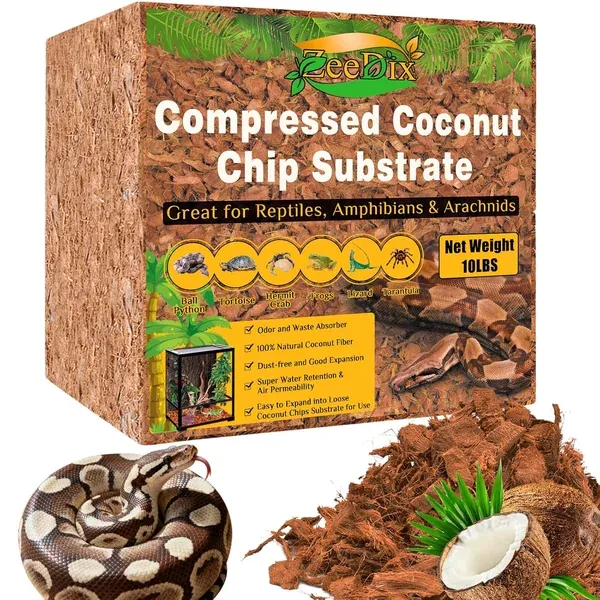
What It Is and Key Specs
The ZeeDix Coco Husk Chip Substrate ships as a single compressed brick measuring 11.8 × 5.12 × 11.8 inches and weighing 10 pounds. Once hydrated, the brick is described by the manufacturer as expanding to approximately 72 quarts of loose coconut husk chips, with individual chip sizes ranging from roughly 10 mm to 35 mm. That range of chip sizes places the material in a medium-to-coarse texture category, distinct from finer coco coir fiber or peat-based beddings.
The substrate is marketed as made from matured coconut husks and described by ZeeDix as natural, organic, dust-free, biodegradable, and compostable. The manufacturer also notes on its official site (
zeedix.shop) that its coco coir line is designed to offer moisture retention and aeration — properties that align with the humidity needs of many commonly kept reptile species.
Build Quality and Material Safety
According to the listing, the material is derived from naturally matured coconut husks and is described as free of added chemicals or synthetic components. The chips are characterized as clean, breathable, and compostable, which are attributes associated with responsibly sourced coco husk products in general.
No independent third-party safety certifications or CPSC-specific compliance statements were included in the provided product information. Buyers with safety certification requirements should verify directly with the manufacturer or retailer before purchasing.
Odor and Moisture Management
The manufacturer states that the coconut husk chips are designed to absorb liquids, water, and waste quickly while safely breaking down odors. The listing credits the organic composition of the material for helping maintain a clean and healthy living environment for animals. Coco husk substrates, as a category, are commonly used for humidity-sensitive enclosures because the fibrous structure of coconut shell material is known to hold moisture without becoming immediately waterlogged — though actual performance will vary depending on enclosure size, ventilation, and the specific species being housed.
How to Use It
ZeeDix specifies that the brick must be rehydrated before use. The recommended process involves placing the compressed brick in a large container, adding an appropriate amount of water, and allowing it to soak and expand. The manufacturer notes that using a mixing tool can help speed up the decomposition and loosening of the chips. This is a standard preparation method for compressed coco coir products and should be straightforward for experienced reptile keepers, though first-time buyers should factor in preparation time and the need for a suitably large container.
Real-World Fit: Who It Suits and Who Should Skip It
Based on the listing's stated applications, this substrate is a reasonable candidate for keepers of ball pythons, tortoises, geckos, lizards, snakes, frogs, tarantulas, and other reptiles or invertebrates that benefit from a loose, humidity-retaining bedding. The medium-to-coarse chip size (10–35 mm) may be better suited to medium and large animals; keepers of very small juvenile reptiles or species that burrow through fine substrate may want to evaluate whether the chip size is appropriate.
The 10 LB / 72 QT yield makes this a reasonable option for keepers maintaining larger enclosures or multiple tanks, though single-tank owners with smaller setups may find the volume more than immediately needed.
Honest Limitations
- Preparation is required. Unlike ready-to-use loose substrate bags, the compressed brick format demands advance soaking and expansion time. This is not a drop-in, same-day solution.
- Chip size variability. The 10–35 mm range is fairly wide; buyers wanting a uniform chip size for aesthetic or functional reasons should be aware the material will vary within that range.
- Limited independent verification. Available web sources for ZeeDix are largely limited to the manufacturer's own site. There is no widely published third-party coverage of this specific product to corroborate performance claims beyond what the manufacturer states.
- Moisture management is enclosure-dependent. While the listing promotes humidity balance, real-world results will depend heavily on tank ventilation, ambient room conditions, and keeper husbandry practices — not the substrate alone.