What It Is and Key Specs
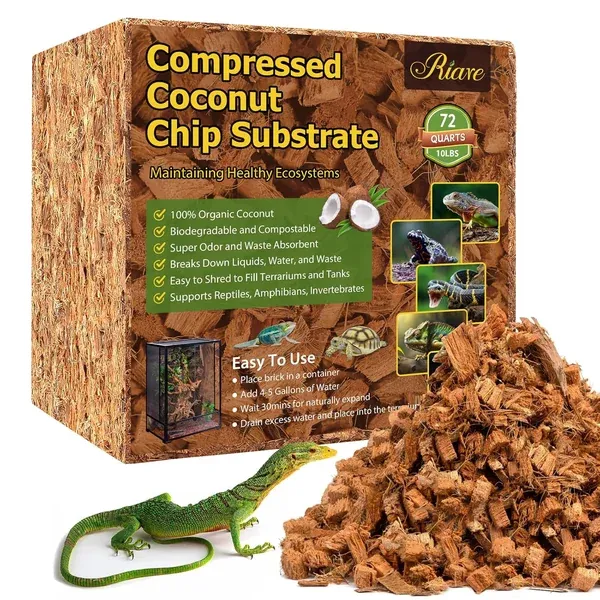
The Riare Coconut Chip Substrate arrives as a single compressed brick measuring 11.81 x 11.81 x 5.12 inches and weighing 10 lbs. According to the manufacturer, adding water causes the brick to expand to approximately 72 quarts of loose substrate — a substantial yield from a compact form factor. The material is derived from natural coconut shells, specifically the coarse outer husk, and is described by Riare as biodegradable and renewable.
The substrate is marketed toward a broad range of animals: snakes (including ball pythons), tortoises, bearded dragons, geckos, lizards, frogs, salamanders, and other burrowing animals and invertebrates. That versatility is one of the more notable selling points of the product category as a whole.
Build Quality and Material Composition
According to the listing, the chips are extracted from natural coconut shells and are described as soft, comfortable, clean, and odorless. The loose, textured surface is intended to encourage natural digging and burrowing behavior — a behavioral consideration that is relevant for many of the species listed above.
Riare states the substrate is free of added chemicals and safe for animals, though no independent third-party certifications are cited in the available listing information. Prospective buyers who prioritize lab-verified purity may want to follow up with the manufacturer directly.
Moisture Retention and Heat Management
A key functional claim from the manufacturer is that the coconut husk material offers strong water absorption and moisture retention, helping terrariums maintain appropriate humidity and temperature levels. The listing specifically mentions suitability for hibernation and egg hatching — applications where humidity stability is critical. Coconut husk substrates as a category are commonly noted for these properties, and the manufacturer's claims here are consistent with how this material type is typically positioned.
Ease of Use and Disposal
Setup requires only the addition of water: the brick expands, excess water is squeezed out, and the substrate is ready to use. The manufacturer also notes that the used substrate can be composted directly in a garden, making disposal straightforward for owners who prefer an eco-conscious routine. The listing describes the chips as having strong odor- and dirt-absorbing capabilities, which, if accurate, would reduce the frequency of full substrate changes.
Real-World Fit: Who It Suits and Who Should Skip
This substrate appears well-suited to keepers housing tropical or humidity-dependent species — ball pythons, frogs, and certain geckos among them — where moisture retention is a priority. The large post-expansion volume (72 quarts from a single brick) also makes it a reasonable value consideration for owners managing larger enclosures or multiple tanks.
Keepers of arid-environment species — such as leopard geckos, bearded dragons in dry setups, or desert tortoises — should approach with caution. While bearded dragons are listed among the compatible species, coconut husk substrates in general are typically better suited to higher-humidity environments, and owners of dry-habitat reptiles may find moisture retention more of a liability than an asset. That context is worth evaluating against a specific animal's husbandry requirements before purchasing.
Reader Reception
Across 1,103 Amazon ratings, readers have given this product a 4.6 out of 5 — a strong aggregate for a substrate in this price tier. That volume of feedback suggests the product has meaningful real-world use, though individual results will vary based on enclosure size, species, and local humidity conditions.
Honest Limitations
- No independent third-party safety certifications are referenced in the listing.
- The 72-quart yield depends on proper hydration technique; under- or over-watering during prep can affect substrate texture.
- Arid-habitat keepers should carefully consider whether a moisture-retaining substrate is appropriate for their specific species, despite some being listed as compatible.
- The listing does not specify particle size consistency, which can vary between batches in coconut husk products and may affect burrowing behavior and impaction risk for smaller animals.