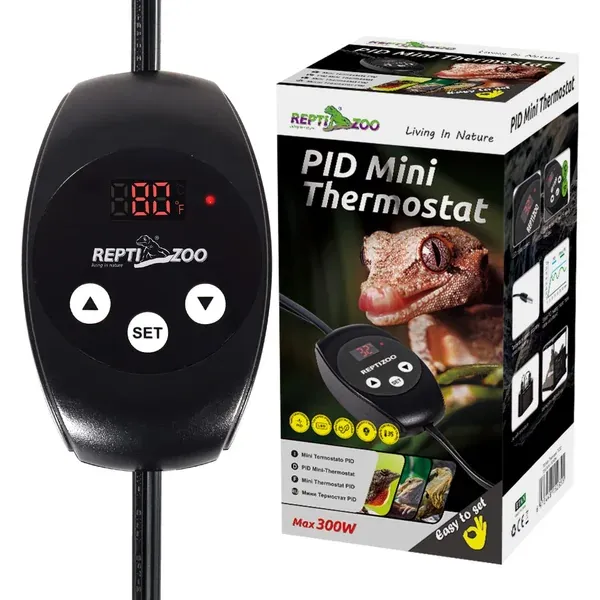
What It Is and Key Specs
The REPTIZOO Dimming Thermostat (model TC02) is a PID temperature controller built around a dimming mechanism rather than the on/off switching found in basic thermostats. According to the manufacturer listing, it is designed specifically for heat lamps, though it is also noted as suitable for heating mats, heat cables, and most other heaters.
Key specifications drawn from the listing and manufacturer sources:
- Temperature control range: 5°C to 60°C (41°F to 140°F)
- Maximum output load: 300W
- Maximum heater compatibility: Do not use with heaters exceeding 1,500W
- Display: LED digital screen showing ambient temperature and set value simultaneously
- Unit switching: Celsius and Fahrenheit selectable
- Notable feature: Memory function retains settings after power interruption
The PID (Proportional-Integral-Derivative) heating mode, as described by the manufacturer and elaborated in coverage from
manuals.plus, works by gradually increasing or decreasing power to the heating device rather than cutting it fully on or off. This approach is intended to produce more stable temperatures and, per the manufacturer, to extend bulb lifespan.
Build Quality and Safety
The listing describes a "highly accurate and precise sensor" capable of detecting real-time temperature changes and making continuous adjustments. The manufacturer includes an explicit usage warning: do not use with heaters exceeding 1,500W, and recommends monitoring the device closely during first use — guidance that prospective buyers should take seriously with any new electrical controller in an enclosed habitat.
One important placement note from the listing: the temperature probe should be positioned at least 15cm away from the heat source and never directly beneath it. Failing to follow this can cause the controller to misread ambient conditions and produce very low output — a troubleshooting point the manufacturer proactively addresses by recommending users increase the set temperature by 3–5°C to verify correct operation if the device appears unresponsive.
Sunlamp incompatibility is explicitly flagged by the manufacturer — this thermostat should not be used with sunlamps or UV-emitting bulbs.
Real-World Fit: Who It Suits, Who Should Skip
Based on listing details and forum coverage at Chameleon Forums, this controller appears well-suited for keepers running standard incandescent or halogen-style heat lamps in enclosures where temperature stability matters — chameleon keepers, for instance, have noted positive long-term experiences with it. The manufacturer specifically recommends it most strongly when the heating device is a light bulb.
Keepers who should look elsewhere:
- Those running sunlamps or UV-producing bulbs (explicitly excluded by the manufacturer)
- Setups requiring heaters above 300W output through the thermostat's outlet (the 300W load limit is a firm ceiling)
- Users needing a high-end temperature range beyond 60°C, which some advanced reptile setups may require
The double-press SET button operation and switchable temperature units make it accessible for beginners, though the probe placement nuances and PID troubleshooting steps do require some initial attention.
How It Compares in Its Category
Basic on/off thermostats cycle power fully, which can cause visible light flickering and temperature swings — a known characteristic of that approach across this product category. The REPTIZOO's dimming PID method, as described in manufacturer and third-party coverage, addresses this by modulating power gradually. The manufacturer states this is more beneficial to reptile health by avoiding "temperature instability and strong lighting changes." Forum coverage suggests real keeper satisfaction over multi-month use, though individual enclosure variables will always influence results.
Honest Limitations
- 300W output cap is meaningful: larger enclosures or high-wattage bulbs may not be compatible without additional planning.
- Probe placement is sensitive — the 15cm minimum distance from the heat source is a setup requirement that, if overlooked, leads to underperformance and confusion.
- No sunlamp support limits its utility for keepers who rely on combined UV/heat bulbs in a single fixture.
- The 60°C upper control limit may be a constraint for desert species setups requiring higher basking-spot temperatures beyond what ambient air monitoring at that ceiling can facilitate.
- At the time of this review, readers' aggregate feedback on the product skews positive, though the sample of published forum commentary is limited to specific keeper communities.