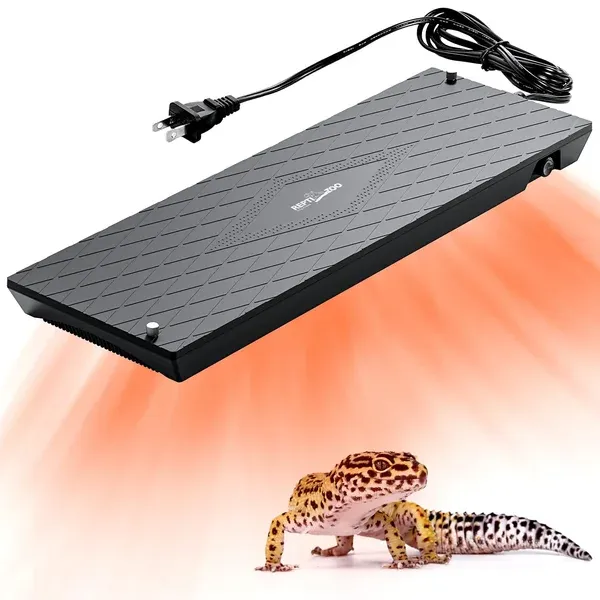
What It Is and Key Specs
The REPTI ZOO Reptile Heat Panel measures 6" x 18" and is engineered to screw-mount directly under a terrarium lid rather than sit freestanding on a surface. According to the manufacturer, this under-lid orientation directs warmth downward, which the listing claims significantly improves heat utilization compared to panels placed elsewhere in the enclosure. The panel ships with all mounting screws included.
The manufacturer lists a recommended maximum enclosure size of 48"L x 24"W x 24"H (120 cm x 60 cm x 60 cm), positioning it as a solution for larger habitats housing snakes, leopard geckos, crested geckos, leopard tortoises, turtles, and hermit crabs. A related REPTI ZOO heat pad in the brand's lineup notes a temperature adjustment range of 20–50°C (68–122°F), which provides useful context for the brand's thermoregulation approach, though the specific wattage and exact range for this 6"x18" panel should be confirmed on the live product page.
Build Quality and Safety
The panel integrates a built-in fan designed to distribute heat evenly and prevent localized hot spots — a meaningful feature, since uneven surface temperatures are a recognized risk with radiant heating products. The adjustable knob allows manual temperature tuning rather than relying on a fixed output.
The product is available through the REPTI ZOO brand store and is described as including after-sales support (reptizoo.store). Prospective buyers should independently verify current safety certifications and compliance markings before purchase, as this review synthesizes publicly available listing and manufacturer information and does not reflect hands-on assessment.
Real-World Fit: Who It Suits, Who Should Skip
This panel is purpose-built for keepers running larger enclosures — the manufacturer is explicit that its 6"x18" footprint is scaled for setups approaching the 48"x24"x24" maximum. Hobbyists with smaller tanks (40-gallon breeders and under) may find the coverage area excessive and should consider the brand's smaller 6"x8" option instead.
The zero-light heating design makes it a practical choice for nocturnal species such as leopard geckos and snakes, where visible basking bulbs would interfere with natural day-night behavior. Keepers who need UVB or visible basking light as their primary heat source will want a different product altogether.
The under-lid screw-mount format maximizes usable floor space, which matters in naturalistic or bioactive setups where ground real estate is at a premium. However, keepers using mesh or screen lids will need to confirm their lid's structural compatibility with the mounting hardware before committing.
How It Compares in Its Category
Third-party coverage (
bdpets.com) notes the REPTI ZOO Reptile Heat Panel among recommended radiant heat panels specifically for its adjustable temperature control, calling it "perfect for precise habitat needs." Radiant heat panels as a category are generally favored over under-tank heaters for arboreal species and for enclosures where belly heat is less relevant — the lid-mount orientation here aligns with that use case. That said, panels across this tier typically work best when paired with a separate probe thermometer to verify ambient temperatures independently of the panel's built-in dial.
Honest Limitations
The readers' aggregate of 3.6 out of 5 from 151 Amazon ratings sits below the threshold most buyers associate with confident purchases, and that gap deserves acknowledgment. While the listing does not detail the nature of critical feedback, a mid-range aggregate on a heating product — where consistent, accurate output is non-negotiable for animal welfare — warrants scrutiny of recent reviews before purchasing.
A few structural limitations are worth noting from the product information alone:
- Manual dial, not digital thermostat: Precise temperature control via a knob relies on the user calibrating output against an independent thermometer. Reptile keeping best practice generally calls for a digital thermostat for accurate regulation.
- Enclosure lid compatibility: The screw-mount system assumes a lid that can accept hardware — not universal across all glass terrarium designs.
- Fan dependency: The integrated fan is a feature, but it also introduces a moving part that can fail over time; long-term durability data is not available from the sources reviewed here.
Buyers who prioritize set-and-forget reliability may want to pair this panel with an external thermostat regardless of the built-in knob, a common practice among experienced reptile keepers across this product tier.