What It Is and Key Specs
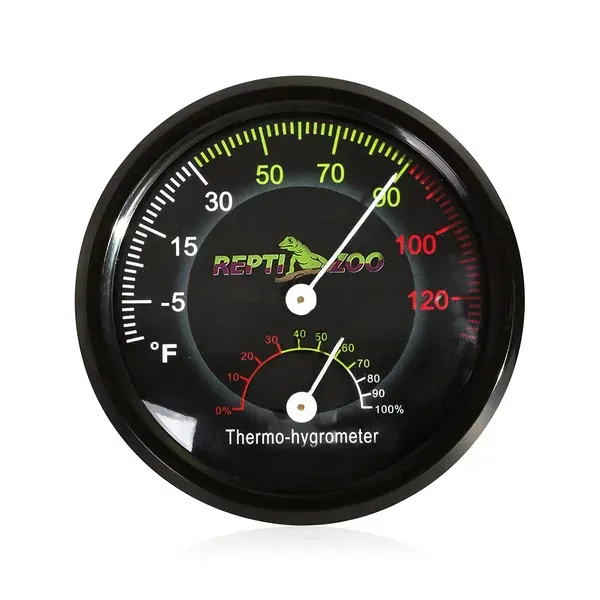
The REPTI ZOO Dual Gauge is a single-unit analog thermometer and hygrometer housed in a compact 8 × 8 × 2 cm (roughly 3.14 × 3.14 × 0.79 inches) enclosure. It measures both temperature and humidity simultaneously — no battery required — and is designed for use in vivariums, hatchers, brooders, propagators, and similar enclosed reptile or amphibian habitats, according to the manufacturer's listing. The unit uses color-coded dial segments to help keepers quickly identify readings at a glance without squinting at fine print. Installation relies on a pre-attached sticky pad on the reverse, which the manufacturer states allows mounting on most surfaces.
Build Quality and Ease of Use
From a design standpoint, the gauge keeps things straightforward. The color-coded segments are a practical touch — useful in low-light vivarium setups where fumbling to read a small numeric scale would be inconvenient. The sticky-pad mounting system is similarly low-fuss, requiring no drilling, suction cups, or additional hardware, though its long-term adhesion on textured or moisture-heavy surfaces will depend on conditions inside the enclosure.
Being battery-free is a genuine convenience advantage: there are no cells to replace and no risk of a dead battery going unnoticed and leaving an animal unmonitored. The manufacturer backs the unit with a 12-month quality assurance guarantee and commits to responding to customer inquiries within 24 hours — a reasonable support promise for a product at this price tier.
The REPTI ZOO store also offers a companion digital LCD model with suction-cup mounting, suggesting the brand serves both analog and digital preferences within its lineup.
Real-World Fit: Who It Suits and Who Should Skip It
This gauge is a reasonable fit for keepers who want a simple, always-on reference point for temperature and humidity in a secondary or low-stakes enclosure — think a brooder, propagator, or quarantine tub where ballpark readings are useful and cost is a priority.
However, keepers housing species with precise environmental requirements should weigh a known category-wide limitation: analog gauges are typically less accurate than digital alternatives, and some reptile-keeping communities consider digital hygrometers with external probes the more reliable standard for critical enclosures. Krawlo's reptile humidity gauge guide notes that "digital hygrometers with probes are the only reliable choice for reptile enclosures," arguing that a separate sensor allows measurement where the reptile actually lives — inside a hide or at substrate level — rather than at the wall of the enclosure where a fixed gauge mounts. That context is worth considering for keepers of humidity-sensitive species like chameleons or dart frogs.
The compact form factor (just over three inches square) also means the dial faces are relatively small. Keepers who prefer large, easy-read displays from a distance may find the size limiting.
How It Compares in the Category
The analog dual-gauge format sits in a well-populated budget segment. As noted in community discussions on OurReptileForum, digital thermometer/hygrometer combos from competing brands offer LCD readouts and replaceable batteries — with some users reporting battery life of two and a half to nearly three years. The REPTI ZOO analog unit sidesteps the battery concern entirely but trades that convenience for the accuracy trade-offs common across analog gauges in this tier. Neither approach is universally superior; the right choice depends on the keeper's species and precision requirements.
Honest Limitations
- Analog accuracy ceiling: Analog gauges typically carry wider margins of error than digital counterparts — a broadly noted limitation across this product category, not specific to REPTI ZOO alone.
- Fixed wall-mount placement: The sticky-pad design fixes the sensor to the enclosure wall; it cannot be repositioned to a hide or substrate level the way a probe-based digital unit can.
- Small display size: At roughly 3.14 inches square, the dial may be harder to read from a distance than larger-format or digital LCD alternatives.
- No backup alerts: Unlike some digital units, there are no audible or visual alarms if readings drift out of a safe range.
Bottom Line
The REPTI ZOO Dual Analog Thermometer Hygrometer earns its 4.4/5 aggregate reader rating as a no-fuss, battery-free option for keepers who want a quick visual reference in a vivarium or brooder. Its color-coded design and simple sticky-pad installation lower the barrier to entry. That said, keepers with species demanding tight humidity or temperature control may want to treat it as a supplementary gauge rather than a primary monitoring tool, and should consider whether a digital unit with a remote probe better suits their setup. This review synthesizes the manufacturer's listing, REPTI ZOO store information, and published community and editorial coverage.