What It Is and Key Specs
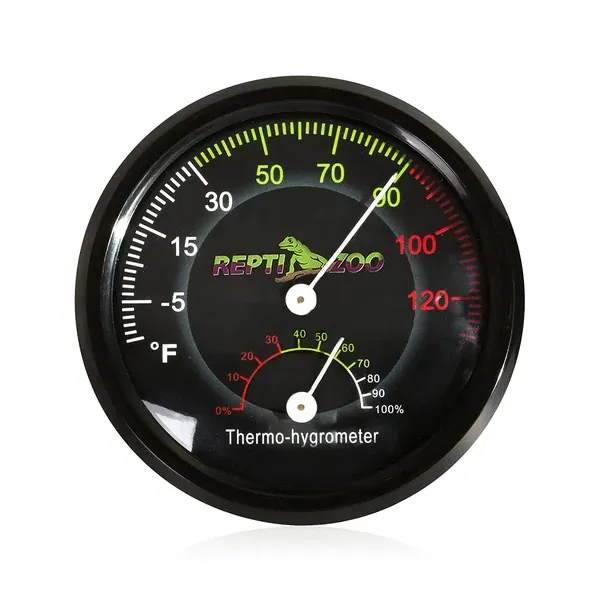
The REPTI ZOO Dual Gauge is a compact analog thermometer and hygrometer combo measuring approximately 8 × 8 × 2 cm (3.14 × 3.14 × 0.79 inches). According to the manufacturer's listing, it is designed to measure temperature and humidity in vivariums, hatchers, brooders, and propagators. The face uses color-coded segments to make readings easier to interpret at a glance, and a sticky pad on the reverse allows mounting on most enclosure surfaces without tools or fasteners. Crucially, it requires no batteries — a point REPTI ZOO highlights as both energy-saving and environmentally considerate.
This review synthesizes the product listing, manufacturer information, and published coverage rather than hands-on installation.
Build Quality and Design
At its stated dimensions, this is a genuinely small unit — useful inside tight enclosures where space is at a premium. The color-coded dial segments are a practical design choice, letting keepers check conditions quickly without squinting at fine print. The adhesive-mount system keeps installation straightforward, requiring no drilling or brackets.
REPTI ZOO backs the product with a 12-month quality assurance guarantee and states that customer inquiries receive a response within 24 hours — a reasonable support commitment for a value-tier accessory. The readers' aggregate of 4.4 out of 5 from 1,561 Amazon ratings reflects broadly positive reception across a meaningful sample size.
Real-World Fit: Who It Suits
This gauge is most appropriate for keepers who want a simple, passive monitor for a secondary enclosure, a brooder, a propagator, or a hatcher — settings where ballpark environmental readings are useful but precision is less critical. It also makes sense as a budget-friendly backup gauge alongside a more precise primary device, or for hobbyists just starting out who want a low-cost introduction to enclosure monitoring.
The battery-free design is genuinely appealing for anyone who has dealt with dead batteries in a digital unit going unnoticed overnight — a real, if infrequent, risk with battery-powered alternatives.
How It Compares in Its Category
It is worth understanding what analog means in this context. Coverage from Krawlo's reptile humidity gauge roundup notes that, as a category-level pattern, digital hygrometers with probes are generally considered the more reliable choice for reptile enclosures, and that analog gauges are commonly regarded across the hobby as less accurate than digital alternatives. This is not a claim specific to this unit, but it is a known trade-off that applies broadly to analog instruments of this type. Keepers who have compared the two technologies should factor this in when deciding how much monitoring responsibility to place on any analog gauge.
Honest Limitations
A few limitations are worth naming directly. First, as an analog instrument, readings are taken at the gauge face — there is no remote probe to measure conditions closer to where the reptile actually shelters (such as inside a hide or at substrate level), a feature that probe-equipped digital units provide. Second, adhesive mounts can lose grip over time, particularly on textured or slightly damp vivarium surfaces, though this is a common consideration across adhesive-mounted accessories in this category rather than a documented failure specific to this model. Third, the single-face 8 × 8 cm footprint, while compact, means both temperature and humidity are read from the same dial cluster — users accustomed to separate large-face gauges may find the information density requires a closer look. Finally, no battery also means no backlighting, so reading the gauge in a dimly lit setup or at night may require an external light source.
Bottom Line
The REPTI ZOO Dual Gauge occupies a clear niche: a battery-free, easy-to-mount, color-coded analog monitor suited to low-stakes or supplementary monitoring in reptile and amphibian enclosures. Its 4.4/5 readers' aggregate from over 1,500 ratings suggests it delivers on its modest promises for most buyers. Keepers who need probe-level precision or are monitoring a sensitive species with narrow environmental tolerances should weigh the analog format carefully — but for general-use enclosures, brooders, and propagators, it offers a fuss-free way to keep an eye on conditions at a glance.