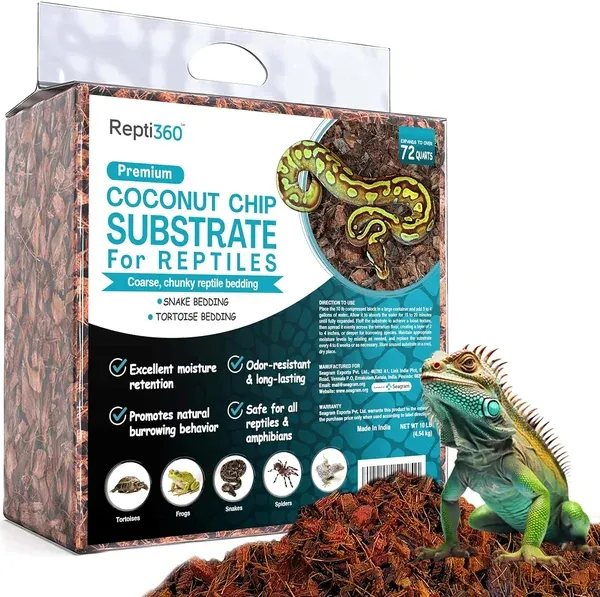
What It Is and Key Specs
The Repti360 Premium Coconut Chip Substrate is a compressed 10 lb block of coconut husk chips that, once hydrated, expands to approximately 72 quarts — or 2.4 cubic feet — of loose bedding. That yield is substantial enough to fill multiple enclosures or a single large habitat without purchasing several smaller bags. It ships in a polybag with handle, which makes transport and storage reasonably practical.
According to the manufacturer's listing, the substrate is made from natural coconut husk and is positioned as suitable for ball pythons, bearded dragons, leopard geckos, tortoises, lizards, amphibians, and invertebrates. The broad species compatibility is one of the product's more prominent selling points.
Build Quality and Material Composition
The substrate is described as 100% natural coconut husk, which is a recognized material in the reptile-keeping hobby for its ability to hold moisture without breaking down rapidly. The manufacturer promotes it as appropriate for bioactive setups — enclosures designed to sustain live plants, microfauna, and naturalistic ecosystems — which places some implicit expectation on the material being free of chemical treatments or additives. No specific third-party certifications or safety test results are cited in the listing materials reviewed here.
Coconut chip substrates in this category are typically noted for being low-dust compared to finer coir products, which can be relevant for keepers concerned about respiratory irritation in both animals and humans. The chip format (as opposed to coir fiber) also tends to support burrowing behavior and moderate airflow within the substrate layer — characteristics valued for species like ball pythons that naturally spend time underground.
Humidity Retention
A core claim in the listing is "superior humidity retention," and the coconut husk chip format is broadly recognized in reptile husbandry circles as effective at holding moisture to support tropical and semi-tropical enclosures. This makes it a natural fit for ball python setups, which typically require 60–80% relative humidity, as well as turtle and tortoise terrariums that benefit from a moist substrate layer. Independent hobbyist coverage of coconut chip substrates — including material published at
reptichip.com, a specialist in this category — consistently highlights humidity control and mold resistance as category-level strengths of coconut chip products. Repti360 makes the same claims, though the listing itself does not provide independent test data to quantify moisture retention rates specific to this product.
Real-World Fit: Who It Suits, Who Should Skip
Keepers maintaining mid- to large-sized enclosures for humidity-dependent species stand to get the most from the 72-quart yield. The compressed block format requires hydration before use, which adds a preparation step — buyers accustomed to ready-to-use loose substrate should factor in drying or expansion time before the bedding is enclosure-ready.
Reptile species guides, including those from coconut substrate specialists, note that chip size matters for smaller or more delicate animals. Finer substrate particles are typically recommended for hatchlings or species with very fine scales, as larger chips carry a higher theoretical impaction risk if accidentally ingested. Keepers of very small reptiles or young hatchlings may want to verify whether the chip size in this product is appropriate for their specific animal before committing to a 72-quart volume.
The product is listed as suitable for bearded dragons, which are desert-adapted animals that do not require high ambient humidity. Coconut chip substrate can be used in bearded dragon enclosures, but keepers of arid-habitat species should monitor humidity levels carefully, as the substrate's moisture-retaining properties could push enclosure humidity above ideal ranges for those animals if not managed properly.
Reader Reception
Readers on Amazon give the Repti360 Coconut Chip Substrate an aggregate rating of 4.6 out of 5 based on 230 ratings — a broadly positive signal from a meaningful sample size, though individual experience will vary depending on species kept, enclosure size, and husbandry approach.
Honest Limitations
- The compressed block requires hydration and expansion time before use; it is not a drop-in, ready-to-use product.
- No independent third-party safety certifications are referenced in the available listing materials reviewed here.
- Chip size is not specified in the listing, which matters for keepers of smaller or younger reptiles where impaction risk is a relevant consideration.
- While marketed to bearded dragons and other arid-habitat species, the substrate's humidity-retaining properties require careful monitoring in low-humidity enclosures.
- The 72-quart yield is a strong value proposition for large setups, but keepers with a single small enclosure may find the volume more than immediately necessary.