What It Is and Key Specs
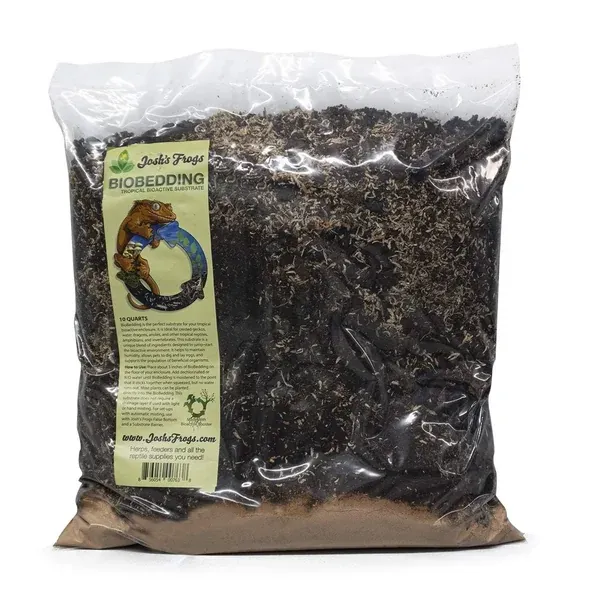
Josh's Frogs BioBedding Tropical Bioactive Substrate is a 10-quart bag of premixed enclosure substrate designed for tropical terrariums. According to the manufacturer's listing on
joshsfrogs.com, it is "a unique blend of organic and inorganic ingredients, trace elements, and beneficial" components formulated to replicate a tropical habitat more closely than conventional substrates.
Setup instructions published on the Josh's Frogs site call for mixing the bag contents thoroughly, then laying a 2.5–3 inch layer in the enclosure. The substrate should be moistened with dechlorinated or reverse-osmosis water until it clumps when squeezed without releasing standing water. Josh's Frogs also notes that a separate drainage layer is not required when the enclosure is lightly or hand-misted, though automatic misting systems may warrant additional drainage planning.
The product sits within a broader BioBedding line; the manufacturer also offers a Desert Bioactive Substrate for arid-dwelling species.
Build Quality and Composition
Reviewers on the Josh's Frogs product page note that the substrate arrives as discrete, identifiable ingredients rather than a pre-blended homogenous mix, which at least one buyer appreciated as confirmation that all components were present. This also means the buyer must mix the contents thoroughly before use — a minor but real preparation step.
The formulation is described by the manufacturer as supporting live plant growth, which distinguishes it from inert substrates and aligns with bioactive keeping principles. No artificial dyes or explicitly synthetic binders are mentioned in the available listing materials.
Real-World Fit: Who It Suits, Who Should Skip
This substrate is purpose-built for keepers pursuing a bioactive setup — one that pairs the substrate with live microfauna such as springtails and isopods. The manufacturer states that in that configuration, the substrate can go years without replacement, reducing both labor and ongoing cost. It is also marketed as providing a cleaner environment by leveraging the natural bioactive cycle to reduce bacterial load.
The listing highlights suitability for species with delicate skin, noting that live plants grown in the substrate are safer than plastic decor for such animals. Customer coverage on the Josh's Frogs site references successful use with tropical and temperate frog and toad species, including dart frogs.
Keepers who prefer a fully set-and-forget substrate out of the bag should note that hand-mixing is required before use. Those using automatic misting systems will need to evaluate drainage requirements separately, as the manufacturer's guidance distinguishes between misting methods. Owners of desert-dwelling species should look to the companion Desert BioBedding line instead — the Tropical formulation is not appropriate for arid enclosures.
Honest Limitations
- Manual mixing required: The bag ships as individual components that must be thoroughly combined by the user before placement — this is an extra step compared to pre-blended alternatives.
- Microfauna dependency for full benefit: The "no changing for years" claim is contingent on pairing the substrate with live springtails and isopods, which are sold separately and add to setup complexity and cost.
- Drainage layer considerations: Automatic misting setups may require a drainage layer beneath the substrate, meaning the 10-quart volume may not stretch as far in larger or more complex builds.
- Not universal: The Tropical formulation is explicitly not suited for desert species, limiting its audience to tropical and temperate enclosure keepers.