What It Is and Key Specs
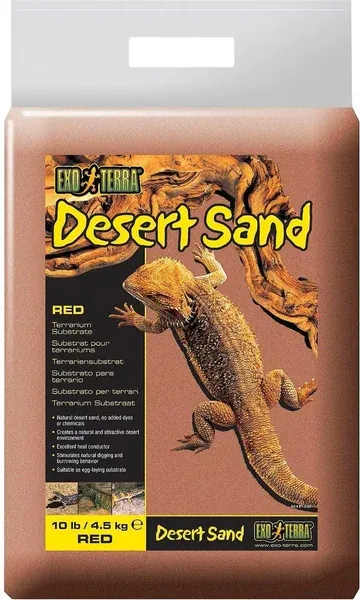
Exo Terra Desert Sand is a natural, loose-particle terrarium substrate packaged in a 10-pound plastic bag. According to the manufacturer, the sand contains no added dyes or chemicals, and it has been sifted to remove impurities and achieve a consistent, homogenous grain size. The red colorway reviewed here is one of several color variants in Exo Terra's Desert Substrates line, which also includes black and other natural tones (exo-terra.com/products/substrates/desert-substrates/).
Per manufacturer information, the substrate functions as a heat conductor, supports natural digging and burrowing behavior, and is suitable as an egg-laying medium — making it a multi-use option rather than a purely decorative one.
Build Quality and Composition
The manufacturer's stated claim of "no added dyes or chemicals" is supported by a practical observation noted in coverage from Reptile Craze: when the sand was mixed with water during informal testing, the runoff appeared a normal brownish color rather than a vivid red, which would be expected if synthetic dye were present (
reptilecraze.com/exo-terra-desert-sand-review/). The same source noted low dust levels, which is a meaningful quality indicator for a loose substrate — excess dust in particulate substrates is commonly associated with potential respiratory irritation in reptiles.
The sifting process described by Exo Terra is designed to yield a uniform grain size. A consistent grain size matters for both aesthetics and function, as it affects how well the substrate packs, holds burrows, and conducts heat from under-tank heaters.
Real-World Fit: Who It Suits
Based on manufacturer information and published coverage, this substrate is best matched to:
- Established desert reptiles such as larger skinks, adult blue-tongued skinks, adult bearded dragons, and similar species that are robust feeders with less risk of incidental sand ingestion.
- Egg-laying enclosures, where a loose, deep substrate is functionally necessary for gravid females.
- Display terrariums where replicating the visual texture of a Sonoran or Saharan environment is a priority.
According to Exo Terra's own product pages, the substrate is designed to mimic "the natural sands found in arid desert or savannah regions" (exo-terra.com/products/substrates/desert-substrates/desert-sand-red/).
Readers have responded positively at scale: the product carries a 4.6/5 readers' aggregate from 3,040 Amazon ratings, suggesting a large base of satisfied users.
Honest Limitations
Loose sand substrates as a category carry a well-documented impaction risk, and this product is no exception to that broader concern. Community discussion on Reptile Forums raises the issue directly: smaller reptiles and fast-striking feeders can ingest sand incidentally during feeding, and over time particulate accumulation in the digestive tract can become life-threatening (
reptileforums.co.uk/threads/exo-terra-desert-sand.549903/;
reptileforums.co.uk/threads/exo-terra-sand.675500/). The risk is generally considered higher for:
- Juvenile reptiles, whose smaller digestive systems are less tolerant of particulate ingestion.
- Fast or indiscriminate feeders, such as young bearded dragons, that frequently grab substrate alongside prey.
- Animals in suboptimal health, where gut motility may already be compromised.
It is also worth noting that "natural habitat" arguments for sand substrates are not universally accepted in the herpetoculture community — forum contributors point out that many captive animals do not always live on the same substrates they would encounter in the wild, and that captive conditions differ from wild ones in ways that affect ingestion risk.
The 10-pound bag size is practical for smaller enclosures but may require multiple bags to achieve an adequate depth for burrowing in larger setups. No CPSC-related safety notice was identified in the available sources for this product.
How It Compares in Its Category
Within the loose desert substrate category, dye-free real sand is a distinct tier above artificially colored sands. The absence of dyes reduces the concern about chemical exposure to animals that contact and occasionally ingest substrate. Reptile Craze's coverage positions Exo Terra Desert Sand favorably for keepers specifically seeking a natural, low-dust option — particularly relative to substrates where water testing reveals heavy artificial pigmentation. Alternatives in this space include excavator clay, tile, and paper-based substrates, each of which eliminates particulate ingestion risk entirely but trades off the behavioral enrichment and naturalistic appearance that loose sand provides.