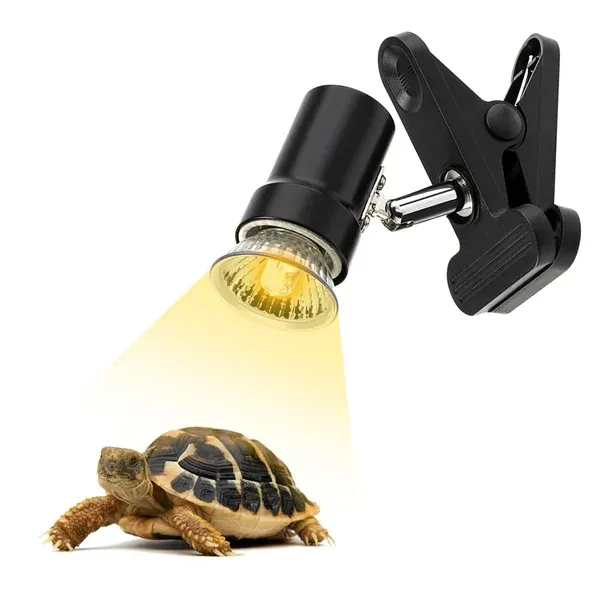
What It Is and Key Specs
The DaToo Reptile Heat Lamp is a clamp-style terrarium light that combines a basking heat source with UVA/UVB output in a single 50W bulb. According to the manufacturer, the included bulb emits a 97% UVA / 3% UVB spectrum intended to simulate natural sunlight exposure. The lamp head rotates 360°, allowing owners to redirect the beam without repositioning the clamp. The socket is E27, which the listing describes as compatible with fluorescent, incandescent, ceramic heater, halogen, and LED bulbs — meaning the fixture itself can be repurposed with third-party bulbs over time. Rated bulb lifespan is listed as 2,000–3,000 hours. The manufacturer states the product is suitable for reptiles, terrapins, lizards, snakes, spiders, birds, amphibians, and even succulent plants.
Build Quality and Safety
The housing is described as a combination of high-strength aluminum alloy shell and a natural ceramic socket. Aluminum alloy dissipates heat more efficiently than plastic housings common at this price tier, and ceramic sockets are the preferred standard for high-wattage reptile lighting because they resist the expansion and cracking that can affect standard plastic lamp holders over time. The clamp is described as large and non-slip, intended to grip tank rims, aquariums, and cages securely.
The manufacturer includes explicit safety usage tips that buyers should read before setup: the lamp must be installed at least 12 inches from any surface, heat-resistant gloves should be worn when handling a hot lamp, each heating session should not exceed 6 hours, and the lamp must be kept away from damp environments and flammable or plastic materials.
These are meaningful restrictions. A six-hour-per-session limit in particular affects how this lamp fits into an automated day/night lighting schedule, and buyers should factor that into their thermostat or timer planning before purchasing.
Real-World Fit: Who It Suits, Who Should Skip
This lamp is best matched to hobbyists setting up a small-to-medium enclosure for bearded dragons, tortoises, lizards, or similar basking species that benefit from a combined heat and UVA/UVB point source. The E27 compatibility and rotatable head add flexibility for enclosures where the ideal basking angle shifts seasonally or as the animal grows.
Buyers running continuous 24/7 heat cycles — common for some tropical snake keepers — should note the stated six-hour heating limit and plan accordingly, potentially supplementing with a ceramic heat emitter for overnight use. The 12-inch minimum distance requirement also means very small or shallow enclosures may not allow safe placement.
Community discussion on reptile forums (
reptileforums.co.uk) reflects a recurring pattern with heat lamps generally: bulb failure after moderate use is a common complaint across the category. The 2,000–3,000 hour lifespan claim from the manufacturer is worth tracking against real-world use, particularly since budget-tier heat lamps typically see variable bulb consistency.
Additionally, published research from the Tortoise Trust (
tortoisetrust.com) notes that heat lamps can present risks to tortoises specifically if used without careful attention to distance, duration, and species-appropriate basking behavior. This is not a condemnation of the product category but a reminder that lamp placement, gradient setup, and species research remain the owner's responsibility regardless of which fixture is chosen.
Honest Limitations
- The six-hour maximum heating time per session limits use in fully automated setups without supplemental heating.
- Bulb lifespan of 2,000–3,000 hours is a manufacturer figure; community experience with heat lamps in this category suggests real-world longevity can vary.
- UVB output is listed at only 3%, which is on the lower end of what some species (particularly high-UV-index desert reptiles) may require for full photobiological benefit — buyers with species that need higher UVB output should verify this level meets their animal's specific needs.
- No independent third-party UVB index or spectral testing data is cited in the listing.