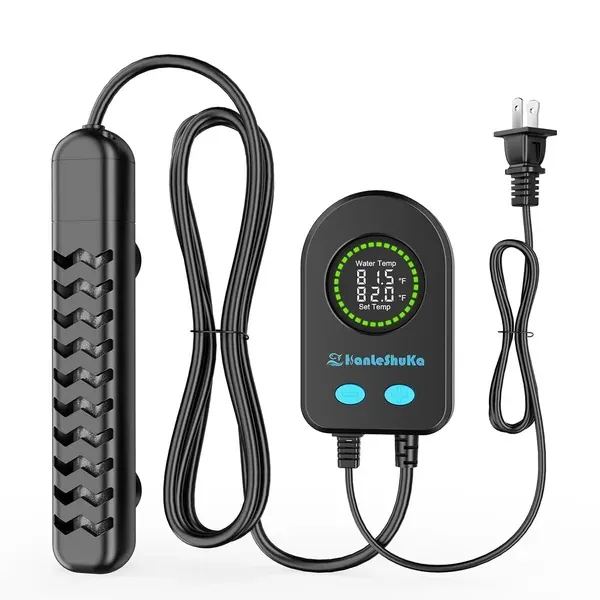
What It Is and Key Specs
The LuvemPets 100W aquarium heater is a fully submersible unit designed for tanks in the 10–20 gallon range. It is part of a wattage family that scales from 100W (5–20 gal) up to 500W (70–120 gal), giving buyers a path to upgrade as their setup grows. The heating element is 2mm quartz glass, wrapped in a wave-patterned ABS guard. The external LED controller displays real-time and target temperatures simultaneously, switches between °F and °C in two seconds, and mounts via suction cups on glass or acrylic. Compatibility spans freshwater, saltwater, and brackish water.
Build Quality and Safety
The headline differentiator here is a three-in-1 safety architecture the manufacturer describes across three independent layers:
1. Dry-burn prevention — the heater detects the moment it leaves water, cuts power, and sounds an audible alarm. Re-submerging it restarts heating automatically.
2. Overheat protection — heating stops if temperature climbs more than 1°F above the set point.
3. Maximum temperature ceiling — a hard limit prevents the thermostat from exceeding the settable range, even in the event of a thermostat malfunction.
Every safety trigger is accompanied by an alarm. This matters in practice: hobbyist forums such as Aquarium Co-Op's community and FishLore document real cases where unprotected heaters drifted well above target temperatures or cracked after exposure to air during water changes — the exact failure modes this design targets. The ABS guard also shields fish and turtles from direct contact with the hot quartz element, a meaningful detail for tanks housing curious or surface-active animals.
Thermostat Precision and Display
The listing claims ±1°F accuracy via intelligent frequency-conversion control, which the manufacturer contrasts against basic on/off heaters that can swing 3–5°F. Tighter temperature swings are genuinely relevant for sensitive livestock — shrimp and many tropical species are stressed by wide fluctuations. The dual-reading LED (red while heating, green when at target) gives a clear at-a-glance status without requiring a separate thermometer check, though independent verification with a quality thermometer remains good aquarium practice regardless of heater brand, as noted in general aquarium troubleshooting resources.
Real-World Fit: Who It Suits, Who Should Skip
This heater is a reasonable match for:
- Betta keepers with 5–20 gallon tanks who want auto-shutoff as a safety backstop during frequent water top-offs.
- Shrimp and sensitive tropical fish setups where temperature stability is critical.
- Turtle tanks, where a heater being nudged above the waterline is a genuine recurring risk.
- Saltwater nano tanks, given the corrosion-resistant guard and stated brackish/saltwater compatibility.
Buyers running tanks larger than 20 gallons should step up to the 200W or 300W variants per the manufacturer's own wattage guide. Those who prefer proven third-party brands with long hobbyist track records — such as Aquatop or Aquarium Co-Op's own line — may want to weigh community reputation alongside the feature list before deciding.
Honest Limitations
- Wattage ceiling for this SKU: The 100W version is rated for 10–20 gallons under normal home conditions. Aquarium Co-Op's published guidance notes that a 100W heater can sometimes manage larger tanks under optimal conditions, but the manufacturer's own pairing guide should be treated as the safe upper bound here.
- Out-of-water alarm: The audible alarm is useful, but it requires someone to be present to hear it. Unattended tanks will still benefit from the auto-shutoff, though the alarm alone is not a remote notification.
- Newcomer brand: LuvemPets does not yet carry the multi-year community testing record of established aquarium heater brands. Buyers who prioritize long public failure-rate histories may prefer a brand with deeper forum documentation.
- Claimed precision needs independent confirmation: The ±1°F claim is stated by the manufacturer. As a general best practice, running a separate calibrated thermometer alongside any heater — new or established — is advisable, since sensor drift is a documented real-world issue across the category.