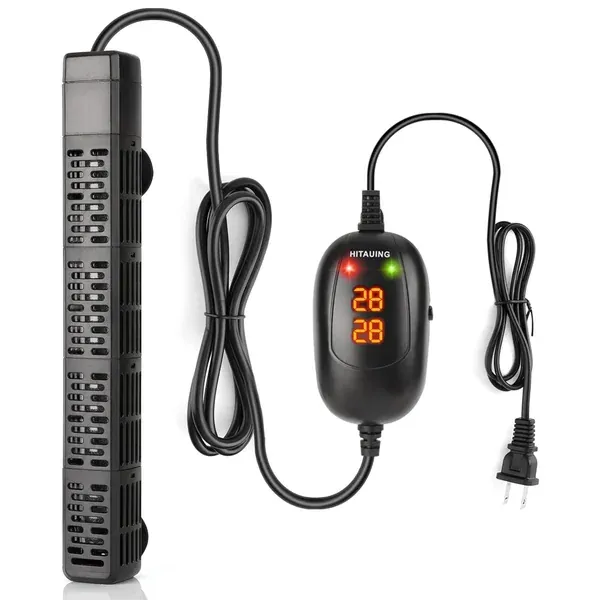
What It Is and Key Specs
The HiTauing Aquarium Heater is a fully submersible heater offered in five power tiers — 50W, 100W, 200W, 300W, and 500W — making it one of the broader wattage ranges in its category. The 300W variant, used as the primary reference in the manufacturer's listing, is rated for tanks in the 40–75 gallon range. The temperature is adjustable between 63–94°F (17–34°C) and can be displayed in either Fahrenheit or Celsius, switchable by holding the side button for two to three seconds.
The external controller features a two-digit red LED display showing both the current water temperature and the user-set target. According to the manufacturer's feature bullets, the display updates in real time and reverts to showing the live water temperature once a setting is confirmed. The user manual (
manuals.plus) further highlights four design pillars: accurate temperature control, high-power fast heating, IPX8-rated waterproofing, and automatic constant temperature maintenance.
A two-year warranty is noted in the manufacturer's documentation (
device.report), which is a reasonable coverage window for this category.
Build Quality and Safety
The heater tube is constructed from explosion-proof quartz glass paired with a nickel-chromium heating wire and silicon carbide heat conduction — materials the manufacturer describes as chosen for thermal stability and longevity. The outer guard shell is made from high-temperature-resistant ABS plastic. One reviewer cited on BestViewsReviews noted that the slotted guard design makes it safe for turtles to be near without risk of scalding, a practical real-world data point consistent with the ABS shell's stated purpose.
Two automatic shut-off mechanisms are central to the safety pitch. First, an intelligent water sensor cuts power if the heater is fully removed from water. Second, an over-temperature protection circuit halts heating if the water temperature climbs rapidly beyond the set point. In both cases, the indicator light turns green as a visual signal. These protections are especially relevant given that heater-related failures — including units running hot or dry — are a recurring concern across hobbyist forums such as Aquarium Advice.
Real-World Fit: Who It Suits, Who Should Skip
The HiTauing heater draws a broad audience based on published coverage. Freshwater community tanks, saltwater setups, and even small fish ponds are all cited as appropriate environments in the listing. The slotted guard and ABS shell make it a reasonable consideration for turtle keepers, per the BestViewsReviews reader note. Hobbyists who value a digital external controller — rather than a manual dial — will find the LED display more intuitive for day-to-day monitoring.
Readers collectively rate it 4.5 out of 5 across 2,411 Amazon ratings, suggesting broad satisfaction. That said, this heater may not be the right fit for serious reef keepers who require laboratory-grade temperature precision. A thread on Reef2Reef specifically noted that Amazon reviews for heaters in this class can be unreliable, and one commenter there favored a premium alternative with a five-year warranty for tightly controlled reef tanks. Hobbyists running sensitive coral systems may want to weigh that community perspective carefully.
How It Compares in Its Category
The Reef2Reef forum thread provides a useful category-level reference point: premium aquarium heaters with multi-year warranties and tighter tolerances do exist, though at meaningfully higher prices. The HiTauing's two-year warranty and five-wattage lineup position it as a mid-tier option. Value-tier heaters typically compete on feature density relative to cost, and the dual safety systems, IPX8 waterproofing claim, and digital controller give this unit more specification coverage than bare-bones competitors — though real-world accuracy should always be independently verified with a separate thermometer, which is standard practice across the hobby regardless of heater brand.
Honest Limitations
A few limitations are worth flagging transparently. The temperature-setting interface requires repeated button presses to cycle through to a target value, which is less convenient than a heater with up/down buttons or app control. The Reef2Reef community expressed general skepticism about heaters in this class for precision reef applications, which is a fair caution even if it isn't a direct criticism of this specific unit's measured performance. Additionally, the listing copy contains minor grammatical issues ("install the aquarium heater no to the tank walls"), which some buyers read as a signal of a newer or smaller brand — worth acknowledging even if it has no bearing on function. Finally, as with any submersible heater, the fully-submerged installation requirement is non-negotiable; the manufacturer explicitly warns that the unit must be kept fully submerged during operation.