What It Is and Key Specs
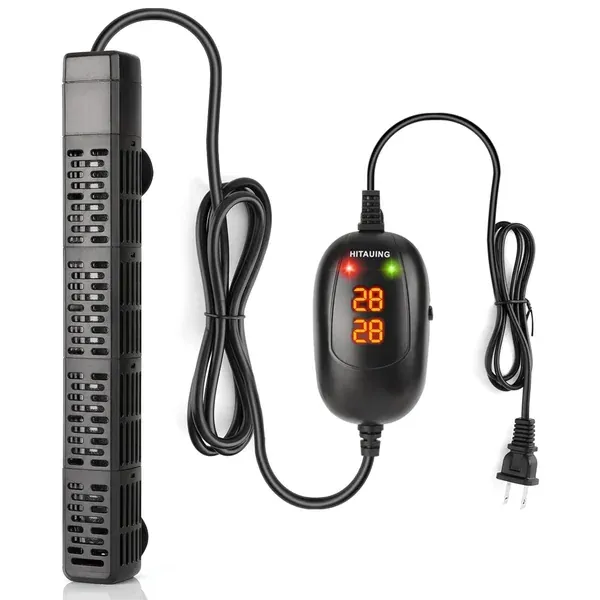
The HiTauing Aquarium Heater is a fully submersible unit offered in five wattages — 50W, 100W, 200W, 300W, and 500W — designed to cover a wide range of tank sizes. According to the manufacturer, the 300W variant is rated for 40–75 gallon aquariums. The heater is compatible with both freshwater and saltwater setups, and the user manual documents an IPX8 waterproof rating, meaning it is engineered for full submersion.
Temperature is adjustable across a range of 63–94°F (17–34°C), covering the needs of most tropical and coldwater fish. The dual-unit display — toggled by holding the controller button for 2–3 seconds — shows both Fahrenheit and Celsius via two red LED digits, with the screen reverting to live water temperature once a target is set.
The heating element itself uses nickel-chromium wire with silicon carbide heat conduction, a combination the manufacturer states enables faster and more durable heat transfer.
---
Build Quality and Safety Features
The heater tube is constructed from explosion-proof quartz glass — a material common in submersible heaters for its thermal resilience. The outer guard shell is made from high-temperature-resistant ABS plastic, which the manufacturer states protects fish and users from contact scalding. Published coverage from BestViewsReviews notes that the slotted guard design has been specifically appreciated by turtle keepers for this same reason.
Two automatic safety mechanisms are highlighted in the listing. First, an intelligent water sensor triggers an automatic power-off if the heater is fully removed from water — a meaningful safeguard during water changes. Second, an over-temperature protection circuit cuts power if the water temperature rapidly exceeds the set point. In both cases, the indicator light shifts to green to signal the shutdown state. These features are documented in both the product listing and the manufacturer's user manual hosted at
manuals.plus.
---
Real-World Fit: Who It Suits, Who Should Skip
The five-wattage lineup makes this heater adaptable across setups ranging from small desktop tanks to larger display aquariums. The 500W option extends its reach to sizable systems. Strong suction cups on both the heater guard and the included thermometer allow mounting to tank walls or the bottom, with the manufacturer specifying that the unit must remain fully submerged during operation.
Hobbyists running standard freshwater community tanks or basic reef-safe fish-only saltwater setups will find the feature set practical. The readable external controller is a genuine convenience — no guessing at dial markings in a dark cabinet.
However, the heater is likely a less natural fit for serious reef keepers who prioritize tight temperature precision. A thread on Reef2Reef forums raised community skepticism about lesser-known brand heaters for reef tanks, with experienced members recommending units with longer warranties and independently verified accuracy. That forum consensus does not constitute a finding specific to this heater, but it is worth considering for coral-sensitive systems where even minor temperature swings carry risk.
---
Honest Limitations
A few real-world caveats are worth flagging before purchase:
- Temperature accuracy is not independently verified in sources reviewed. Aquarium forum discussions (Aquarium Advice) note that 3°C of variance is not uncommon across heater categories generally — a reminder that any heater's displayed temperature is worth cross-checking with a separate thermometer, regardless of brand.
- The wattage-to-tank-size guidance is manufacturer-stated. Real-world heating demands vary with ambient room temperature, tank insulation, and flow patterns, so the published 40–75 gallon guidance for the 300W unit is a starting point, not a guarantee.
- The Reef2Reef community flagged brand familiarity concerns for reef-specific use, though responses were not based on direct experience with this specific unit.
- Readers' aggregate is strong but not universal. At 4.5/5 from 2,411 Amazon ratings, the heater performs well in aggregate, but individual experiences — particularly around long-term reliability — are not captured in available sources.
---
Category Context
Submersible heaters with external digital controllers and auto shut-off sensors have become increasingly common at this tier of the market. The combination of quartz glass construction, dual-unit display, and a five-wattage lineup positions the HiTauing heater competitively among similarly priced units. Whether the long-term durability matches premium alternatives with multi-year warranties — such as those recommended on reef forums — is a question the available sources do not fully answer.
For freshwater and general fish-keeping use, the feature set and readers' aggregate make it a reasonable candidate. For high-stakes reef systems, additional research into precision and longevity is advisable before committing.