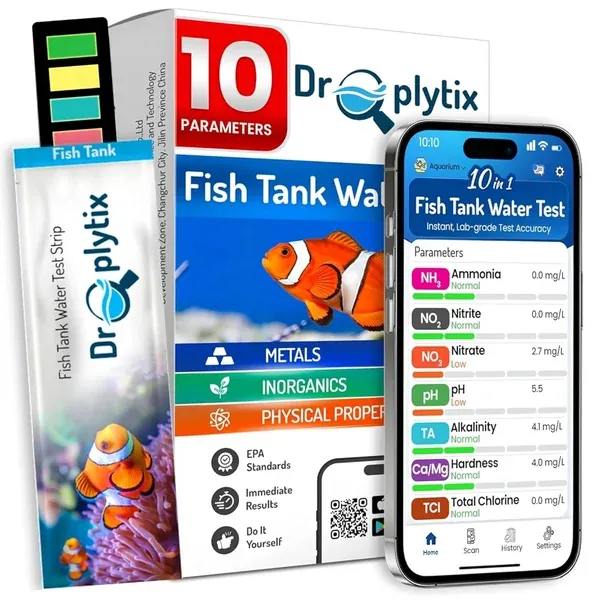
What It Is and Key Specs
The LuvemPets 10-in-1 Aquarium Water Test Kit is a strip-based testing system paired with a mobile app. According to the manufacturer's listing, a single strip measures ten parameters: ammonia, nitrate, nitrite, pH, general hardness (GH), carbonate hardness (KH), chlorine, and additional water quality indicators. The workflow is straightforward — dip the strip, scan it with a smartphone camera through the companion app, and receive a digital readout in place of a manual color-comparison chart.
The kit is listed as compatible with a wide range of aquarium types: freshwater fish tanks, saltwater and reef setups, betta tanks, shrimp tanks, turtle aquariums, nano aquariums, and axolotl enclosures. The manufacturer states it works with tanks from 5 gallons up to 30 gallons, making it a plausible fit for both beginner starter kits and more established hobbyist setups.
The App-Enabled Advantage
The defining feature here is the digital scan step. Traditional test strips require the user to compare a wet pad against a printed color chart — a process that is widely acknowledged in the aquarium-keeping community as prone to lighting inconsistencies and color-perception errors. By offloading the color interpretation to a smartphone camera and app algorithm, the LuvemPets kit aims to remove that subjectivity. The manufacturer describes the results as "lab-grade," positioning the app scan as a meaningful upgrade over manual comparison.
For aquarists cycling a new tank or troubleshooting a water quality issue, having timestamped digital readings on a phone rather than handwritten log entries is a practical convenience the listing explicitly highlights.
Real-World Fit: Who It Suits, Who Should Skip
Based on the manufacturer's information, this kit is well-matched to:
- Beginner and intermediate freshwater hobbyists who want a single product covering the most common parameters without managing multiple liquid reagent kits.
- Multi-tank households maintaining betta, shrimp, or reef setups simultaneously, where the broad compatibility (freshwater and saltwater) reduces the need for separate kits.
- Aquarists who dislike liquid test kits — the dip-and-scan process is meaningfully faster than the multi-step reagent process required by liquid masters kits.
Hobbyists who should consider alternatives include those maintaining demanding reef systems where tight, publication-level accuracy on individual parameters (particularly alkalinity and salinity) is critical. Independent aquarium-keeping sources, including coverage at
aquariumsource.com and
reef2reef.com, consistently note that no single multi-parameter strip kit matches the per-parameter precision of dedicated liquid or digital probe tests — a limitation that applies to the category broadly, not to this product alone. Advanced reef keepers, in particular, are often advised by the community to use discrete tests for the parameters that matter most to coral health.
Limitations Worth Knowing
Every test strip product carries inherent constraints, and the manufacturer's listing — while enthusiastic — does not fully address them:
- Strip shelf life and storage sensitivity. Test strips across all brands are susceptible to humidity and expiration. The listing does not specify strip count, expiration window, or storage requirements, which are practical details buyers should seek out before purchasing.
- App dependency. Accurate results rely on the smartphone app functioning correctly and the camera scan being performed under adequate lighting. Users without compatible devices, or those with older smartphones, may encounter friction not present with a standalone liquid kit.
- Parameter depth vs. Breadth trade-off. Covering ten parameters on one strip means each pad is physically small. Broader independent coverage of the test-strip category (aqualogichq.com, thesprucepets.com) notes that multi-parameter strips generally sacrifice per-parameter resolution compared to single-parameter liquid tests — a trade-off buyers should weigh against the convenience gain.
- No calibration mechanism. Unlike digital probes, strip-based systems cannot be field-calibrated. If the app's color algorithm drifts or a strip batch varies, there is no user-level correction available.
Category Context
The aquarium water testing category broadly divides into liquid reagent kits, test strips, and electronic probes. Published coverage (
aquariumsource.com,
fuhrmannmanagement.com) consistently positions liquid kits — particularly multi-parameter reagent kits — as the accuracy benchmark for home use, while strips occupy a convenience niche. The LuvemPets kit's app-scan approach is a meaningful attempt to close that gap, but independent sources do not yet offer head-to-head accuracy data specific to this product. Buyers prioritizing verified accuracy over convenience may want to consult community forums for real-world user reports as they accumulate.
Readers' aggregate ratings for this product are visible on the product page and reflect direct purchaser experience this editorial review cannot replicate.