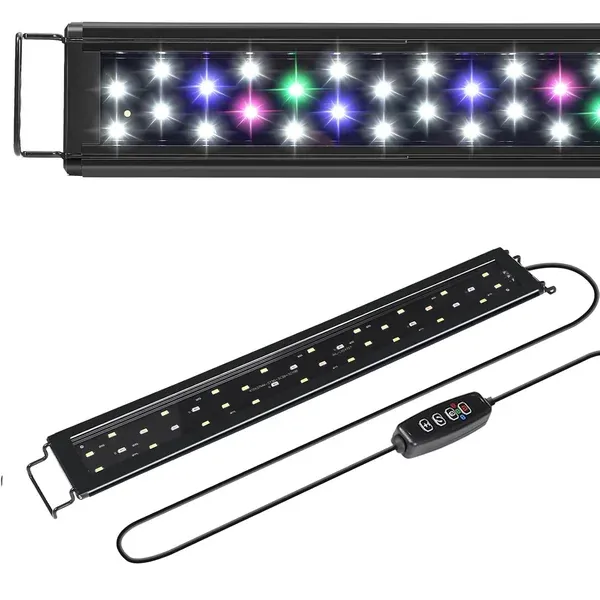
What It Is and Key Specs
The AQUANEAT LED Aquarium Light is a slim freshwater fixture built around 36 total LEDs using 5730-series emitters — a format marketed for energy efficiency and longevity with no bulb replacement required. The LED array breaks down as 24 white (6500K), 6 blue, 3 pink, and 3 green diodes. The light body measures 17 inches long by 2.7 inches wide, and two extendable docking brackets allow it to span tanks from 18 to 24 inches. According to the manufacturer, it works best on 10-gallon tanks with a 20-inch footprint.
Three programmable timer durations — 4, 8, and 10 hours — automate daily on/off cycles. Brightness is adjustable across five steps, ranging from 100% down to 20%, via dedicated plus/minus controls. Three independently switchable LED groups deliver lighting scenes: all LEDs combined for a cool daylight look, the white/pink/green subset for a warmer daylight tone, and six blue LEDs alone for a moonlight mode.
Build Quality and Installation
The fixture's slim profile is a practical design choice: the manufacturer notes it is engineered to leave clearance for filters, pumps, and other equipment that share the tank edge. Brackets are compatible with glass or acrylic tanks, with or without a transparent hood or lid, and with rimmed or rimless designs. The body is marketed as easy to install, though buyers should note the manufacturer's explicit caution: keep the light away from splashing water. No IP or water-resistance rating is stated in the listing, which means owners of active or heavily aerated tanks should be especially mindful of splash exposure.
Published community discussion on Reef2Reef (
reef2reef.com) characterizes lights in this product family as "garden variety LED aquarium lights," suitable for general freshwater use rather than demanding reef or high-light planted setups.
Real-World Fit: Who It Suits, Who Should Skip
The AQUANEAT is well-positioned for hobbyists running a standard 10-gallon or similarly sized freshwater community tank with low-to-mid light plants — think java fern, anubias, moss, or hornwort. The timer automation and brightness range address two of the most common beginner pain points: forgetting to cycle lights and inadvertently stressing fish with overly intense illumination. The manufacturer specifically describes the light output as "soft" and "gentle on the eyes," which aligns with the low-to-mid plant light target.
Hobbyists who should look elsewhere include reef keepers and anyone growing high-demand planted tank species (carpeting plants, demanding stem plants) that require calibrated PAR levels. Community commentary on Reef2Reef suggests this fixture class is not positioned for the intensity or spectral precision those applications require.
Lighting Modes in Practice
The three-group LED system gives users meaningful control without requiring separate hardware. The cool daylight mode (all 36 LEDs) is the brightest setting and best represents the full-spectrum claim. The warm daylight mode (white, pink, and green only) removes blue output for a softer, more orange-toned appearance that some fishkeepers prefer during feeding or evening hours. The six-LED blue moonlight mode allows for low-level nighttime observation without fully disrupting fish sleep cycles — a feature that reviewers at
reviewaqua.com highlight as a useful everyday convenience.
Honest Limitations
No product in this category is without trade-offs, and the AQUANEAT is no exception:
- No water resistance rating disclosed. The explicit splash warning in the listing is worth taking seriously, particularly for tanks with strong surface agitation.
- Light body is 17 inches on a 18–24-inch span. Buyers with tanks toward the longer end of that range should verify coverage is adequate for their livestock and plant placement.
- Targeted at low-to-mid light plants only. High-light plant keepers or reef hobbyists will need to look at more powerful, purpose-built fixtures.
- Timer increments are fixed. The three preset durations (4, 8, 10 hours) cover common photoperiods but offer no custom scheduling for users who want finer control.
- No stated PAR or lumen output data in the listing, making it difficult to benchmark against competing fixtures on measurable light intensity.
Readers can find the current price and reader aggregate ratings on the product page.