What It Is and Key Specs
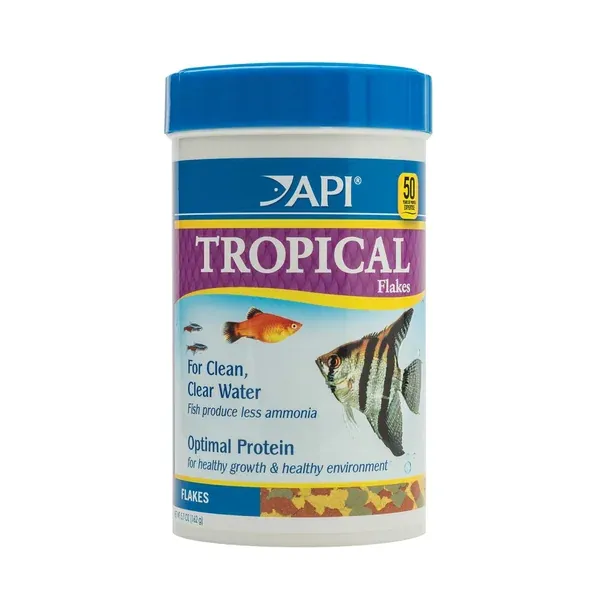
API Tropical Flakes Fish Food comes in a single 5.7-ounce container and is positioned as a complete, balanced staple diet for tropical community fish. According to the manufacturer's listing, the formula centers on two primary protein sources — menhaden (a nutrient-dense forage fish) and squid — chosen specifically for their amino acid profiles to support healthy growth. API states the food is formulated to help fish more readily absorb nutrients, which the brand links to reduced waste output and cleaner, clearer aquarium water. Feeding guidance calls for two daily feedings of only as much as fish will consume within three minutes — a widely recommended best practice for avoiding overfeeding.
Build Quality and Flake Consistency
Based on published coverage at
boxednature.com, the flakes themselves present with some variability in size and texture. Reviewers note that flakes tend to break into relatively small pieces and can range from thicker, clumpier segments to thinner fragments that are already partially broken apart. This inconsistency in flake integrity is worth noting for hobbyists keeping fish that prefer larger, more intact food pieces. The 5.7-ounce container size offers a reasonable supply for small-to-medium community tanks without committing to a bulk quantity.
Nutritional Approach
The inclusion of menhaden and squid as named ingredients reflects a protein-forward formulation strategy. As noted in the manufacturer's feature bullets, the goal is to provide ideal amounts of amino acids for tropical community species. Published coverage at
reviewaqua.com similarly describes the food as a "protein-rich diet specially formulated to promote healthy growth." The reduced-waste claim is tied to nutrient bioavailability — the premise being that when fish absorb more of what they eat, less undigested material ends up cycling through the water column.
Real-World Fit: Who It Suits, Who Should Skip
This formula is broadly aimed at tropical community fish, making it a practical choice for mixed community tanks housing tetras, rasboras, livebearers, and similarly sized omnivorous species. The twice-daily, three-minute feeding guideline is straightforward enough for beginners while still being relevant for experienced fishkeepers.
Those who may want to look elsewhere include:
- Keepers of larger cichlids or carnivorous species that require meatier, specialized diets beyond a general community flake.
- Hobbyists with fish that prefer whole or large-format flakes, given the noted tendency toward smaller, inconsistent flake sizes.
- Tanks with bottom-dwelling fish only, as flakes are a surface-to-mid-water food format and may not sink quickly enough to reach bottom feeders reliably.
Honest Limitations
No product is without trade-offs, and published coverage surfaces a few worth flagging:
1.
Flake size inconsistency: As reported at
boxednature.com, the flakes can vary considerably — some clumpy and thick, others already crumbling. This may affect feeding efficiency, particularly in tanks with small or finicky eaters.
2.
Surface-oriented format: Flakes naturally float before gradually sinking, which inherently favors surface and mid-water feeders over bottom dwellers.
3.
Waste-reduction claims are conditional: The cleaner-water benefit depends heavily on not overfeeding. Without strict adherence to the three-minute feeding rule, any flake food — including this one — can contribute to water quality issues.
4.
No independent third-party nutritional analysis is cited in available sources, so the amino acid and bioavailability claims rest on the manufacturer's own formulation assertions.