What It Is and Key Specs
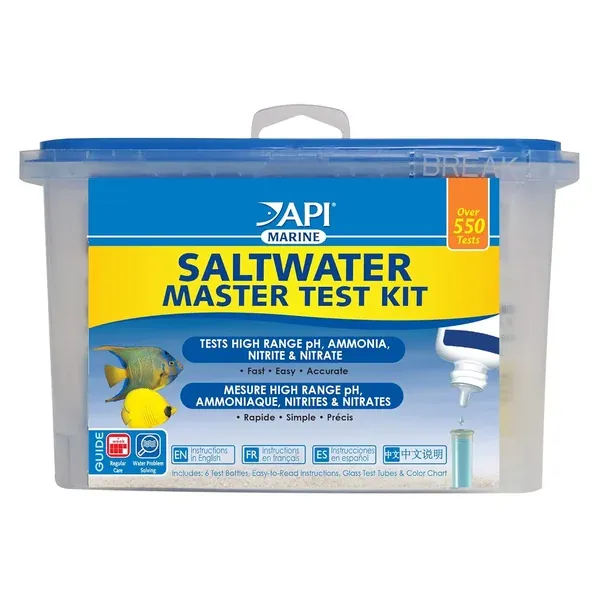
The API Saltwater Master Test Kit is a liquid reagent-based testing kit built exclusively for saltwater aquarium use. According to the manufacturer's listing, each kit contains six bottles of testing solution, one color card, four test tubes with caps, and delivers up to 550 total tests across its four monitored parameters.
Those four parameters are high range pH, ammonia, nitrite, and nitrate — the core indicators of a saltwater aquarium's nitrogen cycle and overall water stability. The kit is designed both for routine weekly monitoring and for diagnostic use when fish or water problems arise, as stated in the manufacturer's feature bullets.
A complete step-by-step guide is included with the kit, according to information from
reef-aquarium-store.com, which notes the kit is intended to help hobbyists easily test the natural cycle of their aquarium.
Build Quality and Contents
The kit is a liquid-based format, which is generally regarded in the aquarium hobby as more precise than strip-based alternatives at this price tier — though that is a category-level observation and not a claim specific to this product's measured accuracy. The inclusion of four dedicated test tubes with caps allows for discrete testing of each parameter without cross-contamination between samples. The color card provides a visual reference for interpreting results, a standard approach for liquid reagent kits.
With six bottles of solution covering four parameters, the 550-test yield is distributed unevenly across parameters depending on which tests are run most frequently — a practical consideration for hobbyists who, for example, test ammonia more often during a new tank cycle.
Real-World Fit: Who It Suits, Who Should Skip
This kit is a strong candidate for beginner to intermediate saltwater aquarium keepers who want to track the nitrogen cycle through an initial tank setup or maintain an established reef or fish-only system. The manufacturer explicitly recommends weekly use as a baseline, making it well-suited for hobbyists who prefer a scheduled maintenance routine.
The kit is designed exclusively for saltwater aquariums, per the listing — freshwater keepers should look elsewhere in the API lineup. Similarly, advanced reef keepers who also need to monitor calcium, alkalinity, magnesium, or phosphate will find this kit incomplete on its own, as none of those parameters are included. It covers the essentials but not the full spectrum that a mature coral system typically demands.
How It Compares in the Category
The API Saltwater Master Test Kit competes in a crowded segment of liquid reagent kits. At this tier, liquid kits typically offer more readings per dollar than strip kits, and the 550-test count positions this kit as a longer-term value proposition compared to smaller, parameter-specific vials. However, hobbyists prioritizing parameters like alkalinity or salinity precision will likely need supplemental test kits regardless of brand.
Honest Limitations
A few limitations are worth noting before purchasing:
- Four parameters only. The kit does not cover calcium, alkalinity, magnesium, phosphate, or salinity — parameters that become increasingly important in reef systems with corals.
- Color-card interpretation is subjective. Liquid reagent kits rely on visual color matching, which can be challenging under certain lighting conditions or for users with color vision differences.
- Saltwater exclusive. The kit cannot be used for freshwater tanks, limiting its utility for hobbyists who keep mixed systems.
- Unequal test distribution. The 550-test total is spread across multiple parameters and six bottles, meaning individual parameter capacities will vary and some solutions may run out before others depending on testing habits.