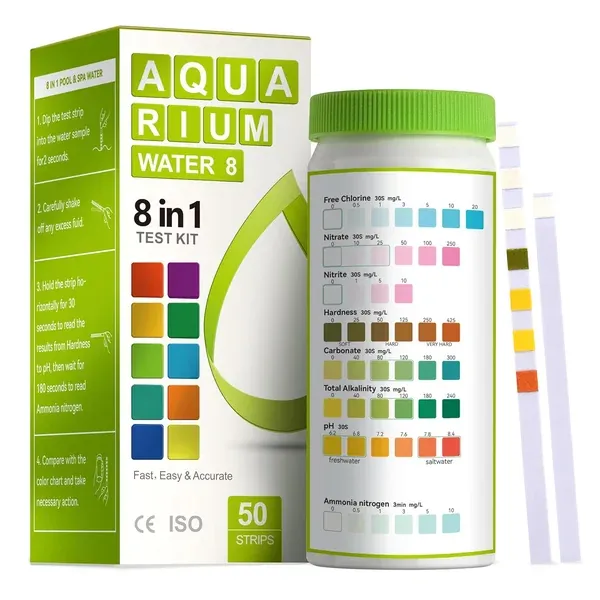
What It Is and Key Specs
The AAwipes 8-in-1 Aquarium Test Kit (model K02-50) ships 50 test strips in a single sealed bottle. Each strip tests eight water parameters in one dip: Free Chlorine, Nitrate, Nitrite, Hardness, Carbonate, Total Alkalinity, pH, and Ammonia nitrogen. According to the manufacturer's product pages, the strips are made from high-quality fiber paper with non-bleeding color pads — a construction detail intended to keep individual pad readings distinct and easy to compare against the included color chart.
AAwipes also offers the same strip formulation in 100-strip (K02-100) and 150-strip (K02-1500) configurations for higher-volume users, so the 50-strip K02-50 is the entry-level quantity.
Build Quality and Safety
Manufacturer information states the strips are housed in a well-sealed bottle engineered to protect against moisture and environmental factors, which is the standard approach for reagent-based test strips and directly affects shelf life. The fiber-paper substrate with non-bleeding dyes is noted across multiple AAwipes product pages as a deliberate quality choice to prevent color migration between adjacent pads — a common complaint with lower-grade strip products in this category.
No CPSC safety recall or compliance flag was identified in the sources reviewed for this product.
How It Works
The testing procedure, as described in the listing, involves three steps:
1. Dip — Submerge the strip in aquarium water for 2 seconds (pads 1–7); pad 8 (Ammonia nitrogen) requires a separate 5-second dip.
2. Hold — Remove without shaking off excess water, then hold the strip horizontally for 30 seconds for pads 1–7; Ammonia nitrogen (pad 8) requires a longer 180-second development wait.
3. Compare — Match pad colors against the chart. The manufacturer claims up to 99% accuracy using this method.
The staggered timing for the Ammonia pad is a practical detail worth noting: users who rush the read before the full three-minute development period may get unreliable Ammonia results.
Real-World Fit: Who It Suits, Who Should Skip
Based on manufacturer information and published coverage from
reviewaqua.com, this kit is positioned for both novice and experienced fish keepers who want routine, at-home monitoring without sending water samples to a lab. The versatility claim covers freshwater aquariums, saltwater tanks, ponds, pools, and shrimp tanks — making it broadly applicable rather than niche.
Experts cited in the listing recommend testing aquarium water at least twice a week, which means a 50-strip bottle could realistically last three to six months for a single-tank household testing one strip per session. Hobbyists managing multiple tanks or following the twice-weekly recommendation for several setups may find the 100- or 150-strip variants a better value per strip.
Aquarists who require laboratory-grade precision — for example, those breeding sensitive species where narrow parameter windows are critical — should weigh whether colorimetric strip tests meet their accuracy threshold. Liquid reagent test kits typically offer finer resolution for parameters like Ammonia and Nitrite, a category-level consideration common across strip-based products at this tier.
Honest Limitations
- Ammonia read time is longer than other pads. The 180-second wait for pad 8 adds friction compared to the 30-second read for the remaining seven pads, requiring users to stay attentive during testing.
- Colorimetric comparison is subjective. Color-chart matching depends on lighting conditions and individual color perception; results may vary between users or environments.
- 50-strip quantity may run out quickly for multi-tank households or those following the manufacturer's own twice-weekly testing guidance.
- Sodium Chloride is listed in the Amazon bullet but Carbonate appears on the manufacturer's own product pages for equivalent strip SKUs — buyers should confirm the exact parameter set on the packaging received, as listing copy and product-page copy show a minor discrepancy across sources.