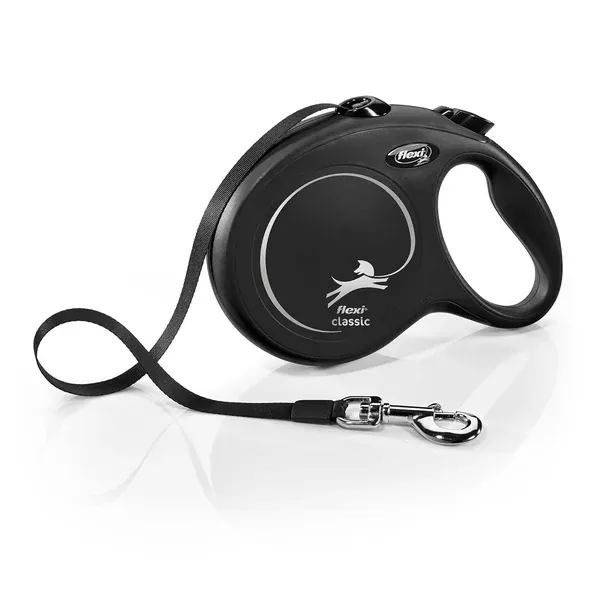
What It Is and Key Specs
The FLEXI Classic Tape Retractable Dog Leash (Large) is a black, tape-style extending leash rated for dogs up to 110 lbs and offering up to 26 feet of range. It is manufactured in Germany by FLEXI, the company that, according to the brand, originated the first fully functional, mass-produced retractable leash more than 50 years ago. The tape format — a flat, ribbon-style line rather than a round cord — is the defining spec here, and it feeds through the brand's 360° tape guidance system, which is designed to prevent tangling during extension and retraction.
The Large sizing places this leash in the upper tier of the FLEXI Classic range, intended for medium-to-large breeds. FLEXI offers multiple lengths and sizes across its lineup, so the 26 ft / 110 lb variant is one configuration within a broader family of products.
Build Quality and Engineering
FLEXI describes its leashes as the product of "superior German craftsmanship" and states that the brand was awarded the "Brand of the Century" award in 2010 alongside numerous other trophies and certifications. The manufacturer emphasizes that materials are sourced for quality and that each leash undergoes rigorous testing for daily-use durability.
The core mechanical feature is the patented brake system, which the listing describes as enabling smooth, precise control — including sudden stops and quick maneuvers. The 360° tape guidance system is a separate patented mechanism designed to allow effortless, tangle-free leash handling as the dog moves in various directions.
It is worth noting that this review is based on manufacturer-provided specifications and listing information rather than hands-on evaluation. Independently verified durability data is not available in the sources at hand.
Real-World Fit: Who It Suits, Who Should Skip
This leash is best suited to owners of larger dogs — up to 110 lbs — who frequently walk in open spaces such as parks, trails, or low-traffic areas where giving a dog room to roam is practical and safe. The 26-foot range provides meaningful freedom compared to a standard 6-foot leash, and the brake system is specifically designed to reel that freedom back in quickly when needed.
The tape design, as opposed to a cord, is generally considered among retractable-leash users to reduce the risk of the line wrapping tightly around legs — though this is a category-level observation and should not be taken as a guarantee specific to this product's performance.
Who should consider skipping it: Retractable leashes as a category are widely noted by trainers and safety advocates as less suitable for urban environments with heavy foot traffic, dogs still learning leash manners, or any situation where consistent close control is required. A traditional fixed-length leash may be more appropriate in those contexts. Additionally, buyers who prioritize ultra-lightweight gear or minimalist carry should be aware that retractable housing units add bulk compared to a simple leash.
Honest Limitations
- Category trade-offs apply. Retractable leashes — regardless of brand — inherently allow more slack than fixed leashes, which can complicate training and reduce reaction time in unpredictable situations. These are well-documented concerns across the category, not specific defects of this product.
- Tape vs. Cord is a preference call. While the tape format has advantages, some users find tape-style leashes slightly heavier or bulkier in the housing than cord equivalents.
- No hands-on performance data included. Claims about brake responsiveness and tangle prevention are drawn from manufacturer specifications. Prospective buyers should weigh those claims alongside owner reviews published on the retailer's product page.
- Size commitment. The Large designation is load-rated to 110 lbs, but owners of dogs significantly under that threshold may find a smaller-size FLEXI variant (with a lighter housing) more ergonomically comfortable.
Category Context
FLEXI's position as the originator of the mass-produced retractable leash gives it a longer development track record than most competitors in this space. The brand's continued patent activity — evidenced by the cited brake and tape-guidance patents — suggests ongoing engineering investment rather than a static product. Whether that legacy translates into a meaningful performance edge over current competitors is a question the available sources do not fully answer.