What It Is and Key Specs
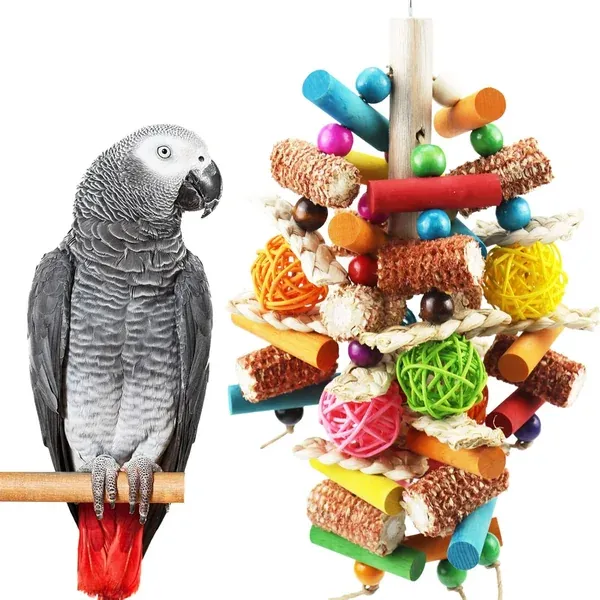
The LuvemPets hanging parrot toy is a multi-component chew and enrichment piece assembled from natural rattan balls, corn cobs, and macaw-safe food coloring, according to the manufacturer's listing. It is designed for large and medium psittacines — specifically called out are macaws, African grey parrots, Amazon parrots, and cockatoos. The toy mounts via a movable hook that the manufacturer states can be fixed to both the top and side of a cage, giving owners some flexibility in placement. The construction is described as handmade and colorful.
Materials and Safety Considerations
The manufacturer states the materials — corn cobs, natural rattan, and food-grade coloring — are "harmless to pets." Rattan and corn cob are broadly recognized in the bird-toy community as natural, bird-appropriate substrates; avian care resources such as those published by Best Friends Animal Society (https://bestfriends.org/pet-care-resources/how-pick-safe-bird-toys) and PDS Parrot Shop (https://pdsparrotshop.com/blogs/pds-parrot-blog/how-to-identify-unsafe-bird-toys-bird-toy-safety-guide) note that natural, untreated plant-based materials are generally among the lower-risk choices for bird toys. PDS Parrot Shop specifically flags toxic woods such as cedar and redwood as materials to avoid — neither is listed as an ingredient here. That said, no independent third-party safety certification is cited in the listing, and as VCA Animal Hospitals notes (https://vcahospitals.com/know-your-pet/toys-for-birds), birds can injure themselves even on well-designed toys, with toe entrapment being a common risk across the category. Owners should inspect this toy — and any cage toy — regularly for fraying, loose components, or gaps large enough to trap a beak or foot.
The Case for Chew Toys in an Enrichment Routine
The manufacturer's "edible chew toy" framing is consistent with widely published avian behavioral guidance. As the listing itself states, in their native habitat birds engage in chiseling holes and tearing branches — a point echoed by sources including Best Friends Animal Society, which recommends providing toys that simulate natural foraging experiences (https://bestfriends.org/pet-care-resources/how-pick-safe-bird-toys). Super Bird Creations and similar specialty retailers also emphasize that boredom during alone time — often 8–10 hours for companion birds — can manifest as feather-picking or destructive behavior (https://www.superbirdtoystore.com/). A chewable, destroyable toy addresses that behavioral need directly, and the manufacturer claims birds will "spend long hours playing with these toys every day, keeping your parrot busy, less destructive and more fun." These are reasonable expectations for a chew toy of this type, though individual bird temperament will vary.
Real-World Fit: Who It Suits, Who Should Skip
This toy is best positioned for owners of the listed species — macaws, African greys, Amazon parrots, cockatoos — who want a natural, disposable enrichment item at an accessible price point. Because it is described as chewable and edible, it is by design a consumable: heavy chewers will likely work through it relatively quickly, which is functionally appropriate but worth factoring into the ongoing cost. Owners seeking long-lasting mechanical or foraging toys built from anodized aluminum and stainless steel — such as those highlighted by Busy Bird Toys (https://www.mysafebirdstore.com/TOYS_BY_MANUFACTURER-BUSY_BIRD_TOYS.html) — will find this a different category of product entirely. Smaller birds not listed (budgies, cockatiels, lovebirds) may find the scale of the toy unsuitable, and the listing's own language hedges by describing the size range as "small and medium-sized" in one bullet while naming large-bird species in the product title — worth noting as a minor inconsistency buyers should weigh against their specific bird's size.
Honest Limitations
Several limitations are worth naming directly. First, no specific dimensions are provided in the listing, making it harder to assess cage compatibility before purchase. Second, because it is handmade, consistency between individual units may vary — a common characteristic across handcrafted bird toys in this segment. Third, while the manufacturer offers an exchange or return policy if a bird dislikes the toy (excluding human damage), individual bird preferences for toy type, texture, and color are highly variable, as any experienced parrot owner knows. Finally, the listing does not cite any independent safety testing or certifications, so buyers who prioritize third-party-verified materials will want to seek additional assurance before purchasing.