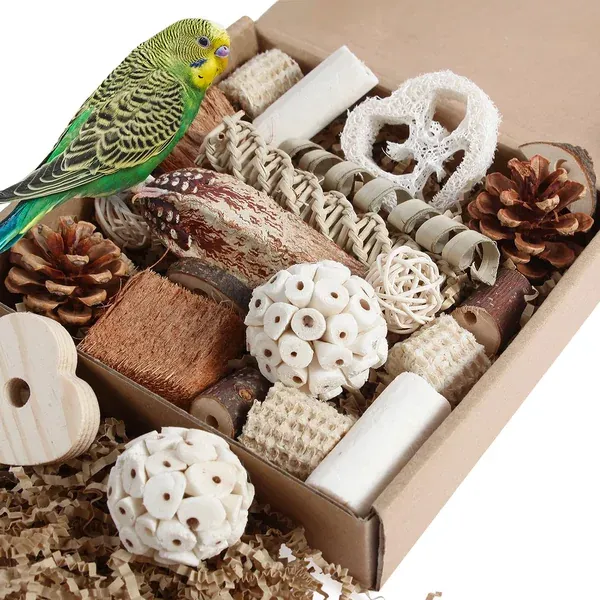
What It Is and Key Specs
The Kyouki Natural Bird Foraging Box (Medium) is a multi-component enrichment toy assembled from an array of natural materials: pine cones, apple wood, apple wood chew blocks, coconut shells, sola fibers, loofahs, spiral seagrass, wicker balls, and corn. According to the manufacturer's listing, the product contains no metals, paints, plastics, or dyed items. The medium size is marketed as appropriate for parakeets, cockatiels, conures, lovebirds, parrotlets, quakers, macaws, and African greys — a notably wide range that spans both small and medium-sized species.
A core feature of the design is the treat-hiding element: the box and its components are built to conceal snacks, inviting birds to locate and retrieve them through exploratory behavior.
Build Quality and Material Safety
The manufacturer describes all components as eco-friendly and pet-safe, with an explicit absence of metals, paints, plastics, and dyes. This material profile aligns with guidance from avian specialists and retailers, who broadly recommend natural materials like vine, seagrass, and sola for bird toys — as noted by sources including PDS Parrot Shop and Planet Pleasures. The variety of textures and shapes across the components (pine cones, wicker balls, loofah, coconut shell) is consistent with what enrichment-focused avian resources describe as best practice for keeping birds engaged.
This review is based on the manufacturer's listing, published product information, and third-party editorial sources — not hands-on use.
Enrichment Value: Foraging and Mental Stimulation
Foraging enrichment has documented behavioral benefits for captive birds. Resources from Herebird and Arizona Exotics both note that birds provided with engaging toys and foraging activities are less prone to boredom-related behavioral issues. The Kyouki box directly targets this need by combining multiple textures, chewable materials, and a treat-concealment mechanism.
The treat-foraging component is particularly relevant: as
avianadmirer.com and planet pleasures both note in their coverage of foraging toys, hiding food inside toys mimics wild foraging behavior and makes playtime rewarding in a way that pure chew toys do not. The range of materials — fibrous loofahs, crunchy wicker, textured seagrass, dense apple wood — offers varying levels of resistance and sensory feedback, which enrichment sources suggest keeps birds engaged over time.
Readers appear to agree: the toy carries a 4.6/5 aggregate from 655 Amazon ratings, which points to consistent positive experiences across a large sample of bird owners.
Real-World Fit: Who It Suits, Who Should Skip
This toy is well-suited to bird owners who want a single, multi-texture enrichment piece that doubles as a foraging activity. The treat-hiding function makes it especially relevant for owners of curious, food-motivated species like conures and cockatiels.
However, the size designation warrants attention. The listing includes African greys and macaws in the compatible species list alongside parakeets and lovebirds — a broad span. Owners of larger parrots at the upper end of the "medium" category should assess the toy's dimensions relative to their bird's beak strength, as heavier chewers may work through natural fiber components more quickly than expected. This is a common trade-off across this tier of all-natural bird toys.
The toy is less appropriate for owners who prefer minimal cage clutter, as a multi-component foraging box with loose natural materials will generate debris from shredding and chewing — an expected and healthy outcome, but worth noting for tidy-minded households.
Honest Limitations
- Durability is inherently limited: Natural materials like sola fiber, loofah, and corn are designed to be destroyed. Enthusiastic chewers may dismantle the toy faster than expected, making it a consumable rather than a long-term fixture.
- Species-size range is wide: Lumping parakeets and African greys into the same "compatible" list requires buyers to use their own judgment about fit and appropriate challenge level for their specific bird.
- No independent lab certifications cited: The manufacturer states materials are pet-safe, but no third-party safety certifications are referenced in the listing. Buyers who require verified food-grade or CPSC-type certification documentation may want to follow up with the manufacturer directly.
- Treat inclusion not guaranteed: The listing describes the treat-hiding function but does not indicate that treats are included in the box — owners will need to supply their own.